Modica and the Femminello Night BanditsFrom a balcony in Modica, a journey back to a lemon grove in 1859.
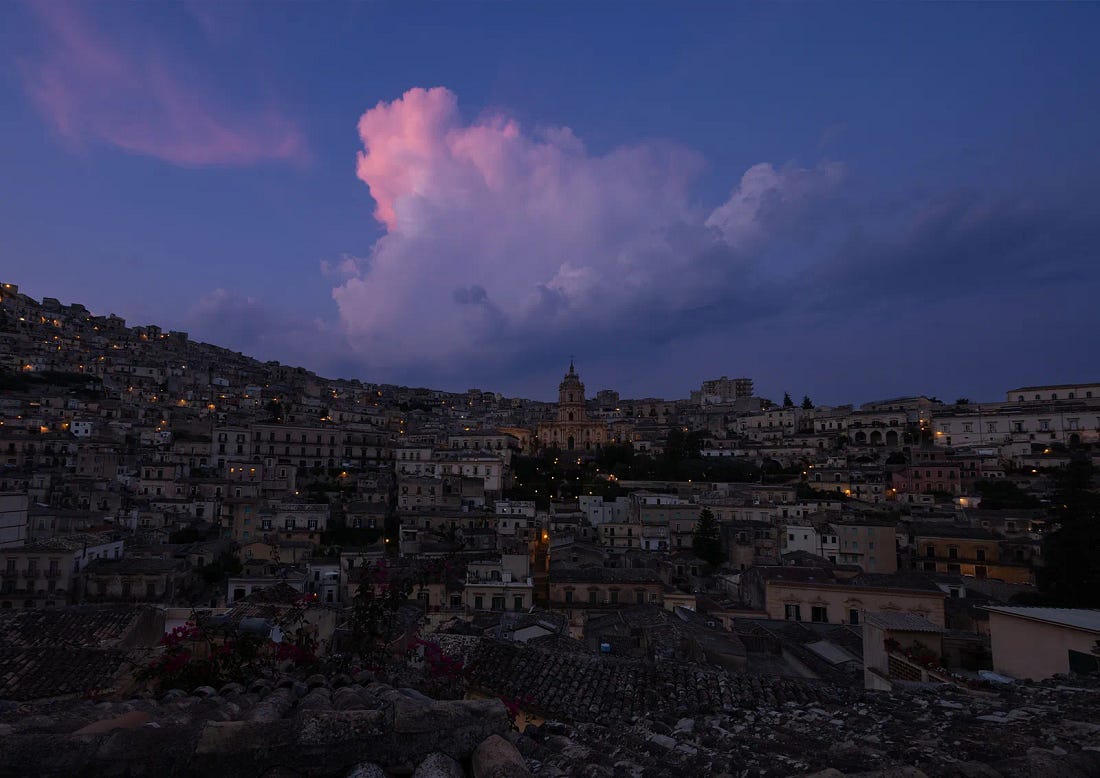
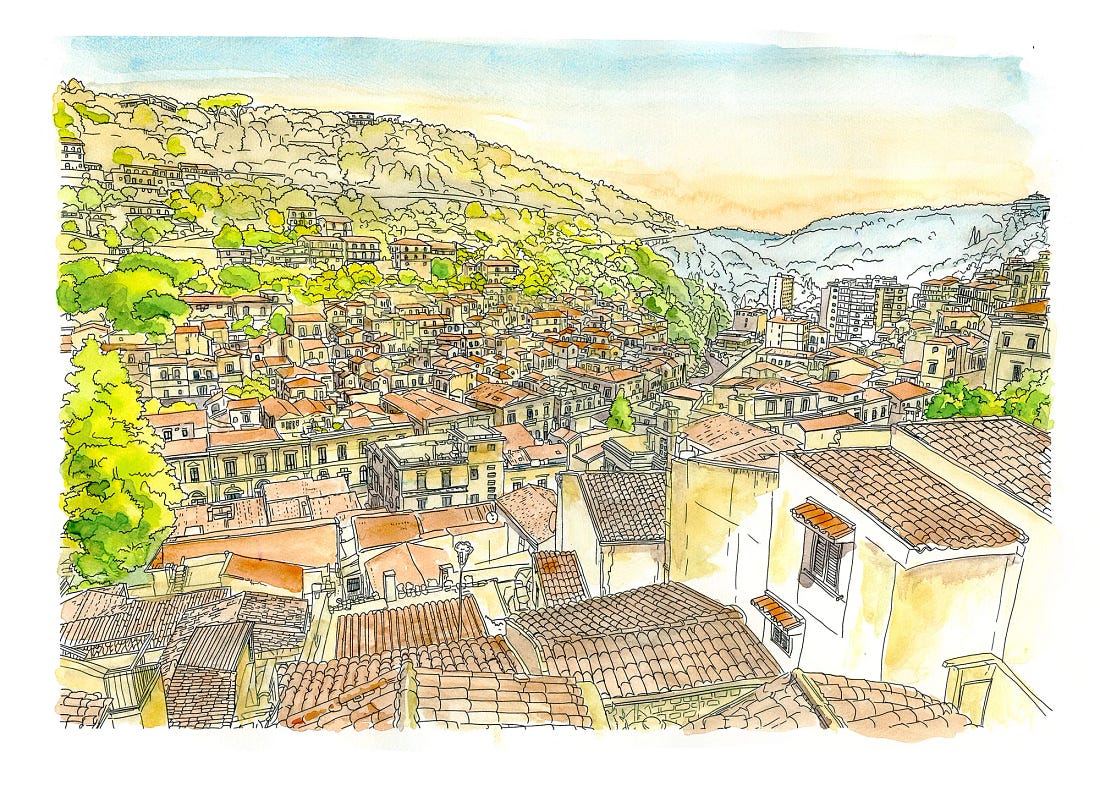
This is Part 7 of 8 of The Citrus Kingdom. I’m publishing this chapter in two installments here on Substack: Part 7.1 on Thursday morning and Part 7.2 on Saturday morning. But there’s no need to wait! The complete, illustrated story is already live on Notes from the Road, where you can read it all in one sitting. I awake in Modica knowing that I need to wash my clothes in the sink and get them out into the morning sun to dry. I plod up from the basement to find Iva in the living room, holding a bottle of nail polish up to the window and frowning at it. I open the doors to the balcony and the city beyond. Sicily has some of the world’s most beautiful villages, Cefalù and Erice among them, but Modica is not a village. Modica is an entire city, built on the steep sides of a ravine. It is houses stacked on houses, staircases everywhere leading under arches and between balconies. Modica has an entirely different relationship with gravity.
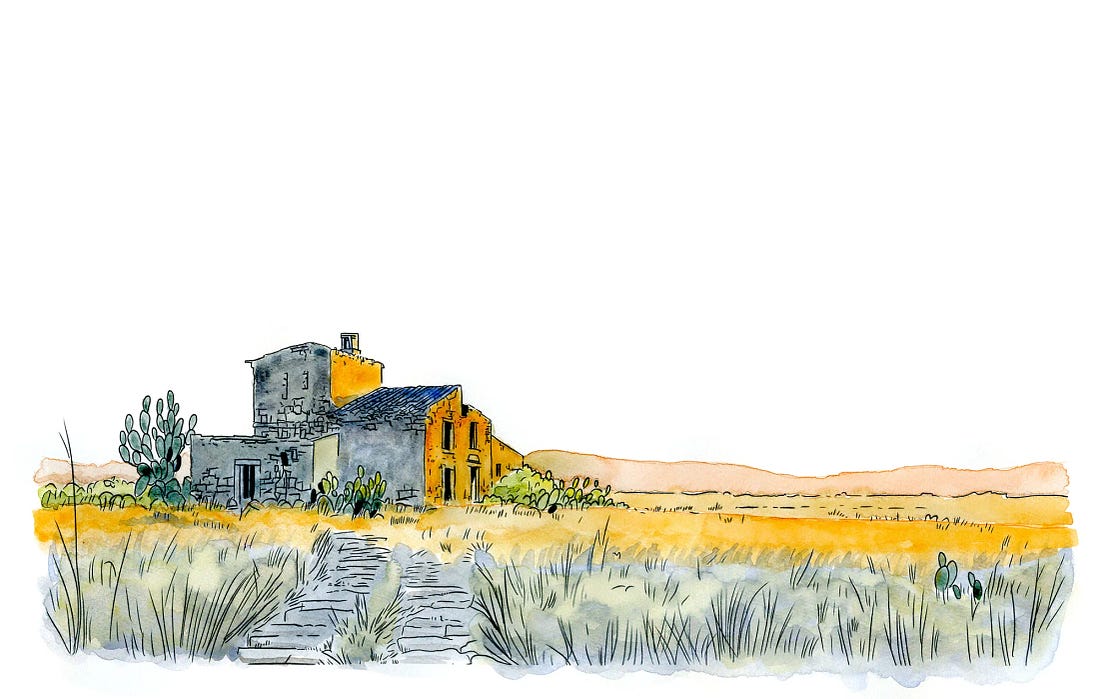
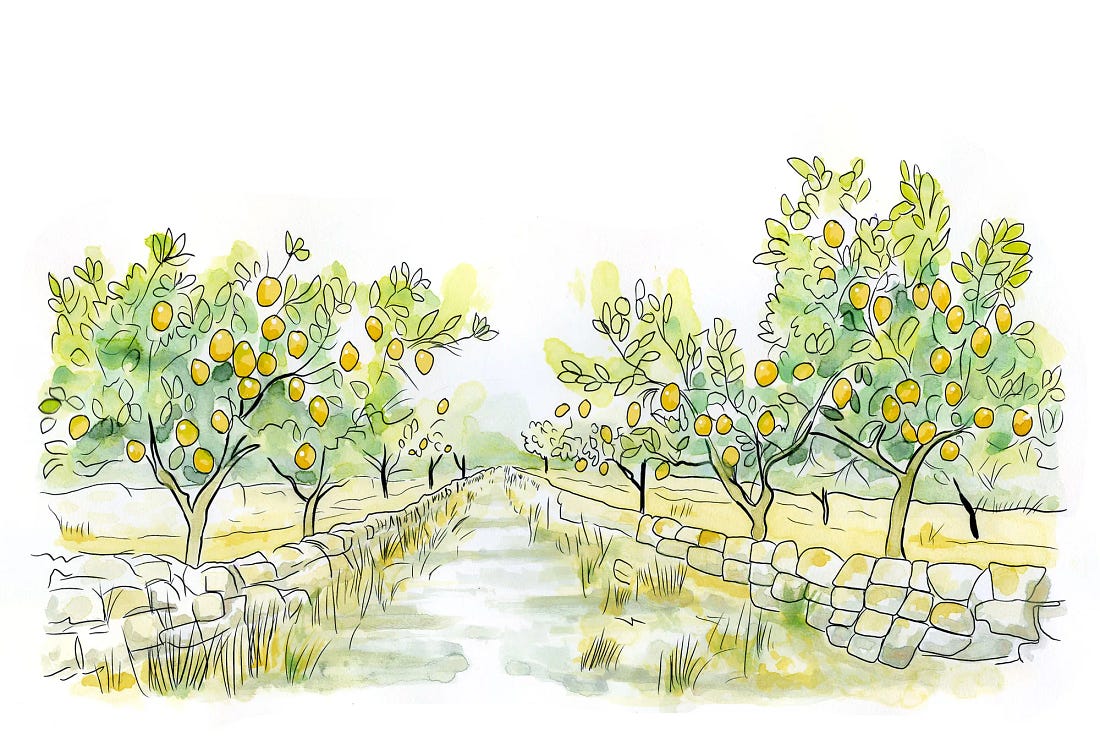
I ask Iva what she’s up to. She discreetly puts the nail polish away and casually mentions that she’ll need to buy a couple of bottles in the city today. Four days earlier, when we entered the Val di Noto, the countryside began to resemble the Sicily that people around the world imagine. Golden grasses, great open agricultural spaces, lonely and abandoned farmsteads, prickly pear cactuses growing between ancient dry-stone walls. It was a great stretch of open horizontal space, broken by old carob trees and old limestone walls. Modica is an extension of that landscape, although here the horizontal world has suddenly turned vertical. Instead of stands of thatching grass and giant fennel rising from the limestone, there are houses and churches. Instead of dry-stone walls dividing the fields, there are retaining walls holding up entire neighborhoods. Modica was built by water. Two streams, the Ianni Mauro and the Pozzo dei Pruni, cut into this gorge, and so the city built up on either side. Modica was once called the Venice of the South, because bridges cut across the creeks at every chance. Then, on September 26, 1902, a storm sent both rivers roaring through the lower town, emptying ground floors and carrying away more than a hundred people. Afterward, the rivers were buried. Corso Umberto, the main street below me, runs where they used to. Modica’s water is still down there, out of sight, beneath the cafés and the chocolate shops. The story I want to tell happened on the other side of Sicily, in the lemon groves outside Palermo. But there’s a reason I want to tell it here. The lemon at the center of it all grows here too. If you drive down from Modica toward Syracuse, you’ll see the groves running in a dark green band between the limestone and the sea. These are Femminellos, the most common lemon in Italy, on an island that grows nearly all of Italy’s lemons. In this corner of Sicily, the Femminello has been the backbone of the farm economy for generations. Syracuse lemons made fortunes in foreign markets, as far away as the United States, and today the Limone di Siracusa is protected by the European Union, the fruit of one Femminello strain grown along a coastal strip of ten towns. Its name means something like “little female,” for its fertility. As we saw in Ortigia, the Femminello flowers again and again, and a grower who knows how to coax it can pick lemons nearly all year.
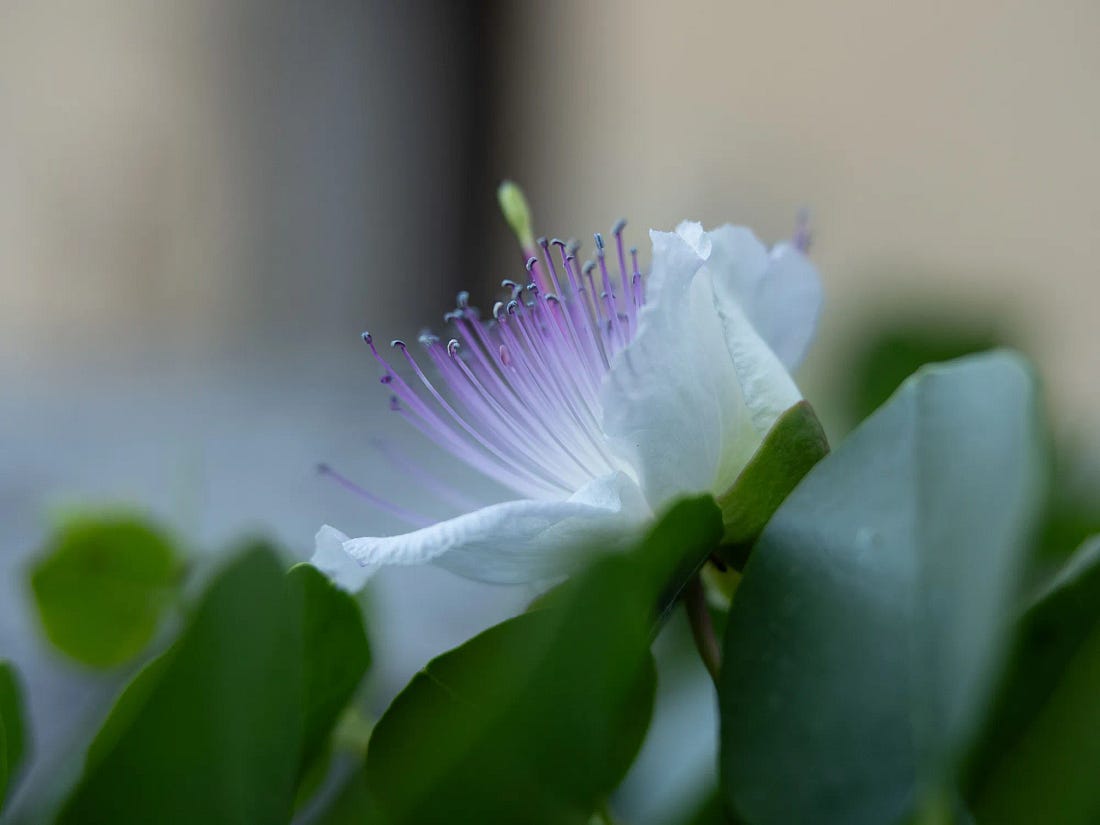
I’ve asked you to travel back in time with me before: aboard a dhow carrying a citron sapling toward Palermo, onto a Portuguese nau rounding the Cape of Good Hope, and millions of years back to the forests of Yunnan, where citrus evolved. Will you come with me once more? This time we don’t have to go nearly as far. I’m not taking you to Asia or the Miocene, only to the other side of Sicily. I’m going to introduce you to a family that lived a century and a half ago. While they are my invention, the world they lived in is not. The Golden BasinIt’s summertime, and it’s 1859. Sicily is still a kingdom that is ruled from Naples. There is no such thing as Italy. In the Conca d’Oro, the lush golden basin just outside Palermo, a man named Antonino Sclafani is walking among his lemon trees at dawn, as he does each morning. His trees are wet from last night’s watering. Antonino knows his trees so well that he knows which ones drink the most and which ones droop when you feed them too much. He knows the old tree by the cistern as the one that always flowers first, and the young one near the wall that has never forgiven him for the transplanting. You and I are standing on the roof of the Sclafanis’ farmhouse, and below, we can see the family mule, walking in circles around a wheel and a well. That contraption, the senia, sends a bucket down into the well and then up to be tipped into the gebbia, a large stone tank the size of a small room. This technology is almost identical to what the Arabs brought to Sicily ten centuries ago. We can see a series of clay channels leading out from the tank and into the trees. The mule and the senia are not actually responsible for quenching the trees’ thirst. This is just a backup, especially on these hot August days, leading up to the most important time of the week: Thursday night. On Thursday night, a man who is known as the water guardian, or the fontaniere, opens a sluice at the water reservoir, and the Sclafanis’ share of the valley’s water comes rushing into their gebbia. The Sclafani farmhouse is built low to the ground. Capers grow out of the cracks where the stone shows through the whitewash. It is built around a modest courtyard that’s floored with river rocks. There is a grapevine covering half the courtyard, and beneath it is a simple farm table.
The kitchen window is directly beneath us. Climb down with me into the courtyard, and let’s peer into the house. There, against the kitchen wall, is a wooden chest, painted long ago with blue flowers and red saints and now well faded. It’s Rosalia’s dowry. Inside are her linens, folded in a mix of dried lemon peel and lavender. She worked on those linens every winter night, every year, embroidering up to the year of their wedding. Nobody ever uses them. Oh, and there she is, Rosalia, out in the garden. Like Antonino, she is active well before the sun rises above the mountains. She’s wearing a dark wool skirt, and her cotton kerchief, tied over her hair, is printed with small red flowers. She wears a tiny branch of red coral on a cord. Her mother did this, to ward off the evil eye. We can see her picking basil from the pots next to the kitchen door. She checks the tomatoes. Then she pulls a handful of wild fennel from the edge of the courtyard. That’s for tonight’s pasta. It looks like the boys are coming. That one there, the one carrying an old double-barreled gun over his shoulder and a couple of rabbits by their hind legs, that’s Salvatore. He’s the oldest son. His gun used to belong to his grandfather. Ahead of him is his lean Cirneco, copper-colored, his big ears pricked up as he runs, fired up by the hunt. Oh, and behind them is sixteen-year-old Pietro. He’s obsessed with rumors from the mainland. The same rumors Antonino pretends not to hear. And little Nino is already in the cistern up to his knees, chasing frogs. Rosalia has made rabbit stewed with wine, and is serving it out on the old farm table under the grapevine. Follow me to the edge of their courtyard so you can see their dinner. The olives, the rustic bread, the fennel pasta, and those lemons cut in quarters and passed around the table. Everybody squeezes lemons on everything. It’s nights like this, when the dog is asleep under Antonino’s chair, and the air smells like orange blossoms from a neighbor’s grove, and when you can smell the damp earth from Thursday’s water, that are pure magic. Family. Now, as nighttime creeps in, the frogs begin to sing from the gebbia. Everybody squeezes lemons on everything. The first lemons go missing from the edge of the road. Look at Antonino out on his morning walk. Because he knows his trees, he knows right away that three lemons near the farmhouse gate are missing. A twig is snapped. Antonino stands there for a while, observing. He knows hungry men walk this road. Laborers between jobs and boys in from the city for summer work. He doesn’t mind a hungry man needing a lemon. He fixes the gap in the stone wall where some stones have spilled over. He doesn’t mention it to Rosalia. But a week later, Antonino finds a whole tree has been stripped up to the height a man can reach. And on the same morning, he finds two more trees, completely stripped. Whoever is stealing his lemons isn’t hungry, because hungry men don’t carry sacks. The family discusses it at the old farmhouse table. Pietro says it’s time to go to the police. Antonino laughs at this. But it’s not a kind laugh. The police are loyal to the king in Naples. Police come out to the country to collect taxes or arrest somebody’s son.
Night WatchThey decide to keep watch. There they are, Antonino and his three boys, sitting silently at the bottom of the grove in the dark. The old double-barreled gun is propped up against a tree, and they are sharing a jug of wine, some bread and cheese. From my vantage point here it looks like they are enjoying it. The dog is curled up between them, Antonino scratching his ears. A lemon orchard at night is a different kind of place. The trees are black shapes against the clear summer sky. The mule has retired and the water channels go silent. The frogs are singing as they always do, and then they stop. And they start again, and if you’re listening closely enough, if you’re listening the way Eric Gangloff spots lizards, you’ll notice the sound one just made in the dry leaves. A scops owl is calling from the mountains. A fig drops. An entire week goes by. Nothing happens. And then, a couple of watches later, the dog stands up. Its big ears forward. Absolutely still, and staring at the road. Salvatore puts his hand on the dog’s back. He feels it trembling. Then they hear it. The crack of a branch. A whisper. Antonino stands up and shouts in the dark. A flash and a crack — a pistol shot. Nino is screaming. Pietro is on the ground. All Salvatore remembers is a shape moving in the dark, and his gun kicking up against his shoulder, and every lemon and tree bright as noon. Silence. Running feet. Pietro gets up. Nobody is hit. For one long breath, the terror is over. But then they hear the breathing. A man is lying under the third tree from the wall. Antonino lights the lantern and leans down by the man. Birdshot, at close range like that, does not make small holes. It’s in his throat and the side of his face, and he is breathing through it all. It’s a wet, bubbling sound that goes on and on. His eyes are wide open. He’s a young man. In fact, he’s younger than Salvatore. He’s barefoot and a cloth sack is still wrapped around his wrist. He tries to say something to Antonino. He tries again, and then gives up. And then his breathing stops. The frogs at the gebbia, which had gone silent with the shot, begin to sing. Nobody recognizes the young man. Soon, that will be for the best.
All four of them sit with him, arguing in whispers. Antonino wags his finger in the air. Of course, if they go to the police, the police will come for one of them. A son will hang for a few lemons. This man had friends with him. There were others running. Antonino has to make a decision, and the way he makes decisions about water, he makes it quickly, and nobody discusses it any further. Before dawn, they load the mule cart with lemon crates. Under the crates is the man, wrapped in a sack. Antonino and Salvatore drive the mule cart down to the Oreto, the river that flows through the Conca d’Oro and out to the sea. They put him in the water deep under the leaves. They are on their way to take the lemons to market. It’s market day, and nobody questions a cart of lemons on the way to the market. When they get back, the pickers are already in the grove, and bees are working the blossoms. Rosalia has hung clothes to dry in the courtyard. Water is running in the channels, and the orchard looks just how it did the day before, although nobody can stand to look at it. Salvatore stops eating with the others. He takes the dog and the gun into the hills after rabbits and comes back with nothing. The thefts stop for a while. Then, that winter, the thefts begin again, but on the neighboring farms instead. The Lo Cascios end up losing their entire lemon harvest. And old Ferrante, wondering why his young orange trees look so thirsty, walks out along his water channel and discovers that a whole section has been smashed to pieces. Those trees were dead two weeks later. But this doesn’t last long, and one by one, the thefts stop on those farms too. There are men that stand next to the gates of many of the Sclafanis’ neighbors. They are armed, and very, very polite to everybody. But it’s not clear who they work for. They are armed, and very, very polite to everybody. When Antonino asks Ferrante about it at Mass, the old man looks at his shoes. Then he wags his finger and says, “It costs a lot less than losing your trees.” And he walks away in disgust. In April 1860, Pietro leaves home to join the volunteer squads in the hills, awaiting the arrival of Garibaldi. He returns home in the fall. He has fought at Milazzo. He carries a military musket. He doesn’t look at the third tree from the wall in the same way his brother does. To him, the third tree is a lesson. By then, the Sclafanis are almost the only family on their stretch of road who still guard their own trees. The thefts come back, and this time they come only to the Sclafanis.
Continued on Saturday. Notes from the Road is free today. But if you enjoyed this post, you can tell Notes from the Road that their writing is valuable by pledging a future subscription. You won't be charged unless they enable payments.
|