|
Thursday, October 22, 2026
The next deal departs in 13 days



The Island That Shouldn't Have Had Freshwater

Part V of the Citrus Kingdom is also available at Notes from the Road. It has been a few days since Ivan scraped the side of the rental car, and now he and Iva are beginning to reconcile with the fact that they will have to outwit the car rental company. “We could park it real tight against the wall, so they don’t see it,” Iva considers. “We could rub it with olive oil until it’s so shiny nobody sees the dent,” Ivan adds. “Maybe we tell them it was caused by gases from Mount Etna. There is nothing in the rules that says you can’t drive on the volcano!” Iva adds. The couple are becoming increasingly preoccupied with the dent, and occasionally they’ll crack each other up with their increasingly preposterous engineering projects. But they aren’t joking. They are trying to find something that will work. I look over at Ivan, driving our dented car, and it reminds me how this Ivan is unrecognizable from the pre-dent Ivan. A few days earlier, pre-dent, in Taormina, the two of us had been walking back to our rental house when I suggested we take a shortcut through a magnificent alley that I had discovered the day before. He refused, citing again his disinterest in the architecture that was the same as his backyard growing up. So we split up and I ascended through the empty limestone alley on my own. Something had caught my eye; a black object falling out of the sky. It was enough to make me step out of the way, and a tiny black ball pounded on the stairwell. It was a tiny Savi’s Pipistrelle bat, the first I had ever been able to identify simply because in the night sky they are indistinguishable from other Sicilian pipistrelles. Somehow it had survived whatever happened to it, and it was dragging itself across the stone dementedly, one wing cocked at a wrong angle, trying to reach somewhere dark. I turned my lens cleaner into a glove, moved it to a shaded ledge, and this act forced me to glance down at the crowded Corso Umberto, where I spotted Ivan among the throngs and hordes. He was puttering at the edges of little shops, picking up trinkets to examine them. I couldn’t tell exactly what he was looking at, but they could be little statues of Mother Mary that glow in the dark, or The Godfather playing cards, or shot glasses with Mount Etna erupting. He was surrounded by sweaty tourists holding their vlogging gimbals, wearing oversized gold sunglasses and T-shirts with slogans like “MY OTHER RIDE IS AN ITALIAN STALLION.” And all I could think was, Poor Ivan! He wasn’t shopping, exactly, or sightseeing. He was just moving from one little object to another, looking for something that might amuse him. He looked like a man waiting for the day to end. We are driving into Syracuse to visit Ortigia, a one-square-kilometer island of ancient streets and limestone buildings that juts into the Ionian Sea. This little outcrop was once the heart of Syracuse, one of the most powerful cities of the ancient Mediterranean, and a place that has figured prominently in Sicilian history for nearly three thousand years. We park in Syracuse and set out by foot across the bridge to the islet.
Ortigia is one of those cities where the history is much more interesting than the place itself. The streets feel used up, and the whole place has the weariness of an everyday European city. Even with the summer sun and the blue ocean surrounding it, something in Ortigia makes me feel like I’m back in Bremerhaven. Despite that, visiting Ortigia means peering directly into some of the world’s foundational history. Ortigia is the original Syracuse, and it was founded by Greek colonists who expelled the native Sicels from the island in the eighth century BC. In the next few hundred years, Syracuse rose to become one of the most powerful cities in the Mediterranean, powerful enough to rival Athens and Carthage. Ortigia has been rebuilt so many times that it’s difficult to see its deep past in its stones, but there are scattered remains of each era, including the remains of a fifth-century BC temple to Athena. But most of that ancient history has been absorbed into the modern city. The cathedral for example incorporated those columns of Athena. Hiding beneath the layers of architecture is something much more important to the history of Ortigia and Syracuse than any temple, theatre, wall or warship. Freshwater. Normally, water is just a baseline necessity for a city to exist. But you have to remember that Ortigia is an islet surrounded by the sea. Ortigia has always had something that became its key strategic advantage. It’s a tiny islet, protected by water from direct land assaults, that happens to have a spring.
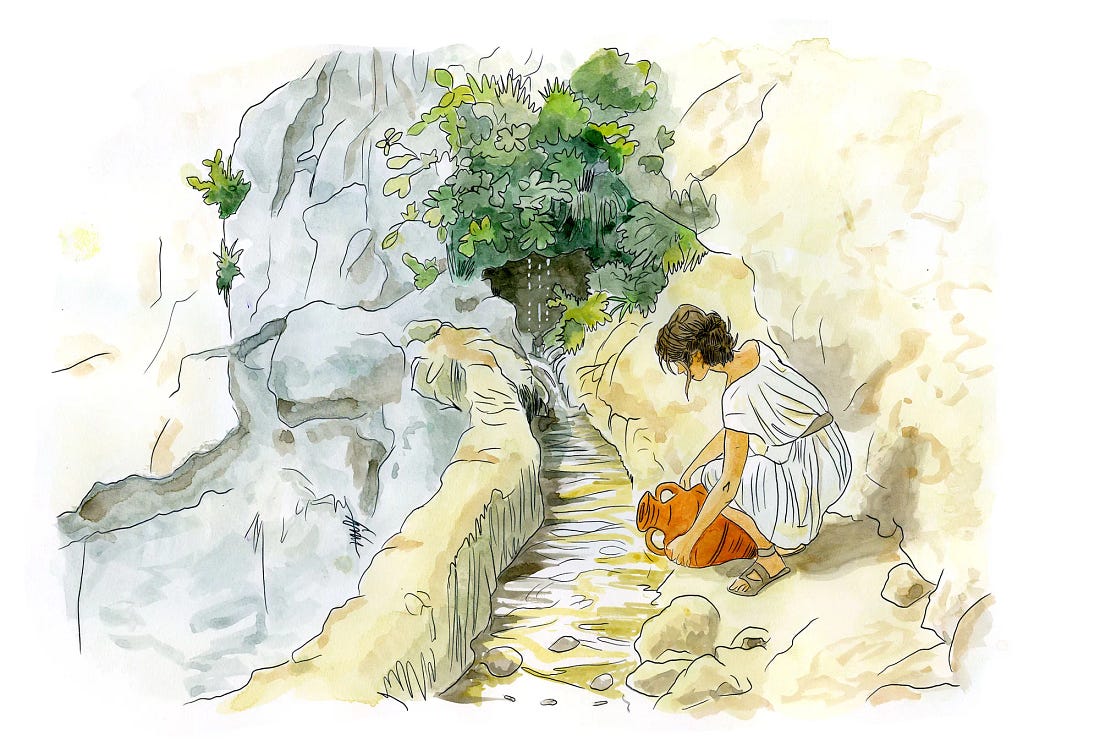
The Spring Beneath the CityWe find the spring while walking along the limestone boardwalk that hugs the harbor. Fonte Aretusa emerges from underground just a few feet from the saltwater bay. It features huge papyrus plants, and a handful of domesticated swans floating in the greenish water. This spring is a peculiarity of Sicily’s limestone geology. When rain falls inland in Sicily, it soaks deep into the porous limestone sponge and emerges along the coast. The Ancient Greeks could not explain this mysterious gift, but of course the Greeks were good at inventing supernatural ones, and so they imagined a nymph named Arethusa. Arethusa loved the woodlands, where she ran barefoot as a primeval hunter. One day, she was so exhausted by the hunt that she threw off her clothes and skinny dipped in a river so clear she could see the stones beneath her feet. What she didn’t realize is that the river was also a river god, and it transformed into a lusty young River god man, and started chasing her in pursuit. Arethusa, a follower of the goddess Artemis, called for her help. Artemis surrounded her in a cloud, hiding her from the river god, Alpheus. But Alpheus continued to pursue her, and in the terror of the moment, she exploded into freshwater tears. To save her in tear form, Artemis dug her an escape passage under the sea, to distant Ortigia. It is a strange bit of mythology, but the premise is rooted in something real. Freshwater does travel through underground passages and emerge in places where you might not expect it. The spring has been enclosed in a semicircular basin, where fish swim among the papyrus. Today, the water is brackish, affected by the intrusion of the sea. Looking at this simple pond, even as it’s shrouded in the glory of its semicircular basin and blind arches, it’s hard to believe how this tiny spring was Ortigia’s most extraordinary secret. Three thousand years ago, a city could have everything: walls, a strategic harbor and access to the Mediterranean’s key trade routes. But if there was no freshwater, it had no chance. Ortigia had something few other cities had. It had freshwater and a giant sea-moat to protect it from attack.
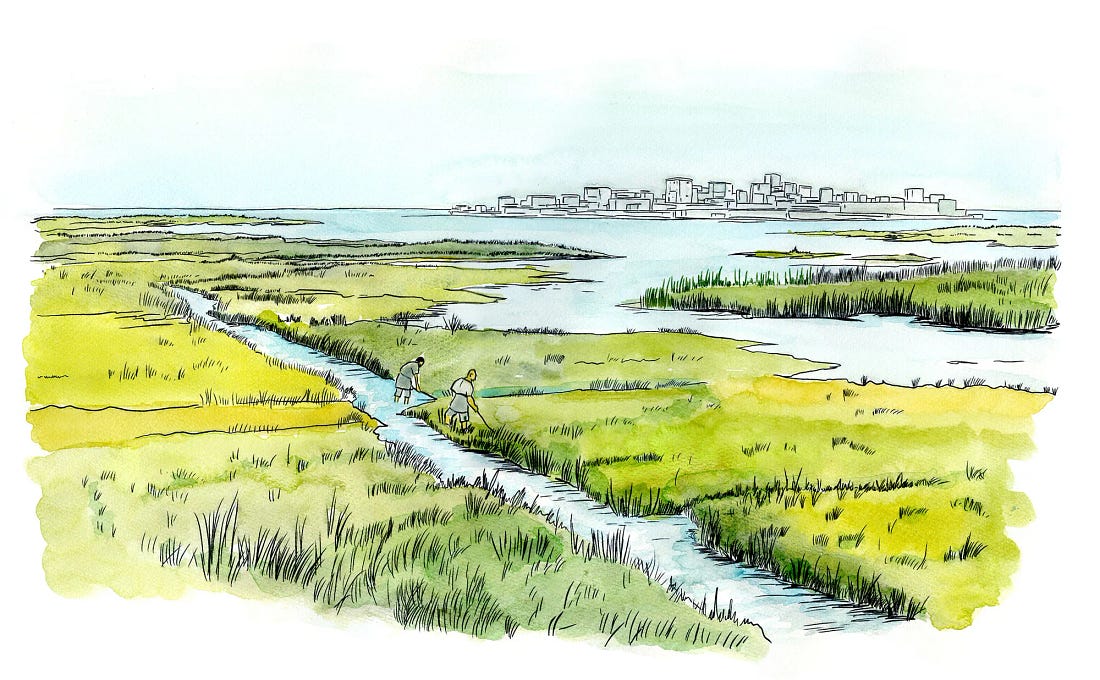
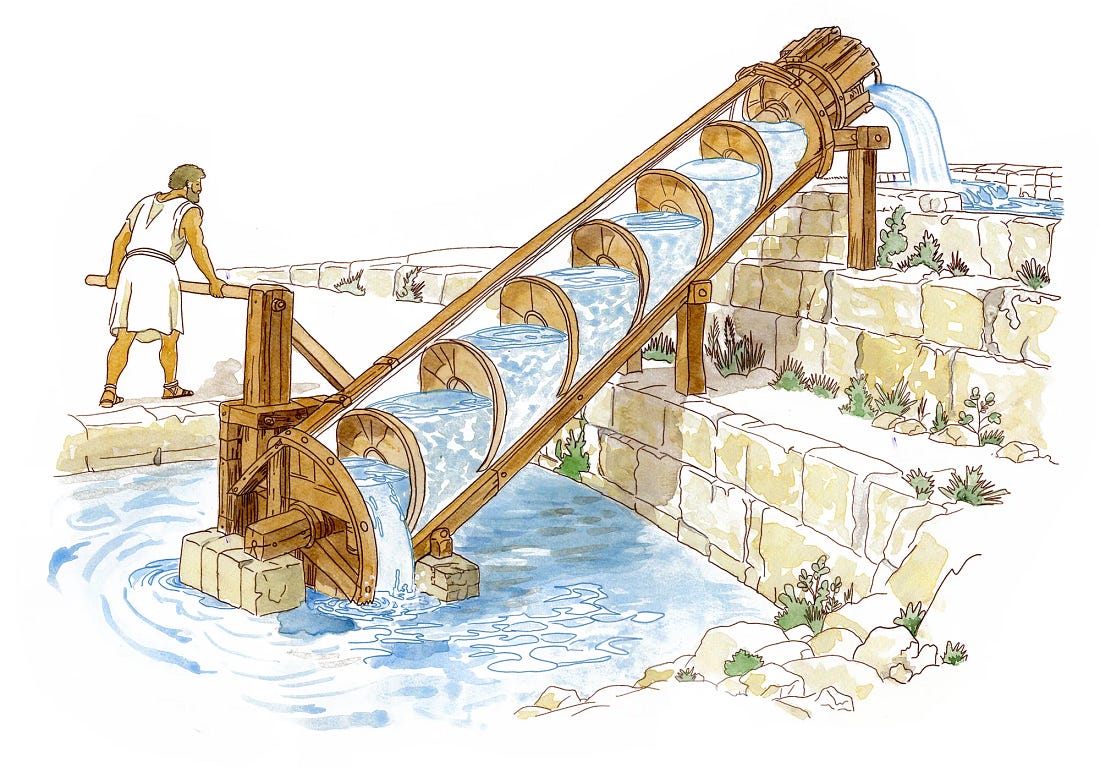
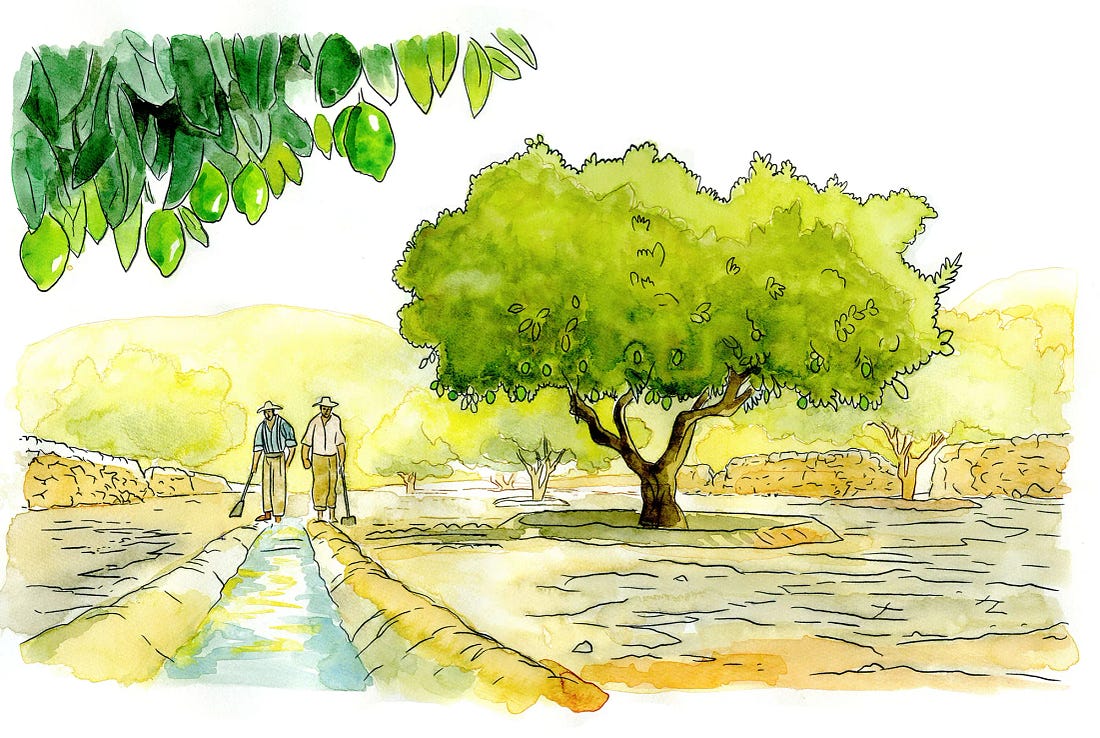
Archimedes and the Lifting of WaterBut Ortigia would eventually be known not just for its freshwater, but one of the most important mechanical inventions in the history of agriculture. And the man behind it may be Europe’s most accomplished generalist tinkerer, Archimedes. He was born in Syracuse sometime around 287 BC, when the city was considered one of the major centers of Greek civilization. He was a mathematician, a physicist, an engineer and an inventor, although those modern classifications don’t really describe what he was all about, and what he accomplished. Archimedes devised machines that changed civilization. One of the machines he either built or modified from earlier civilizations is so simple that it seems almost ridiculous. It is a screw. Imagine that this screw is a very long wooden spiral, enclosed by a wooden cylinder. It is placed diagonally with its lower end submerged in a pool or a river. If you turn the screw, pockets of water get trapped in the blades and rotated upward, until they spill out at the higher end. In the ancient world, if you could move water uphill, your agricultural prospects would be changed forever. All it takes is a man, or a beast of burden, to rotate a handle and lift water against gravity. Nobody knows for sure that Archimedes actually invented the Archimedean screw. What matters is that it became one of the most enduring ways that humans could move water. With the Archimedean screw, mankind could drain a flooded mine, empty the bilge of a ship, and perhaps most consequentially, lift water from a canal into a field. Versions of the screw continue to be used today. He invented all sorts of other things, including compound pulleys that let men move things much heavier than the effort they put into it. One such pulley system was the Claw of Archimedes, which could grab invading ships out of the water and then drop them, shattering them instantly. Archimedes was killed in 212 BC after Romans finally captured Syracuse. The man who spent his life inventing ways to move things was killed when an army was finally able to move into his city. While that was his end, the idea that man could move water remained, and irrigation became the central concept in the agricultural transformation of Sicily, a large island with very few natural lakes and rivers. And few crops would benefit more than citrus. The Engineered LandIn Palermo, we imagined a shaded courtyard a thousand years ago with a citron tree in its center. Those citrons were grown there because of what they represented: the surreal improbability of a fruit from the moist, rainy paradise of the jungle, right here in arid Sicily. Citrus trees are thirsty. The Mediterranean climate works great for arid-loving olives and grapes; plants evolved to wait out a dry summer. But a lemon tree is another matter. Citrus evolved in rainy Asian mountains where water poured down from the skies all year. A tree in Sicily might survive a dry summer, but intensive fruit production needs moisture exactly when the soil is drying out. In commercial citrus orchards, a grower’s most crucial mechanism in controlling a predictable fruit harvest is water. For generations of Sicilian gardeners, control of water was the fundamental problem to solve. And solving it could mean untold wealth. Sicily’s Arab era of the ninth century brought all the agricultural science knowledge of the Islamic world: wells, reservoirs, channels, water-lifting devices and carefully-managed gardens. The Conca d’Oro, the great plain around Palermo, became the improbable landscape of cultivated fruit trees. But this land was not naturally fertile. Groundwater had to be hauled up, run through channels, and held in basins and shallow furrows, and the groves were walled in against the wind. By the nineteenth century the payoff was obvious. Sicily was shipping lemons and oranges across Europe, and the larger groves had invested in norias. A mule walked in circles, hour after hour, turning a wheel that lifted water out of the ground and into terracotta channels running between the planted rows. These engineered orchards were expensive, and took years of capital output before young trees could mature. But the potential profits were enormous. Even so, the technology was embedded with a problem of its own. What if a man owned his own land and his trees, but not the well? What if he depended on a shared channel with his neighbors? And what if he had to buy his water from somebody else? Or somebody could divert that water away from him? Water could be measured, scheduled, distributed and sold. As we have moved through Eastern Sicily, we have thought only about the men and their trees. But there is an important distinction that Ortigia reveals. There is the man who owns the tree and the man who can decide whether that tree receives water. But Sicilian growers would soon do something stranger with water, something that may be the strangest invention in the entire global history of citrus. They learned how to coax fruit out of a lemon tree in the most unlikely of seasons. The result would be called the Verdello.
The VerdelloThe Verdello is usually called a Sicilian summer lemon, and its most obvious trait is that it can stay greenish even when ripe. It is more petite than the big yellow commercial lemons. And crucially, it grows in the hottest months of summer, the time no lemon tree was meant to fruit. Verdellos are less acidic than ordinary lemons. When Jane buys me a granita di limone, I am likely eating frozen verdello — Sicily’s chilly answer to summer heat. But what makes it fascinating isn’t the color or its sweetness. It is how growers learned to produce it. There were already several lemon varieties that can flower more than once a year. In Sicily, the lemons of fall and winter are called primofiore lemons: first flower lemons. And in spring come the bianchetto lemons: the little white ones. And following that come the maiolinos: the May lemons. Sicilian growers found that by manipulating the water they could break the ordinary rhythm of the tree. The technique deliberately stresses the tree. It’s called forzatura, from the Italian for forcing. In those hot Sicilian summers, water is already scarce, but the lemon grower withholds irrigation entirely. The soil dries, and cracks like dried desert mud. The tree begins to suffer, and its leaves begin to wilt with the stress. The trees look as if they are about to die. Then, the grower floods the trees, usually by channeling water from the main irrigation canals into the tree well. The shock stimulates a new flowering, and fruit develops over the following months to be harvested the next summer. The tree has been tricked into keeping a different calendar. I find this remarkable because of how different it is from what Colonel Interdonato did on the coast across from Lipari. Interdonato spent years at his grafting knife trying to invent a new lemon, one that ripened early enough to beat the season to market. The Verdello growers wanted the same commercial edge as Interdonato, but they did not need to breed a new fruit. They simply changed the conditions the tree grew in. They invented a technique. This was not easy on the tree. Such severe water stress could weaken the tree and shorten the life of an entire grove. Growers had to weigh how much suffering to impose against a reward. But the reward was obvious. Summer lemons arrived when there were no lemons. For centuries, people lifted water out of the ground to keep their citrus alive. But now they were withholding it to make the citrus trees perform. It’s important to understand that these two things are the same skill. You can’t make a tree thirsty to the exact point where it is about to die, and then bring it back, without the same intimate understanding as the gardener in Palermo understood when he kept his citron alive. Care and exploitation are two edges of the same knife. In Sicily today, that relationship has acquired a final complication. The island is getting hotter, and drought is becoming a serious problem for agriculture. There is a dark irony in this. The whole technique depended on being able to relieve the tree of its thirst at the chosen moment. But a warming Sicily offers no such choice. Who Controls the WaterAnd that reminds us of the distinction between owning a tree and owning its water. By the nineteenth century, lemons were among the most valuable agricultural goods in Europe. A lemon grove was years of accumulated investment in living trees that could be damaged or destroyed in any given year. Unlike wheat, which could be harvested and stored, a grove could be ruined without anyone stealing a single lemon, if someone cut the trees, or wrecked the noria, or simply saw to it that the water never arrived. You can see the incentive a lemon grower has here. The incentive to want protection. We leave Ortigia, and Ivan is plainly relieved to get back to the only thing in Sicily that now holds his full attention: the dent. Post-dent Ivan has, in fact, acquired a new plan. In Syracuse, before we leave, he insists we stop at a body shop to ask about a repaint. As we visit more body shops, we learn they either won’t touch the car or they’re closed for the summer holiday. And each failure makes him more determined, and Iva more inventive, and before long they have moved on to debating whether a sufficiently confident attitude at the rental return might simply do the trick.
MarzamemiA couple of days later, we drive back down to the Ionian coast, much further south, almost at the southeastern tip of the island. Marzamemi is a small fishing village, and it has nothing to do with Greek mathematicians or three thousand years of anything. In its more modest history, Marzamemi was a tonnara town. If the invention that created verdello lemons is the strangest of the citrus world, tonnaras may be the strangest of the fishing world. They were essentially giant underwater structures made entirely of nets, and extending far out into the sea. As migrating tuna channeled right into the structure, they were funnelled toward the shore where they could essentially be harvested on land.
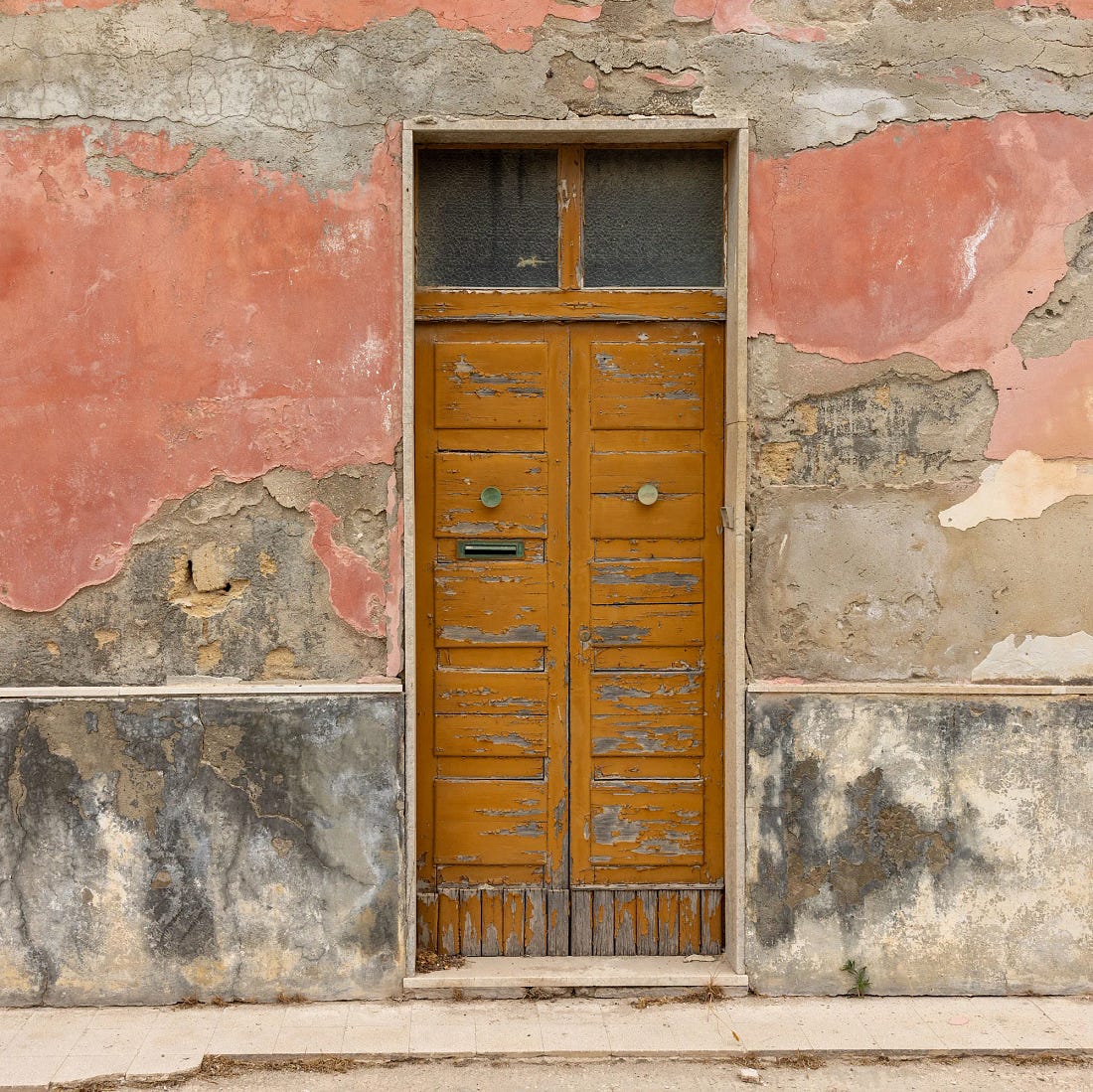
Iva and Ivan make, predictably, for the main piazza, with its restaurants and its little shops around the old tonnara buildings. Jane settles in with them. I go the other way. I wander through the alleys off the piazza, and discover they are filled with maritime color. There are old doors with faded blue and sea-green paint, wooden windowsills, and a window with a cat asleep in the shade of its sill. A couple has just gotten married, and I watch them stuff themselves into a classic beige Fiat 500 for photographs while the wedding party plays what must be the most godawful wedding music on Earth. Beyond these streets, I notice something — water. It’s not the Mediterranean, which surrounds Marzamemi from nearly every side. It’s a wetland, a shallow salt-pan lagoon hidden against the back edge of the village. The only way out to it, as far as I can tell, runs through a gravel parking lot, so I find the woman who runs the lot and ask, in English, whether I might walk across it. At the far edge of the gravel lot, and through a wire fence that is easy to penetrate, the ordinary world drops away. There are flamingos out on the shallows, that same improbable pink. Black-winged Stilts work the margins on their ridiculous red legs. And gulls, four species of them, loafing and squabbling on the mud. Among them is the elegant Audouin’s Gull. I stand at the edge of a parking lot at the end of a fishing village and watch a small wild world that is invisible to nearly everyone at the piazza. Most Italians have never seen a wild flamingo. But here they are, everywhere. Back in the piazza, I find Jane and the Croatians, and we order drinks on the harbor. Although I will not taste chinotto until I return home to Portland, I see it on the drinks menu. When I’m home, I’ll order bottles of it. The chinotto is a small and bitter citrus grown here in eastern Sicily. It’s a tiny cousin of the sour orange. The soda is nearly black, like a natural cola. But when you taste it, it’s nothing like cola at all. In Palermo, it was a fluorescent-green cedrata soda that had piqued my interest in Sicilian citrus in the first place. But the chinotto is the dark edge of that same discovery, and describing it as carbonated cough syrup undersells it. Now I have 23 bottles sitting around.
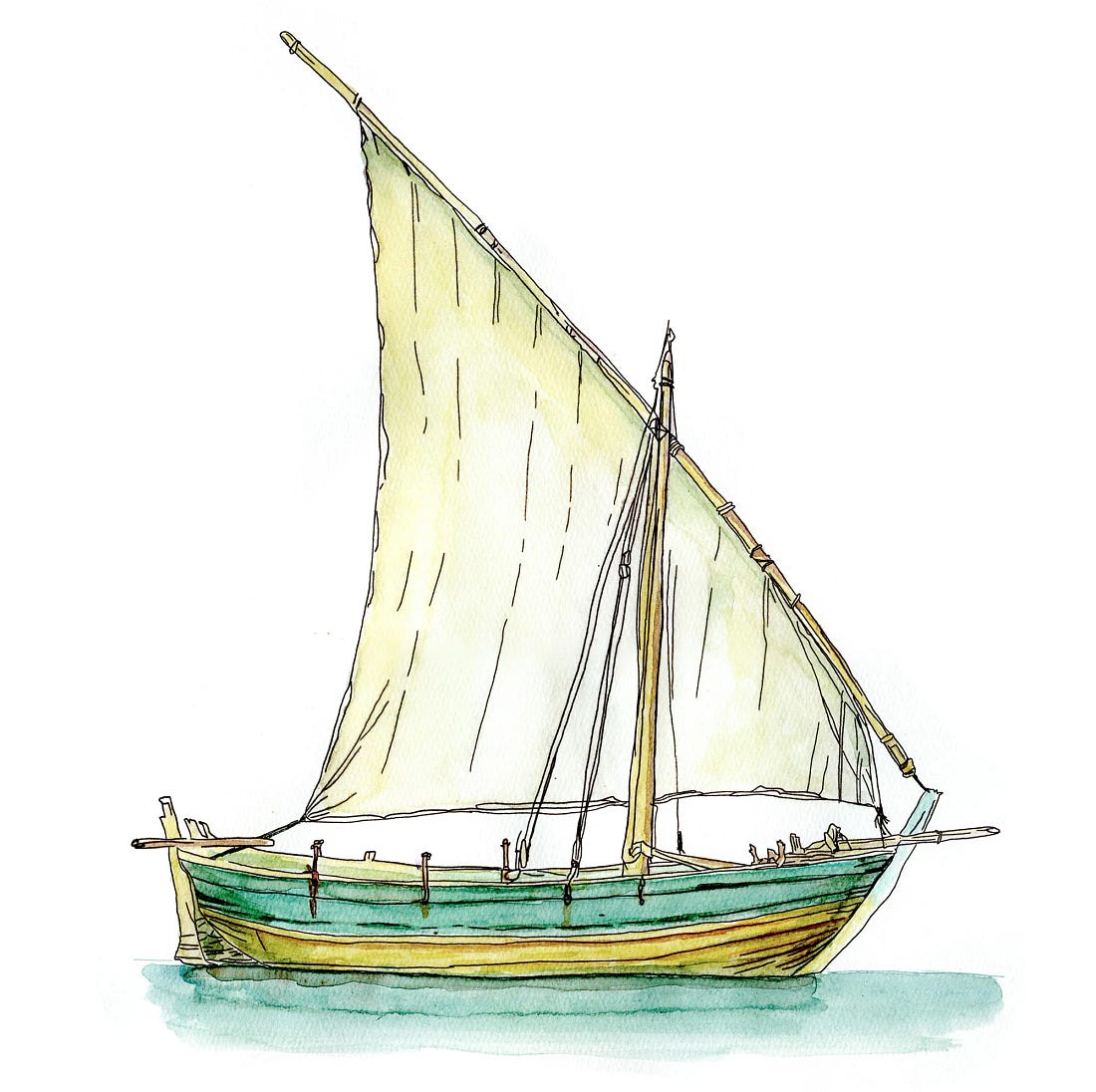
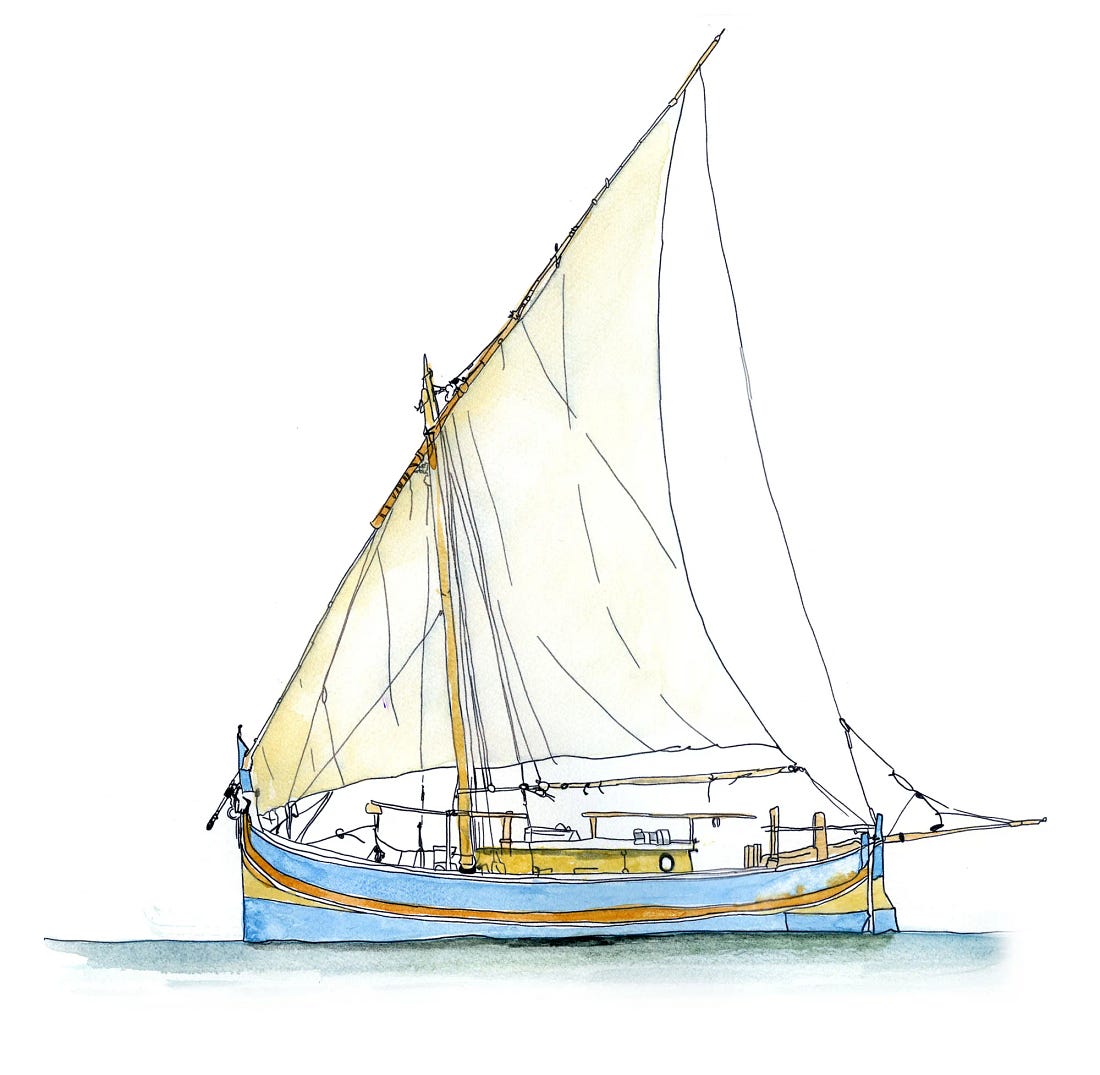
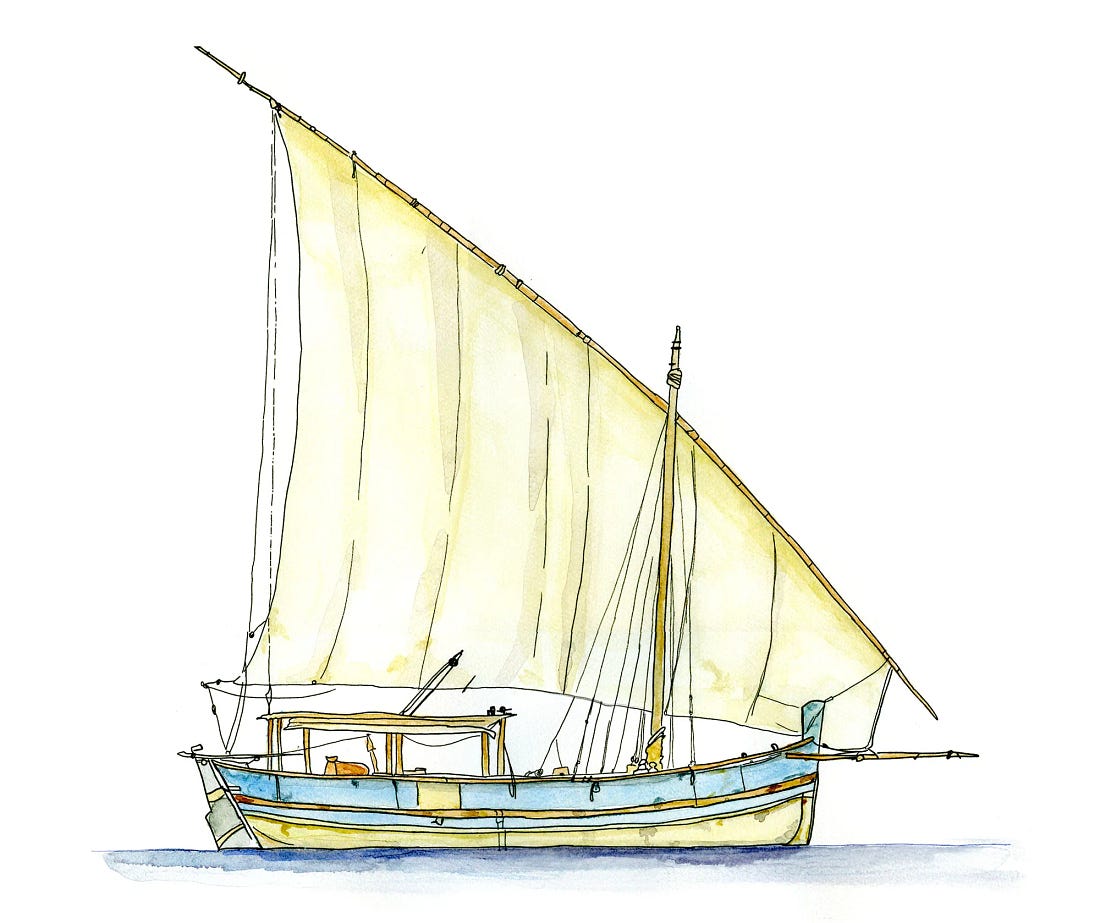
I drink it looking out at the old tonnara, and I think about the boats. I have been wanting to sketch them ever since I discovered Malta’s similar historical fishing boats. I imagine these boats moving tuna, salt and citron saplings. I imagine them carrying sacks of oranges and lemons to ports where sailors relied on them for their very survival. Nearly everything in this whole story arrived here by water, and left the same way.
On the drive back north, Iva and Ivan are tinkering, plotting. We stop one more time. We pull into an auto-body shop hidden on a sharp turn in the road. It’s a few corrugated sheds and a slab of concrete. The mechanic comes out still wiping his hands on a grease towel. In about ninety seconds, Iva and Ivan have him laughing, and it’s hard to imagine that this isn’t a reunion with a long-lost childhood friend. They all disappear into the shop. Jane and I stay in the car. When they come back out, the mechanic is carrying a bucket of white paint and a brush. Oh no, he won’t accept any form of payment. He simply dips the brush and paints over the long gray scrape. He does it freehand, a true artist. Just a modern-day da Vinci, still laughing at something Ivan has said. From inside the car I can see the exact moment Iva’s face changes, the same face she gives when I talk about Orange Nutella. The instant the fresh white paint goes on and she understands, all at once, what it is going to look like. Ivan climbs back in beside me, delighted, and entirely unbothered that a stranger has just donated the worst repair in Sicily to our cause. “It will look better when it dries,” he says. Notes from the Road is free today. But if you enjoyed this post, you can tell Notes from the Road that their writing is valuable by pledging a future subscription. You won't be charged unless they enable payments.
|