Time in the Tunis Medina, Part IIIn the Tunis Medina, walking with my family becomes a lesson in how ideas of power either live or collapse across generations. Part II
These notes conclude from Zaghouan to Sebhet Sejoumi and Time in the Tunis Medina, Part I. Part II online here. Place du 14 JanvierWe’re headed out to Carthage, and I’m sitting beside Tahir in his aging taxi as we idle near Place du 14 Janvier. The palm-lined boulevard opens wide around the Tunis Clock Tower. “Here,” Tahir says, nodding toward the square. “The revolution!” I didn’t anticipate that we would drive through here, this place that fifteen years ago was called “Avenue 7 Novembre 1987,” back when I was glued to the footage that ran from this place…grainy videos, crowds spilling down Avenue Habib Bourguiba, chants I didn’t understand.
It all began 185 miles south of here in a central Tunisian interior town called Sidi Bouzid. Like many other places, it was long neglected under Ben Ali, far from the dazzle of the coast. Sidi Bouzid was poor, and young, and overeducated, and Ben Ali’s government ignored it. On December 17, 2010, Mohamed Bouazizi, a 26-year-old fruit vendor, pushed his fruitcart out into the street, selling apples and bananas and any other fruit he could buy on credit. He did not have a permit. Almost no one like him did. Permits were a currency of power that were selectively enforced, a way to remind people where they stood. That morning, municipal police stopped him. His cart was confiscated. He protested. In many retellings of what happened that day, a female police officer slaps him in the face. A tiny slice of official cruelty, ordinary, casual, bureaucratic. But made unbearable by the fact that it was also his livelihood. Bouazizi, who had a diploma, had been supporting his family since his father’s death. He had no job in the formal economy, no leverage, no obvious path forward. He did what people are told to do in functioning states. He went to the local governor’s office to complain, to ask for his cart back, to ask to be heard. Nobody was willing to listen. Not long afterward, standing outside that building, Bouazizi poured paint thinner over himself and lit a match.
He did not die immediately. He lived for days in a hospital burn unit in Tunis, his body failing in slow motion while his name spread fast. Sidi Bouzid exploded with protest almost immediately. These protests were not ideological, nor paid, nor organized or scripted. They were raw and local. People marching for work, for dignity, against corruption, against the daily contempt that had hardened into normal. Security forces responded in the familiar authoritarian way, with pepper spray, batons, smashing driver’s windows, arrests, then bullets. Videos leaked. Funerals turned into rallies. Towns that had learned silence out of habit began speaking aloud. The protests moved north, town by town, following roads more than slogans. And then they reached Tunis, where the ministries are, the cameras are, the embassies are. They converged here, at this wide boulevard, where a crowd can become a nation, and a nation can suddenly refuse to be managed. Tunis had become a Boston Tea Party, saying no to Kings, a refrain of a thousand Berber routes for thousands of years. January 14, 2011. Ben Ali, curdled by power into a nasty authoritarian, flees. And then, after that, the fire of the story leaps borders. Like fire, it doesn’t leap because of policy or ideology. It travels because it’s feeding, like fire feeds, on organic material, on hydrocarbons, on people. If Tunisians could make a dictator run like a chicken kicked in the rear-end, then perhaps this illusion of the permanent Arab state was a fraud. In Egypt, crowds gathered in Tahrir Square. In Libya, protests escalated into war. In Yemen, Bahrain, Syria, everybody began to ask the same question: What if fear is not actually the strongest thing in the room? I remember how I felt watching this on TV. The naïve thrill that progressivism, secularism, and democracy were spreading through a region that needed accountable institutions as urgently as anywhere on earth. I wanted it to be that simple. When I ask Tahir how things are going, he turns to me and says, “We tasted freedom.” Above the square, swifts streak past the tower, fast and unbothered by borders or dates or decrees.
Rue Sidi Ben ArousI walk with Jane and Kellan slowly down Rue Sidi Ben Arous, the spiritual spine of the medina. The light turns the soft orange of evening. Street lamps start to flicker on. We’re looking for dinner. Jane points out doorways. Kellan lingers behind, crouching with the cats. Jane and I have had Tunisia in our sphere throughout our marriage, mostly for the food. Long ago, when Kellan was just a wee tot, I attempted several times to make brik, and Jane, perhaps inspired through her Korean heritage of hot pepper pastes and our family love for hot sauce, embraced harissa years ago. Harissa, which on the surface resembles Korean gochujang, is often incorrectly attributed as a Moroccan or Maghrebi ingredient, but Jane, while making shakshuka or even harissa with olive oil and bread, always points out that harissa is purely Tunisian. Through our love for artisanal cheeses, we slowly discovered that the global history of cheese is dependent on its Berber history. By the time we had worked our way from harissa to brik to olive oil and goat cheese, I started to see this food as more of a story of ancient history. It was this food that helped me to learn how Berber societies actually organized themselves long before modern states ever existed here. These ancient foods were not born under kingdoms ruled by divine right or empires imposed from afar. They came from communities that survived by deciding things together. Across much of North Africa, Berbers governed themselves through local assemblies, councils of adult villagers who met in designated spaces to argue and deliberate. They settled disputes, set customary law, organized irrigation and grazing rights, and determined how collective labor would be shared. Nothing was secret. Nothing was distant.
Leadership was provisional. Village chiefs were selected by the assembly and treasurers managed communal funds that came from fines or shared contributions. They were expected to account for every coin. Authority could be taken away by the people, and decisions could be revisited. Power lived close to the ground, exercised in public, sustained only by consent. In desert and pastoral regions, similar assemblies governed trade routes, seasonal movement, and conflict resolution. The expectation was not obedience but participation. Law was not handed down from a ruler. It emerged from precedent, negotiation, and collective memory. These systems were imperfect and exclusionary by modern standards. Women were often left out of formal assemblies. But they embedded something crucial. The idea that the government was something people did together. Through all this Berber history, there were empires that layered over this. There were Roman administrators, Arab caliphates, Ottoman governors, French colonial bureaucracies. But underneath all those formal institutions, there persisted a cultural expectation that leaders must answer, that power should be limited, and that rule without consent is fragile. Once I understood this, the food made more sense. Harissa, bread, oil, and cheese are not culinary luxuries. They are practical, communal, negotiated, the edible expression of a society that learned early that survival depends on sharing, arguing, and deciding together.
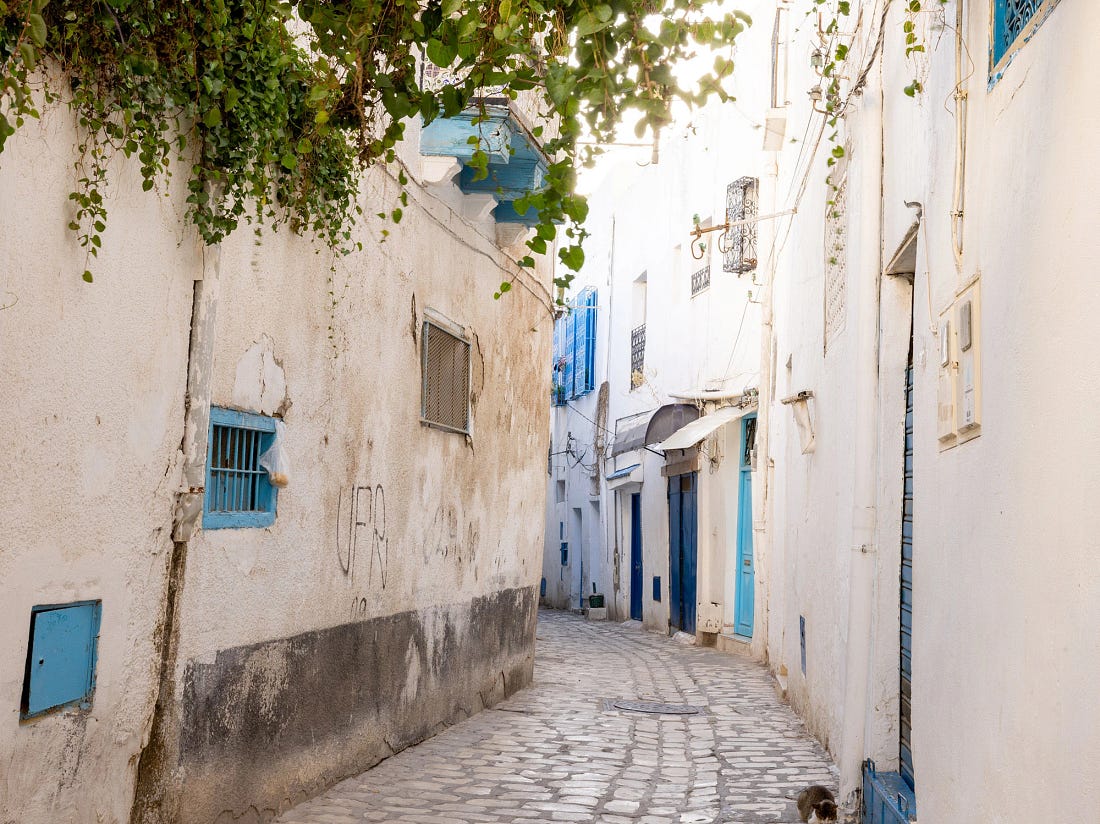
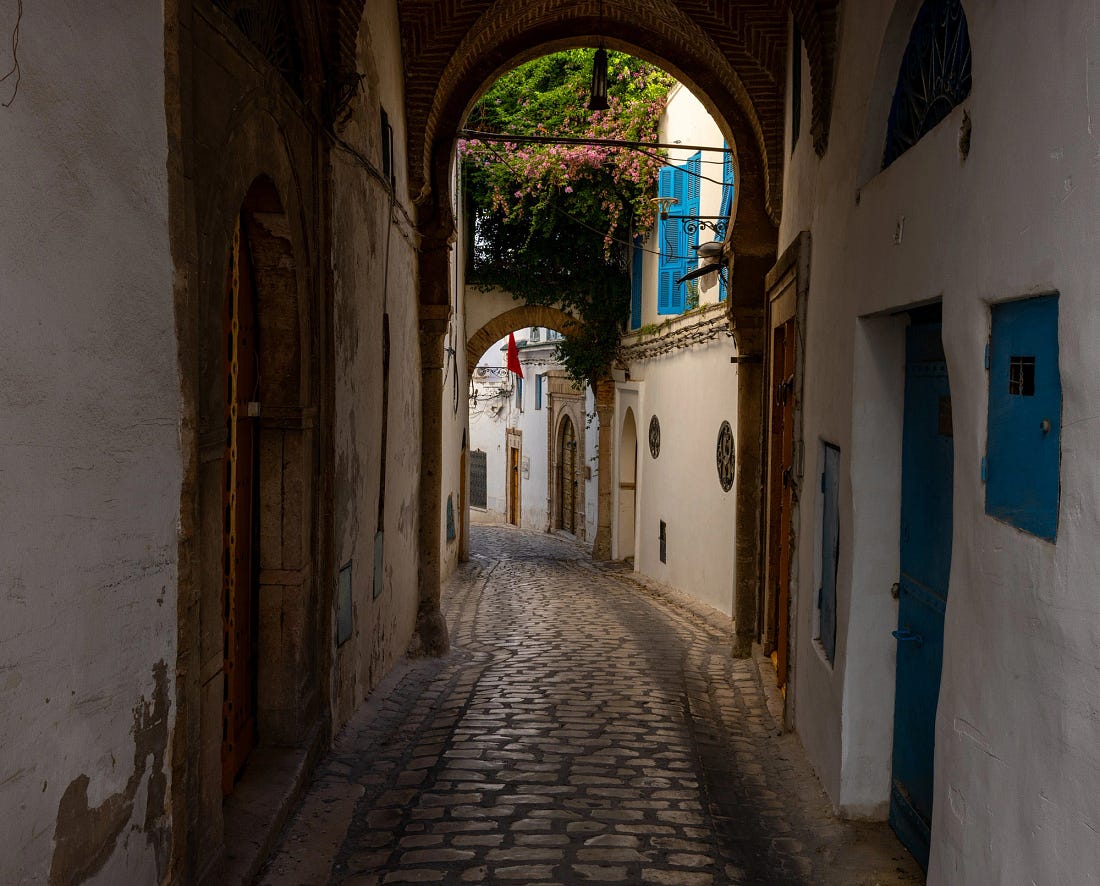
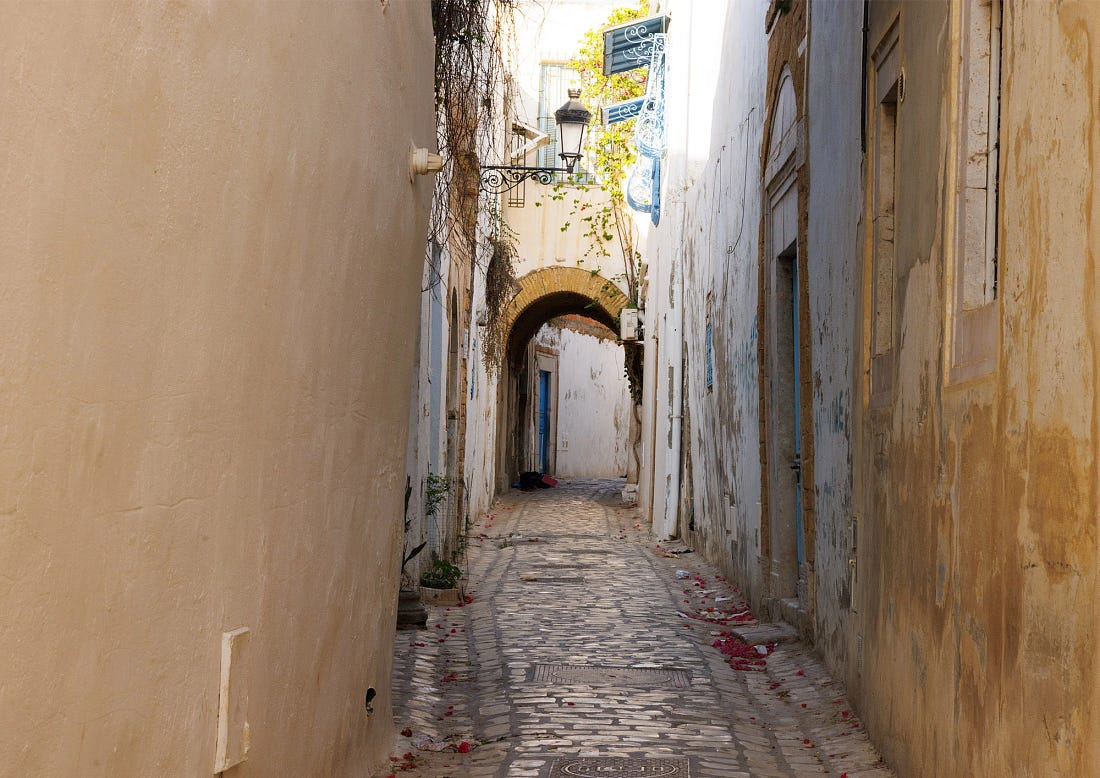
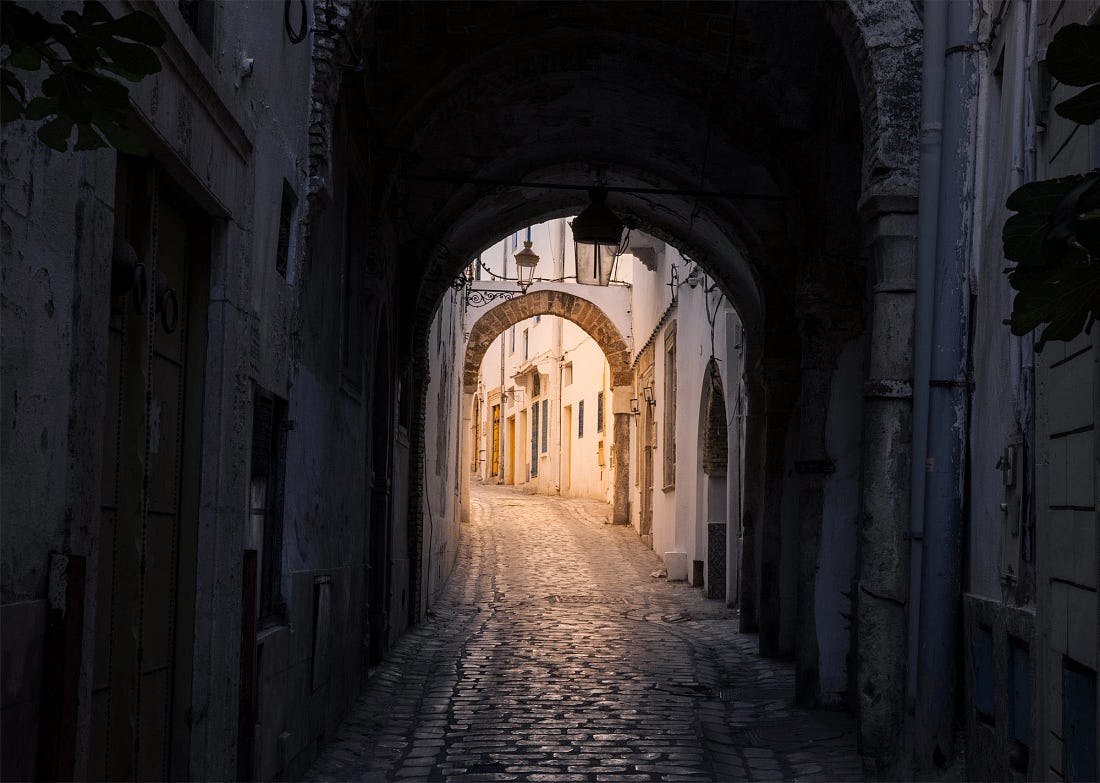
Rue MeffrejRue Meffrej slopes gently downhill. It is narrow, whitewashed, and quiet enough that your voice carries across it. Medinas were built this way on purpose, for conversation, public life, and private spaces, a form of urban design that assumes people belong to one another. Rue Meffrej is almost certainly one of the most striking medina streets anywhere in the Arab world. But alleys like this are under threat. Some are hollowed out by neglect, others gutted by speculative development, their courtyards split into luxury hotels or cheap souvenir corridors. Tunis’s medina survives because it is protected, legally, institutionally, deliberately as a UNESCO World Heritage site. Preservation requires laws, enforcement, funding, and public consent. It is not lost on me that societies willing to safeguard their cultural inheritance are often the same societies willing to tolerate argument, pluralism, and accountability. Culture survives best where power is constrained.
Rue Meffrej is a reminder that the medina is a living place, and that too is political. Tunisia’s 2011 experiment with democracy emerged from a deep, indigenous expectation that authority should answer to the people it governs. After the Arab Spring, the country drew on that Berber history. Elections were contested. Coalitions formed and fractured. Islamists governed alongside secularists. The press spoke freely. Civil society expanded. There was a renewed focus on a long-standing Tunisian notion that Women’s legal protections should be strengthened. LGBTQ+ Tunisians, long criminalized and forced into invisibility, began speaking aloud. Courts asserted independence. Power changed hands peacefully, a first in the modern Arab world. It was messy and loud, and it all mattered. Tunisia became the region’s first functioning democracy as it accepted uncertainty as the price of freedom. Argument replaced fear. Participation replaced obedience.
Tunisia had achieved something that all of the Arab world wants. Over the past two decades, repeated surveys across the Arab world have found that large majorities, often 70 to 85 percent, say democracy is the best form of government, and most see it as compatible with Islam. Most Arabs support secular governance, even if they reject secular identity, believing that religion should guide values, not control the state. The problem, these surveys find, is that Arabs don’t believe their own societies can achieve democracy because of embedded corruption and elite interests able to bend society to achieve their goals.
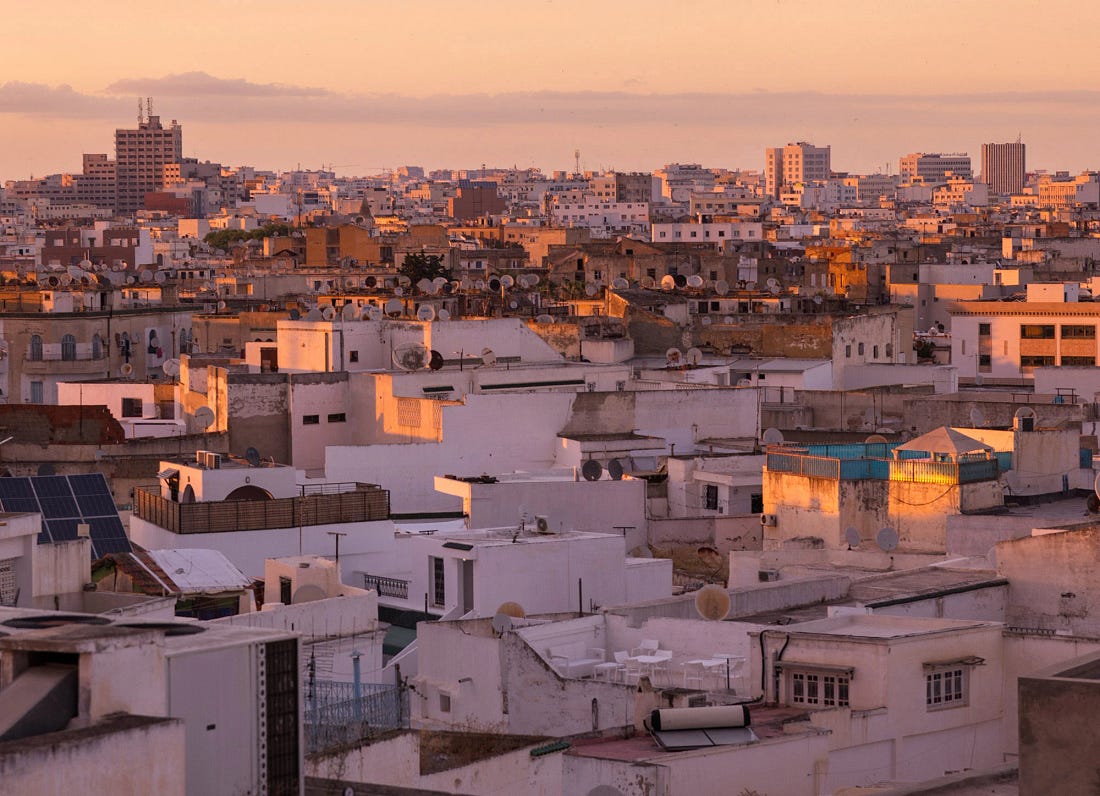
The RooftopOn our last night, we take the elevator up to The Rooftop above Dar El Jeld. It’s the only place inside the medina where you can order a beer. The view from the Rooftop Bar is stunning, an almost complete view of not only the medina below, but modern Tunis beyond. I tell Jane and Kellan to look out at the sky. If you look long enough, you’ll see not just swifts, but falcons and Night-Herons and maybe even flamingos. But mostly, it’s thousands of Common Swifts tearing through the sky overhead, looping and diving in the tangerine light. Scientists have learned that swifts can remain airborne for up to ten months at a time, eating, sleeping, and even mating in flight. They land only to breed. Gravity barely applies to them. For nearly two billion Muslims worldwide, Tunisia’s recent history was a living argument that pluralism, women’s rights, and secular governance are not foreign impositions. They are compatible, natural, and possible. The Tunisian Berbers maintained their proto-democracies for thousands of years, adapting in every way to the empires that invaded them while keeping the expectation that power should answer to the people. Tunisia’s democracy did not last. In 2021, President Kais Saied suspended parliament, ruled by decree, dismissed judges and rewrote the constitution to concentrate power. Democracy vanished before anyone realized it was gone. The world didn’t really notice until a man was sentenced to death for a Facebook post critical of the president. Tomorrow, we leave this city of light and beauty. In the weeks to come, Tunisian rage will boil over. Thousands of protests against one-man rule will erupt across the country. Tunisians are joining up, regardless of political affiliation, in massive numbers, and saying they want an end to one-man rule for good. If I could say anything to Tunisians now, it would be this. Authoritarianism has been stopped elsewhere recently by people who refused to treat power as permanent. South Koreans removed Yoon Suk Yeol through mass protest and constitutional process. Brazilians jailed Bolsonaro with a 27-year sentence for his attempted coup. He will die in jail. Polish voters reversed years of democratic erosion at the ballot box. And in Guatemala, judges, Indigenous movements, and international pressure blocked an attempt to nullify an election. The swifts keep flying. The medina settles into the night. Those little birds, just an evolutionary blip away from our New World hummingbirds, are, as individuals, just fragile things. Animals as elegance and muscle. Animals forever on the wing, the embodiment of freedom. Notes from the Road is free today. But if you enjoyed this post, you can tell Notes from the Road that their writing is valuable by pledging a future subscription. You won't be charged unless they enable payments.
|