A Walk in TunisIn the Tunis Medina, walking with my family becomes a lesson in how ideas of power either live or collapse across generations.
These notes can be read in full and high resolution on Notes from the Road. This is the second of a three part series on Tunisia. I am exhausted after a long day on the road. It’s that kind of good exhaustion that makes the changing out of hiking shoes into flip-flops as enticing as quenching thirst. I am just outside the Medina of Tunis. As I slip into this 1,300-year-old medina inside a 3,000-year-old city, the honking, the diesel smell, and the glare of asphalt and glass storefronts dissipate, and everything becomes quiet. Bougainvillea drape arched passageways, and cats, lots of them, sleep soundly in the afternoon heat. High in the sky, Common Swifts fly in sharp arcs. They never seem to land.
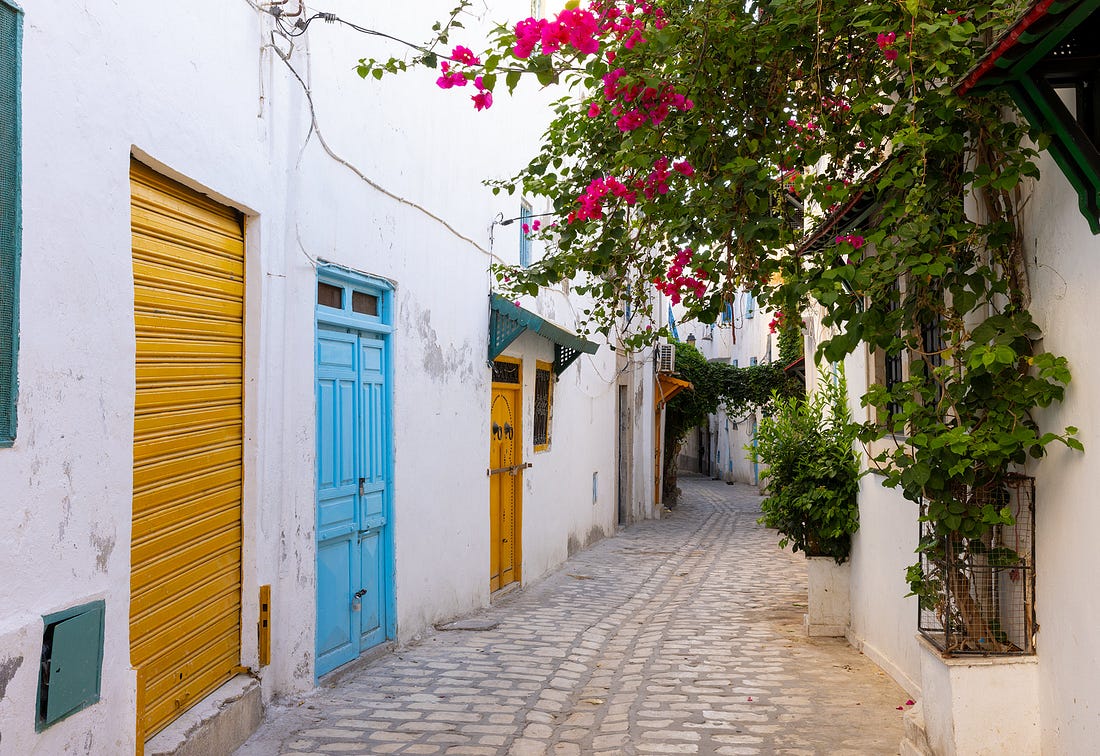
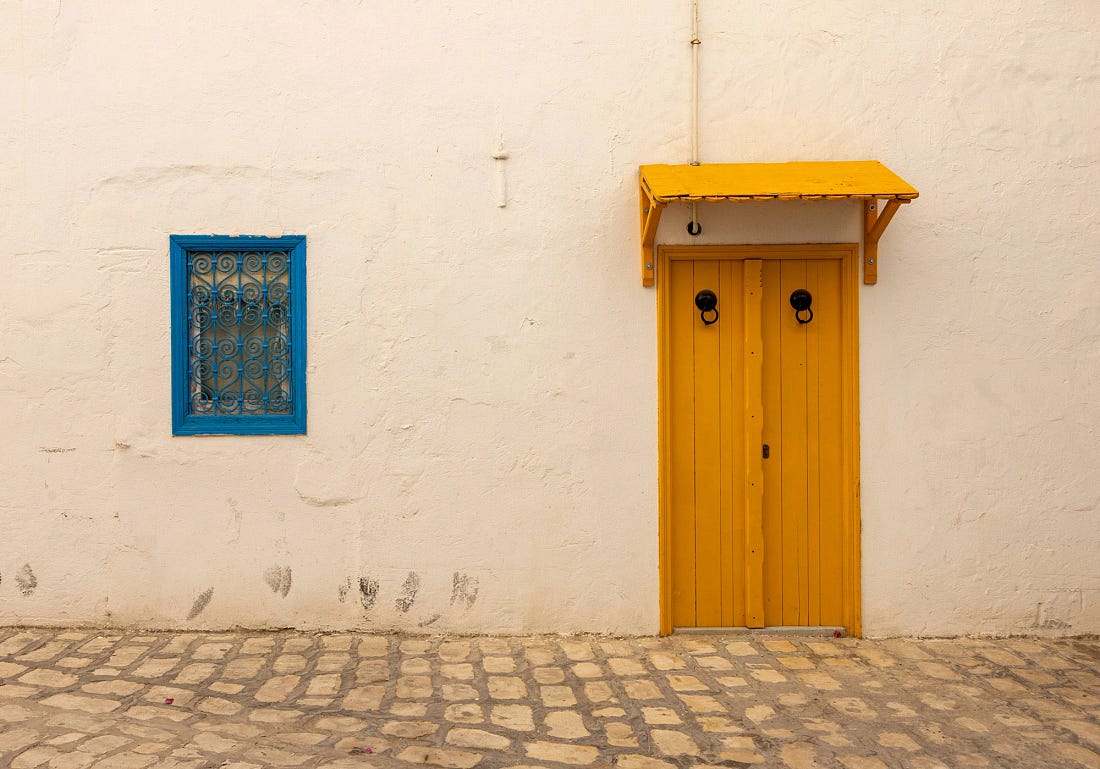
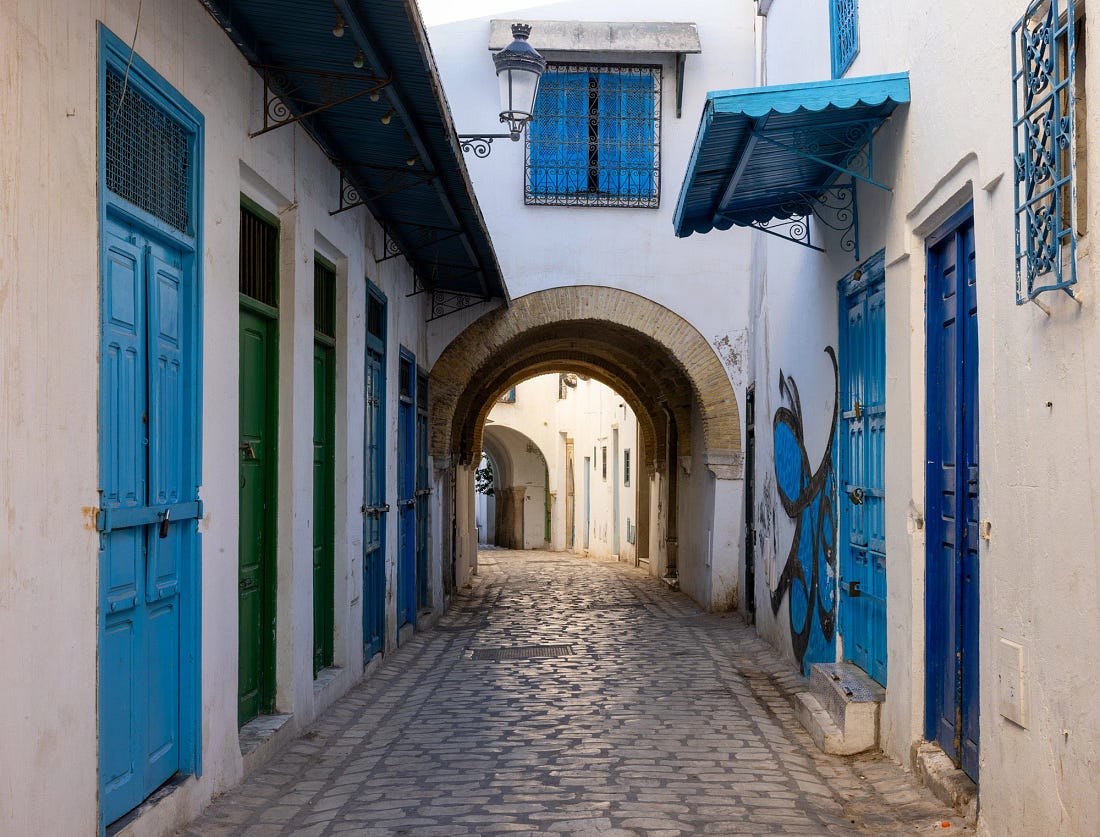
Rue Sidi Brahim RiahiThe home we rented is a sprawling 1800s courtyard dar. It had been featured in architectural coffee-table books and costs less than a night at a Motel 6. I enter through an unassuming door in the narrow whitewashed alley of Rue Sidi Brahim Riahi. Jane and Kellan have already learned their way around the medina, so Jane offers to help me find something to eat. We sit at a small outdoor table across the street from a tiny pizza shop, waiting for my tuna-and-olive pizza. Jane tells me about her day. Mostly, she wants to tell me about the cats. But when it’s my turn to talk, my mind keeps drifting thousands of miles away, back to the United States. I couldn’t avoid the news. Trump is testing how far the system can be bent, centralizing presidential power. The machinery meant to reckon with January 6, with an attempted theft of an election, is being dismantled piece by piece. Prosecutions of his political rivals are ramping up. Fake charges. Unscrupulous allies as prosecutors. What unsettles me most is not the audacity of it, but the absence of outrage, the inability of the system to work against the Founding Fathers’ greatest fear. Talking over this pizza, I realize how little I had understood democracy’s fragility. There are real forces committed to eroding it patiently, incrementally. Before you have the time to recognize the patterns, it has slipped away.
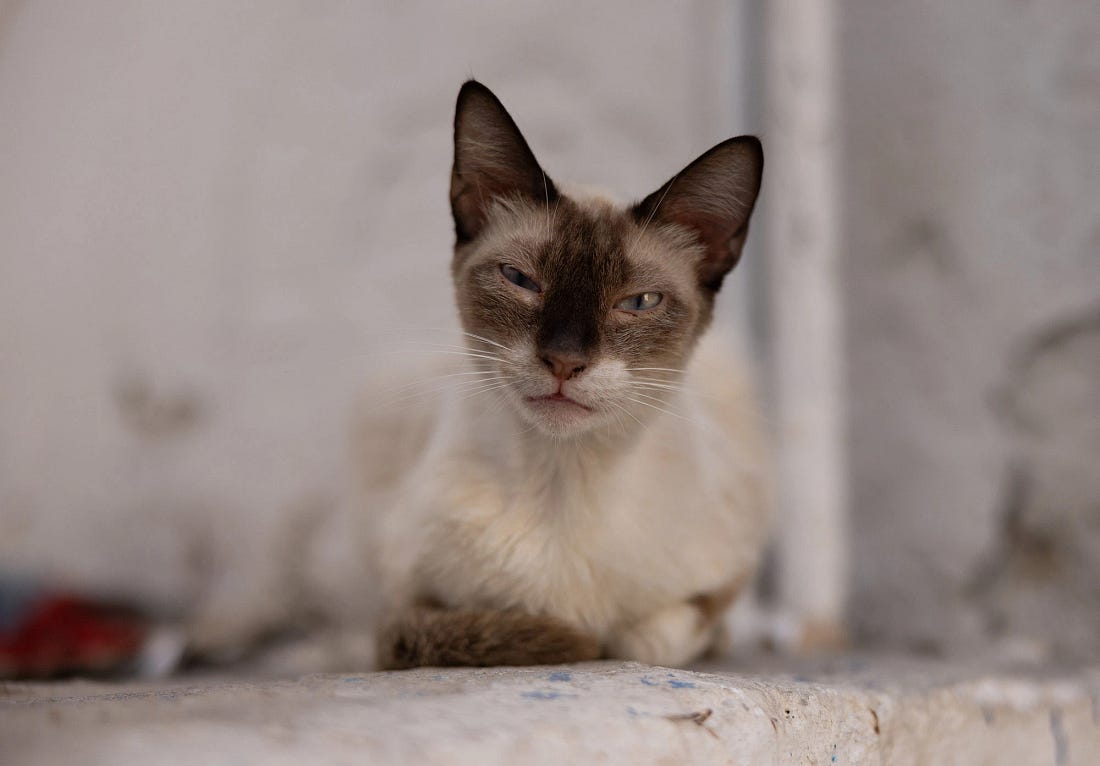
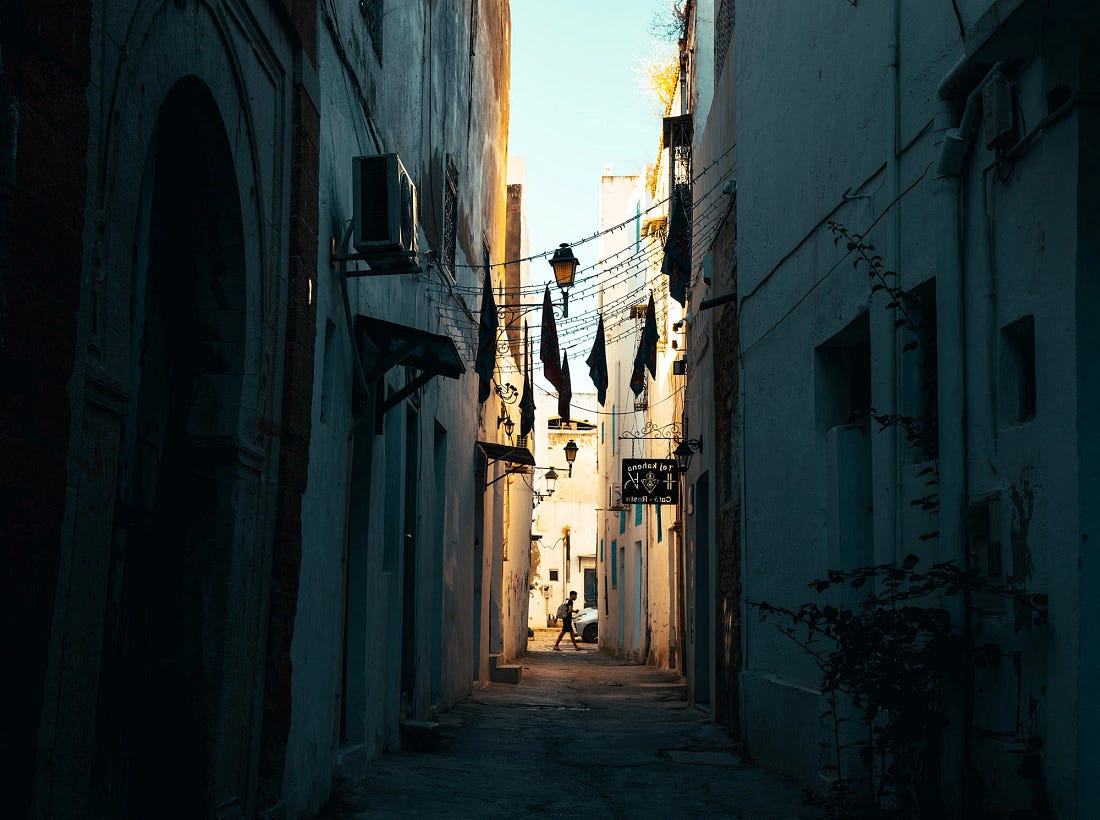
Rue Sidi SridekThere are different ways to travel. Ours is to avoid itineraries. We’ve all seen the other approach. Two days is plenty. Day One: visit a museum, then another, and a third, then quick authentic snack, suggested on TripAdvisor, another museum. Day Two: market at 9:00, panoramic viewpoint at 9:17, hidden gem at 9:42, taxi to the next city, 12:00. Photos, boxes checked, culture efficiently consumed. For us, it’s none of the above, but rather wandering in flip-flops, going nowhere, achieving nothing, petting alley cats. When Kellan asks if I want to do just exactly that, I’m thrilled. It’s an old habit from when he was small. Now, with college only weeks away, I wonder if there will ever be a time for us to pet alley cats together again. We take all the side alleys off Rue Sidi Sridek. We find a scrawny calico cat in a window, we feed a sleek, blue-eyed white cat, and watch a glossy black cat meowing for pets under a blue doorway. By doing nothing, we see things. People carrying groceries home, hundreds of shoes stacked outside a mosque. We hear that haunting call to prayer rising and falling through the lanes. Overhead, the swifts are looping through the sky. Rue Dar El JeldLater, while walking alone on Rue Dar El Jeld, a heavy fellow introduces himself, and we end up talking about Palestine, the one subject American travel blogs tell us not to talk about with Tunisians. I tell him about an idea I’ve been carrying for years. An idea of three layers of governance. A shared top-level authority above both Israel and Palestine, and then two separate governments beneath it. The key, I explain, is a sort of secularism made just for Israel and Palestine. The administrative executives may be agnostic, atheist, Hindu, Buddhist, but they must be foreign to the Middle East, and they must not be Jewish, Christian, or Muslim. That’s not a rejection of religions, I tried to say, but the only way to let the grievances of any one faith sit at the controls of power in a place where faith has already done so much damage. He listens, asks questions. He agrees with parts and disagrees with others. When I remark on his openness, he explains that Tunisians are different. He tells me he once lived in Vancouver, British Columbia, and Seattle, and that “you sure know how to protest in Portland!” He explains that people around the world tend to assume that Morocco is the most progressive and democratic country in the Arab world. “Not really true!” he says. “Morocco is very Western. But Morocco is a religious monarchy! Tunisia doesn’t have the same money that Morocco does, but democracy is more than money.” Later in our conversation, he says, “In Tunisia, people argue. They want you to listen. They want their voice to mean something.” As we say goodbye, I think about our conversation, and I try to remember my faint knowledge of the Tunisia that existed as I was growing up.
Zine El Abidine Ben Ali assumed power in a bloodless 1987 coup. It was a coup that he communicated was a necessary constitutional correction. He spoke calmly to Tunisians about law and order, stability, about protecting the nation from disorder. “Freedom does not mean disorder and chaos,” he would often say. Elections continued and arrived on schedule. The margins in favor of Ben Ali’s party were so large, the elections stopped being interesting. Opposition figures were permitted to exist, but only in ways that posed no risk. Outcomes became fixed. Politics shifted from competition to management. Ben Ali redistricted political voting boundaries to dilute opposition strongholds, and voting was tweaked so that rural communities had more voting power than urban communities. Urban voters were educated, had access to foreign media, and had more progressive ideas. Rural voters could be fed a managed narrative, a carrot dangled for them to follow. Daily life adjusted to increasing levels of authoritarianism. Phones were tapped and emails became records. Conversations became things you needed to have edited before you even talked. The Ministry of the Interior hovered over public life, always shaping behavior. Journalists, students, lawyers and educators learned that influence invited scrutiny, and scrutiny carried consequences. Ben Ali insisted Tunisia enjoyed freedom of expression. In his final address, he declared, “Do write on any subject you choose. There are no taboos except what is prohibited by law and press ethics.” The line said it all. Ethics were defined from above. Bloggers were arrested. Journalists were harassed or jailed. Websites vanished.
The courts remained open. Judges wore robes. Procedures were followed. But prosecution became selective and political. Detention could stretch on without explanation. Charges could be vague enough to fit almost anyone. Families learned that asking questions publicly invited attention. Innocence offered no insulation. Alignment did. Plainclothed security forces operated with wide latitude. Men without badges could smash your car window and ask for your ID. Human rights organizations documented torture and severe abuse for years. Beatings, electric shocks, sleep deprivation, and psychological pressure were methods used in one way to punish detainees, but in another to instruct everyone else on how they should behave. Fear worked best when it was visible enough to be imagined everywhere. Certain groups were targeted more deliberately than others. LGBTQ Tunisians were subject to the harshest criminal law. Same-sex relationships were illegal, punishable by prison. Police raids were common. Arrests were often accompanied by humiliating “medical examinations,” forced confessions, blackmail, and public exposure. The state framed these actions as moral enforcement, not repression, as protection of values, not punishment of identity. LGBTQ people became both illegal and unspeakable, threats, not citizens. The same narrowing applied racially. Sub-Saharan African migrants, people who were workers, refugees, or just people passing through, were increasingly framed by the Ben Ali administration as a threat to national identity and social order. They were tolerated when economically useful, aggressively policed when convenient, and blamed publicly for strain they did not create. Cooperation with European governments turned migration control into leverage. Racism went unchallenged. Abuse went unpunished. Belonging was quietly racialized. Ben Ali, who saw them as vectors of disease and illegality, began policies of remigration, sending sub-Saharan Africans back to ‘where they belonged’ in order to protect Tunisia’s identity, maintain social cohesion, and defend public order, all while combating illegal migration.
On the international stage, Tunisia signed environmental accords and delivered speeches about sustainability, development, and climate adaptation. The vocabulary was polished. On the surface, Tunisia sounds modern, aligned with the world on global scientific consensus and multilateral goals. But it was all smoke and mirrors. Scientific institutions were tightly controlled by the state. Research was permitted, but only if it supported economic growth, tourism, or Ben Ali’s development narratives. Studies that challenged pollution, land misuse, industrial corruption, or public health risks that challenged Ben Ali’s powerful friends disappeared. Environmental degradation, especially in industrial regions, was treated as an inconvenience. The economy followed a parallel logic. Ben Ali’s inner circle, especially the extended family of his wife, Leïla Trabelsi, consolidated control over major sectors. Licenses, contracts, land, and businesses shifted into friendly hands. U.S. diplomatic cables later described Tunisia as a “kleptocracy.” Wealth rose quickly at the top while opportunity narrowed everywhere else. Young Tunisians felt this most sharply. Degrees accumulated, but jobs did not. Entrepreneurship stalled unless it aligned with the right networks. Interior regions understood what coastal cities pretended not to see. Effort alone offered no protection. A single administrative decision could erase years of work. Civil society was managed accordingly. Unions were monitored. NGOs infiltrated or neutralized. Human rights advocates smeared as destabilizers. Protest framed as irresponsibility, even treason. Ben Ali spoke constantly of unity, but unity meant compliance. Order meant silence. Soon, Ben Ali started ordering his rise to power placed on street and boulevard names and public buildings. Sometimes renamed after himself. More often, places of culture were renamed for the date he assumed power. One of the most central places in Tunis, the “Avenue de la République,” was renamed “Avenue 7 Novembre 1987,” the day he assumed power. By the final years of his rule, Tunisia looked calm from the outside. Controlled media, polished infrastructure, predictable politics. But inside, it was something very different. It had become a nation of surveillance, scapegoating, the policing of identity, and the containment of knowledge in order to function. It was a nation that had to be told, again and again that only one man, one circle, one voice could be trusted to protect the nation from chaos. Continued on December 24. Notes from the Road is free today. But if you enjoyed this post, you can tell Notes from the Road that their writing is valuable by pledging a future subscription. You won't be charged unless they enable payments.
|