Time in the Tunis Medina, Part IIIn the Tunis Medina, walking with my family becomes a lesson in how ideas of power either live or collapse across generations. Part II
These notes conclude from Zaghouan to Sebhet Sejoumi and Time in the Tunis Medina, Part I. Part II online here. Place du 14 JanvierWe’re headed out to Carthage, and I’m sitting beside Tahir in his aging taxi as we idle near Place du 14 Janvier. The palm-lined boulevard opens wide around the Tunis Clock Tower. “Here,” Tahir says, nodding toward the square. “The revolution!” I didn’t anticipate that we would drive through here, this place that fifteen years ago was called “Avenue 7 Novembre 1987,” back when I was glued to the footage that ran from this place…grainy videos, crowds spilling down Avenue Habib Bourguiba, chants I didn’t understand.
It all began 185 miles south of here in a central Tunisian interior town called Sidi Bouzid. Like many other places, it was long neglected under Ben Ali, far from the dazzle of the coast. Sidi Bouzid was poor, and young, and overeducated, and Ben Ali’s government ignored it. On December 17, 2010, Mohamed Bouazizi, a 26-year-old fruit vendor, pushed his fruitcart out into the street, selling apples and bananas and any other fruit he could buy on credit. He did not have a permit. Almost no one like him did. Permits were a currency of power that were selectively enforced, a way to remind people where they stood. That morning, municipal police stopped him. His cart was confiscated. He protested. In many retellings of what happened that day, a female police officer slaps him in the face. A tiny slice of official cruelty, ordinary, casual, bureaucratic. But made unbearable by the fact that it was also his livelihood. Bouazizi, who had a diploma, had been supporting his family since his father’s death. He had no job in the formal economy, no leverage, no obvious path forward. He did what people are told to do in functioning states. He went to the local governor’s office to complain, to ask for his cart back, to ask to be heard. Nobody was willing to listen. Not long afterward, standing outside that building, Bouazizi poured paint thinner over himself and lit a match.
He did not die immediately. He lived for days in a hospital burn unit in Tunis, his body failing in slow motion while his name spread fast. Sidi Bouzid exploded with protest almost immediately. These protests were not ideological, nor paid, nor organized or scripted. They were raw and local. People marching for work, for dignity, against corruption, against the daily contempt that had hardened into normal. Security forces responded in the familiar authoritarian way, with pepper spray, batons, smashing driver’s windows, arrests, then bullets. Videos leaked. Funerals turned into rallies. Towns that had learned silence out of habit began speaking aloud. The protests moved north, town by town, following roads more than slogans. And then they reached Tunis, where the ministries are, the cameras are, the embassies are. They converged here, at this wide boulevard, where a crowd can become a nation, and a nation can suddenly refuse to be managed. Tunis had become a Boston Tea Party, saying no to Kings, a refrain of a thousand Berber routes for thousands of years. January 14, 2011. Ben Ali, curdled by power into a nasty authoritarian, flees. And then, after that, the fire of the story leaps borders. Like fire, it doesn’t leap because of policy or ideology. It travels because it’s feeding, like fire feeds, on organic material, on hydrocarbons, on people. If Tunisians could make a dictator run like a chicken kicked in the rear-end, then perhaps this illusion of the permanent Arab state was a fraud. In Egypt, crowds gathered in Tahrir Square. In Libya, protests escalated into war. In Yemen, Bahrain, Syria, everybody began to ask the same question: What if fear is not actually the strongest thing in the room? I remember how I felt watching this on TV. The naïve thrill that progressivism, secularism, and democracy were spreading through a region that needed accountable institutions as urgently as anywhere on earth. I wanted it to be that simple. When I ask Tahir how things are going, he turns to me and says, “We tasted freedom.” Above the square, swifts streak past the tower, fast and unbothered by borders or dates or decrees.
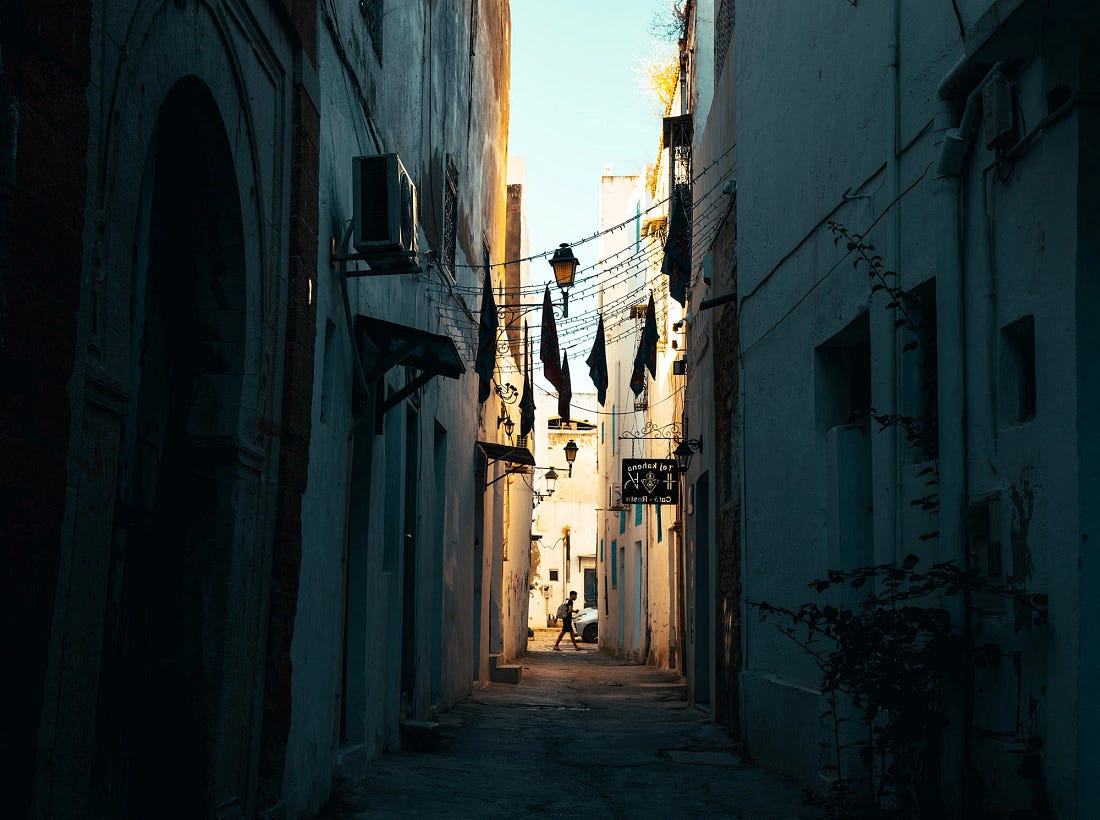
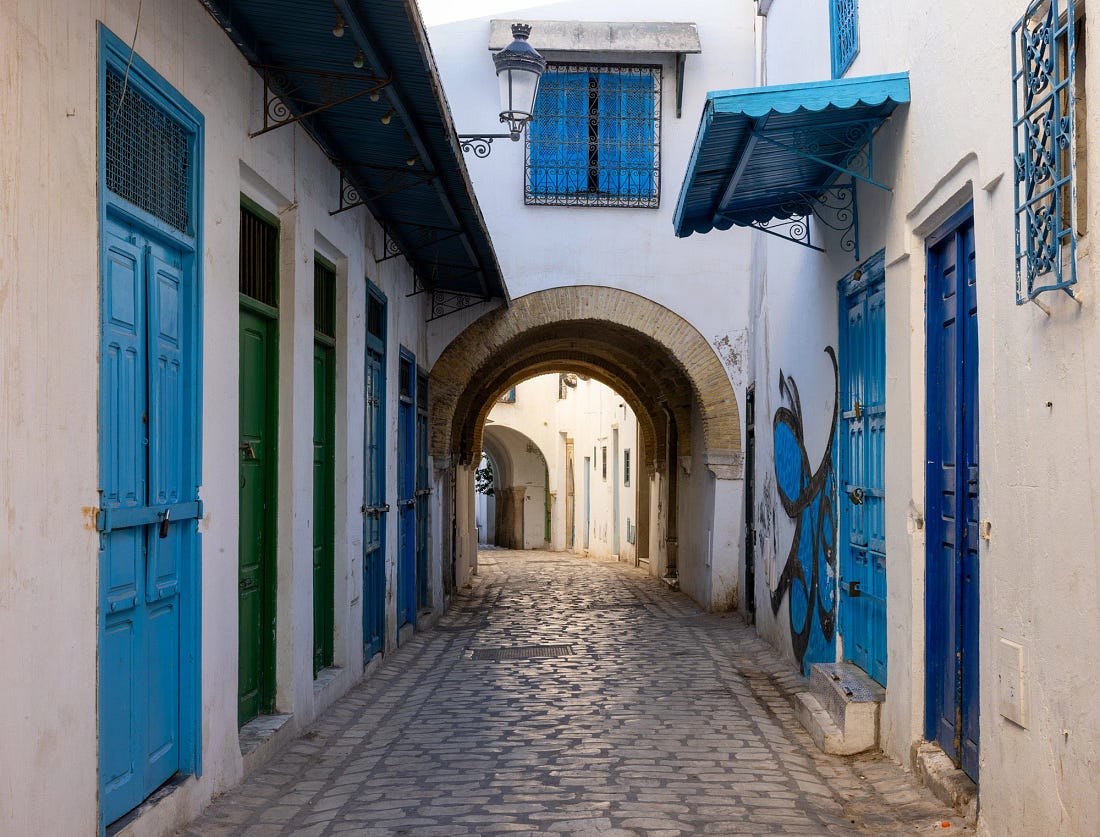
Rue Sidi Ben ArousI walk with Jane and Kellan slowly down Rue Sidi Ben Arous, the spiritual spine of the medina. The light turns the soft orange of evening. Street lamps start to flicker on. We’re looking for dinner. Jane points out doorways. Kellan lingers behind, crouching with the cats. Jane and I have had Tunisia in our sphere throughout our marriage, mostly for the food. Long ago, when Kellan was just a wee tot, I attempted several times to make brik, and Jane, perhaps inspired through her Korean heritage of hot pepper pastes and our family love for hot sauce, embraced harissa years ago. Harissa, which on the surface resembles Korean gochujang, is often incorrectly attributed as a Moroccan or Maghrebi ingredient, but Jane, while making shakshuka or even harissa with olive oil and bread, always points out that harissa is purely Tunisian. Through our love for artisanal cheeses, we slowly discovered that the global history of cheese is dependent on its Berber history. By the time we had worked our way from harissa to brik to olive oil and goat cheese, I started to see this food as more of a story of ancient history. It was this food that helped me to learn how Berber societies actually organized themselves long before modern states ever existed here. These ancient foods were not born under kingdoms ruled by divine right or empires imposed from afar. They came from communities that survived by deciding things together. Across much of North Africa, Berbers governed themselves through local assemblies, councils of adult villagers who met in designated spaces to argue and deliberate. They settled disputes, set customary law, organized irrigation and grazing rights, and determined how collective labor would be shared. Nothing was secret. Nothing was distant.
Leadership was provisional. Village chiefs were selected by the assembly and treasurers managed communal funds that came from fines or shared contributions. They were expected to account for every coin. Authority could be taken away by the people, and decisions could be revisited. Power lived close to the ground, exercised in public, sustained only by consent. In desert and pastoral regions, similar assemblies governed trade routes, seasonal movement, and conflict resolution. The expectation was not obedience but participation. Law was not handed down from a ruler. It emerged from precedent, negotiation, and collective memory. These systems were imperfect and exclusionary by modern standards. Women were often left out of formal assemblies. But they embedded something crucial. The idea that the government was something people did together. Through all this Berber history, there were empires that layered over this. There were Roman administrators, Arab caliphates, Ottoman governors, French colonial bureaucracies. But underneath all those formal institutions, there persisted a cultural expectation that leaders must answer, that power should be limited, and that rule without consent is fragile. Once I understood this, the food made more sense. Harissa, bread, oil, and cheese are not culinary luxuries. They are practical, communal, negotiated, the edible expression of a society that learned early that survival depends on sharing, arguing, and deciding together.
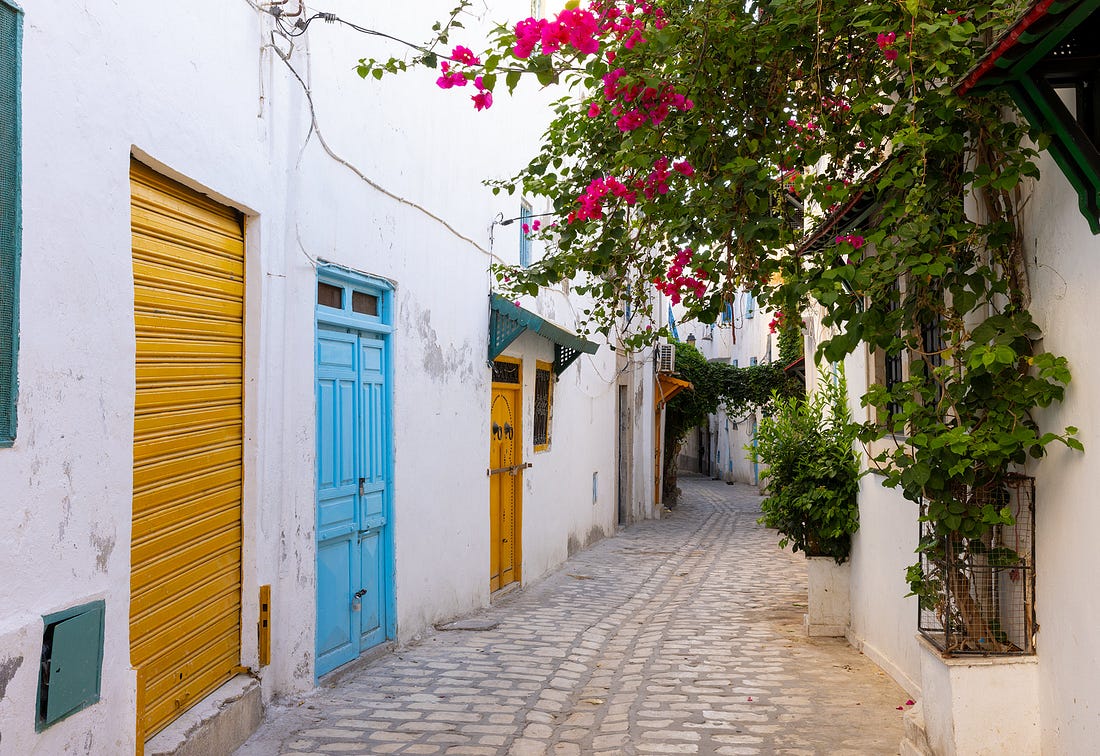
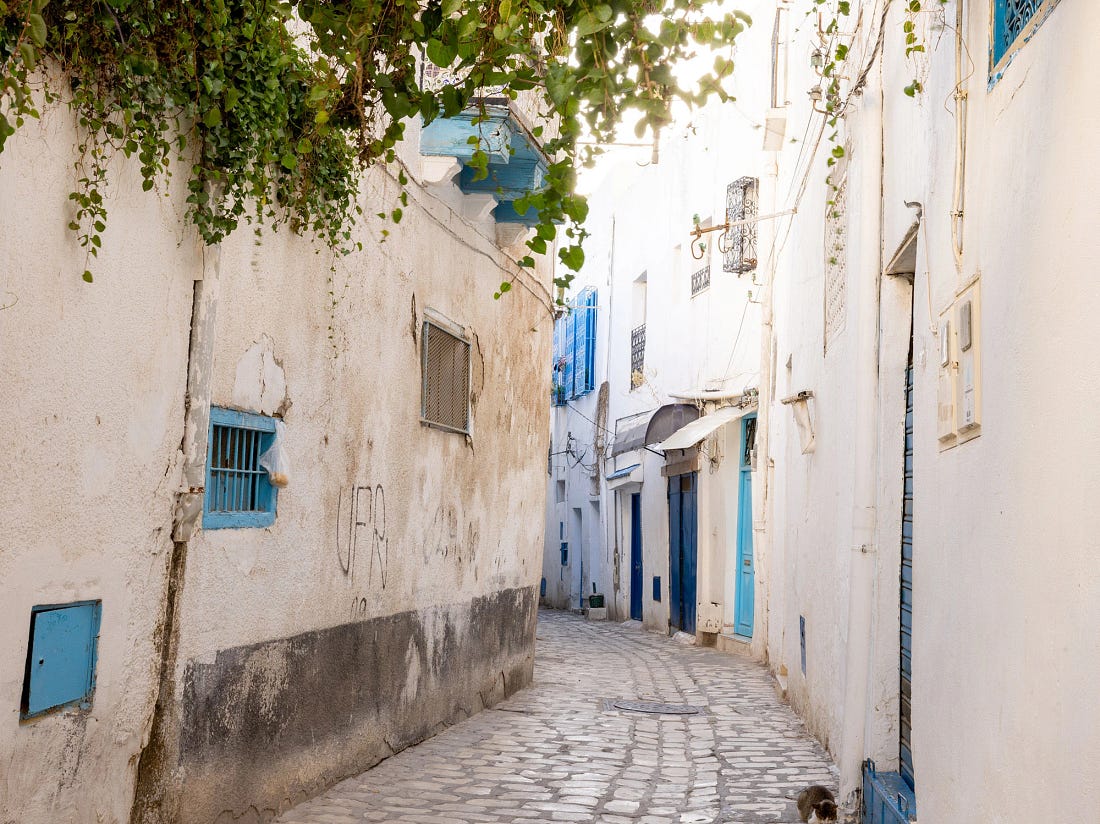
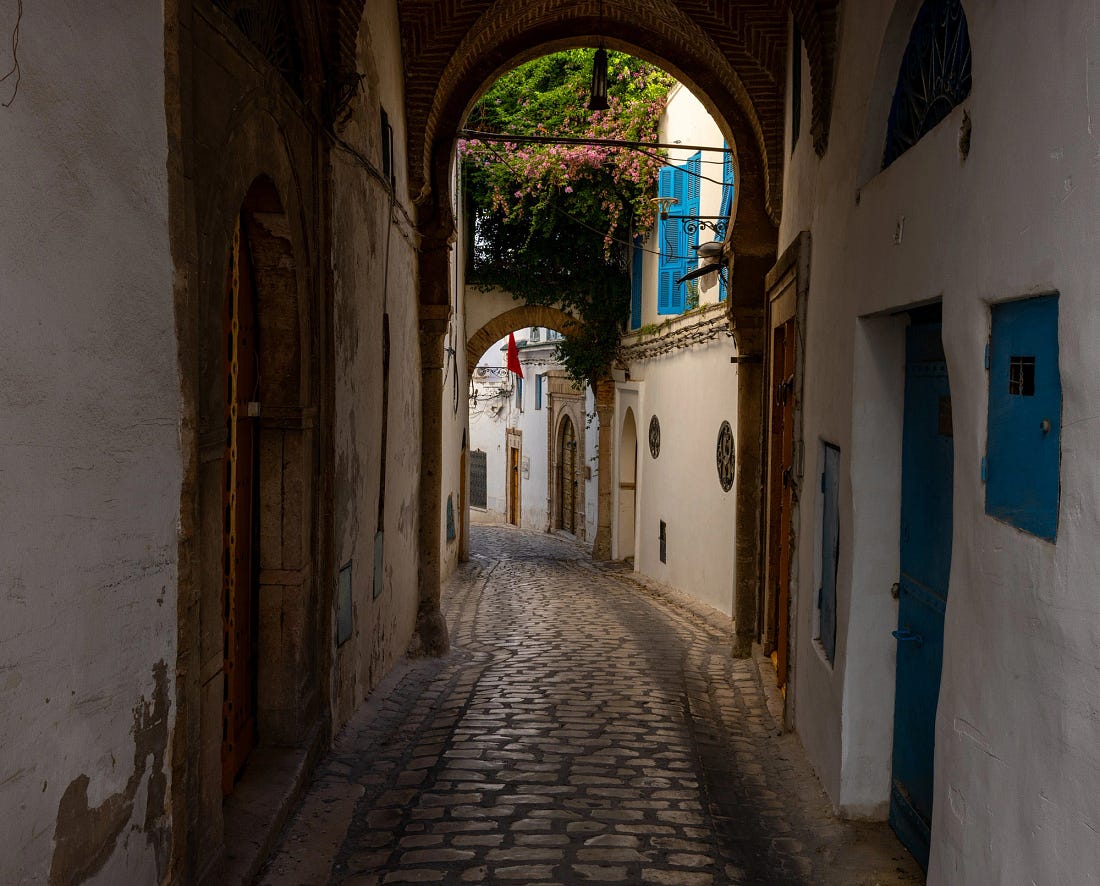
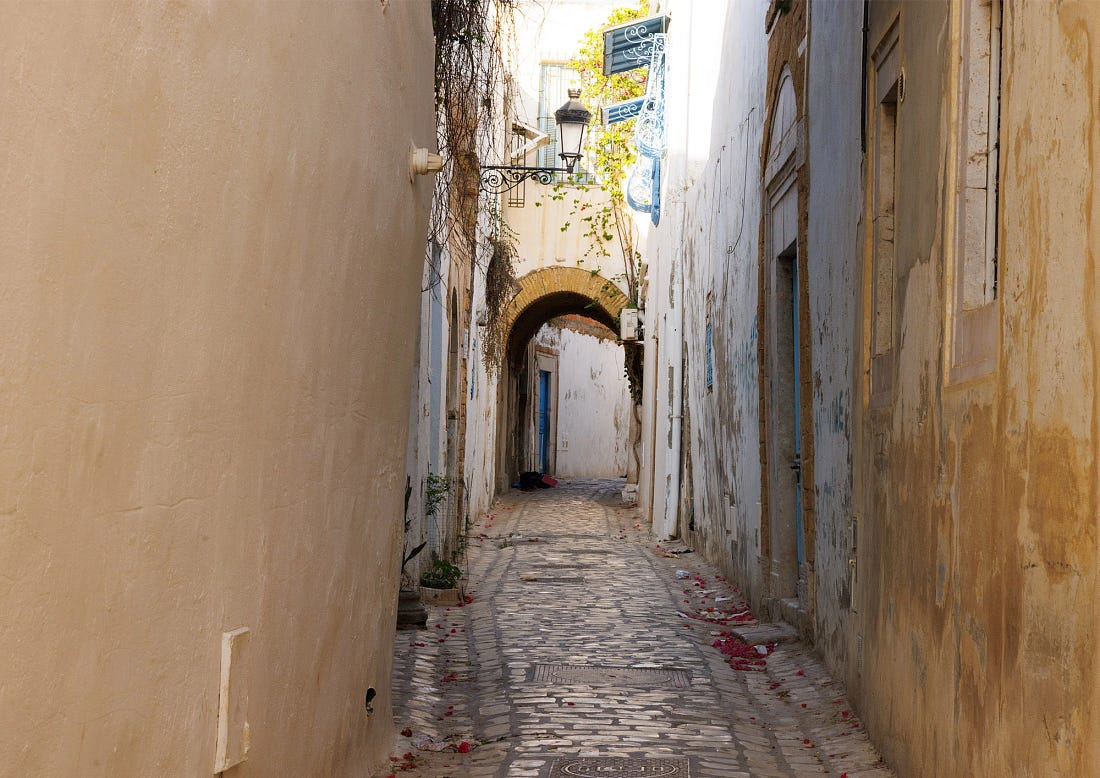
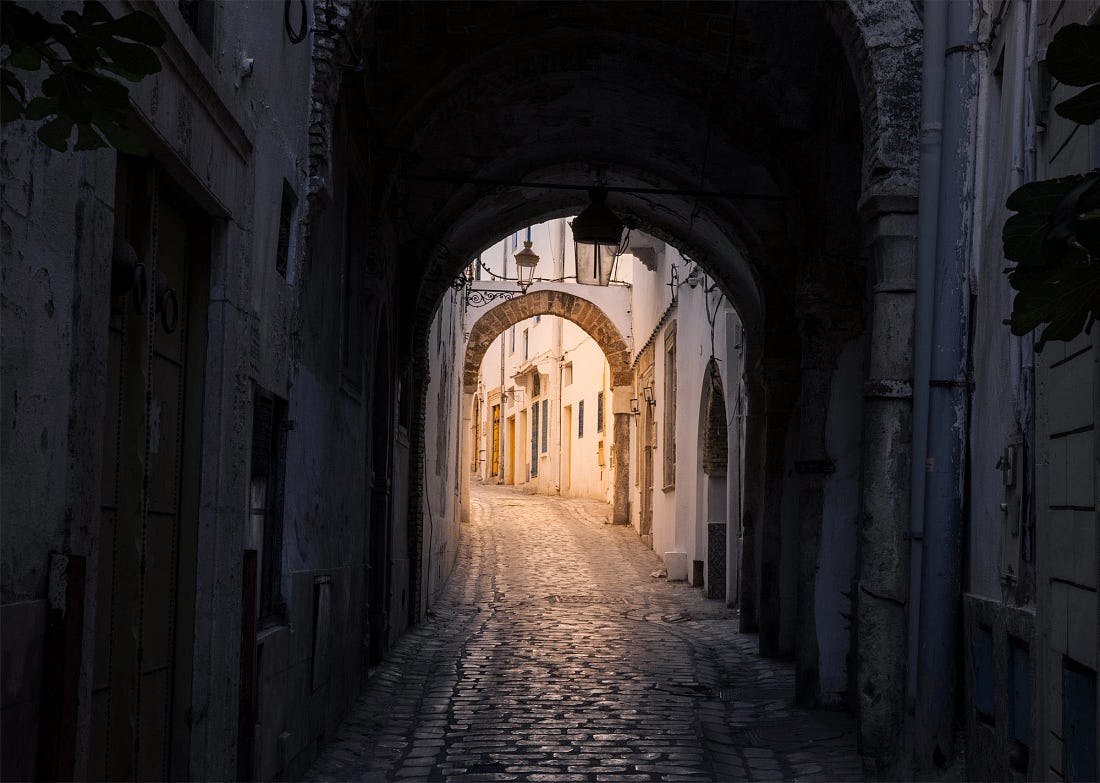
Rue MeffrejRue Meffrej slopes gently downhill. It is narrow, whitewashed, and quiet enough that your voice carries across it. Medinas were built this way on purpose, for conversation, public life, and private spaces, a form of urban design that assumes people belong to one another. Rue Meffrej is almost certainly one of the most striking medina streets anywhere in the Arab world. But alleys like this are under threat. Some are hollowed out by neglect, others gutted by speculative development, their courtyards split into luxury hotels or cheap souvenir corridors. Tunis’s medina survives because it is protected, legally, institutionally, deliberately as a UNESCO World Heritage site. Preservation requires laws, enforcement, funding, and public consent. It is not lost on me that societies willing to safeguard their cultural inheritance are often the same societies willing to tolerate argument, pluralism, and accountability. Culture survives best where power is constrained.
Rue Meffrej is a reminder that the medina is a living place, and that too is political. Tunisia’s 2011 experiment with democracy emerged from a deep, indigenous expectation that authority should answer to the people it governs. After the Arab Spring, the country drew on that Berber history. Elections were contested. Coalitions formed and fractured. Islamists governed alongside secularists. The press spoke freely. Civil society expanded. There was a renewed focus on a long-standing Tunisian notion that Women’s legal protections should be strengthened. LGBTQ+ Tunisians, long criminalized and forced into invisibility, began speaking aloud. Courts asserted independence. Power changed hands peacefully, a first in the modern Arab world. It was messy and loud, and it all mattered. Tunisia became the region’s first functioning democracy as it accepted uncertainty as the price of freedom. Argument replaced fear. Participation replaced obedience.
Tunisia had achieved something that all of the Arab world wants. Over the past two decades, repeated surveys across the Arab world have found that large majorities, often 70 to 85 percent, say democracy is the best form of government, and most see it as compatible with Islam. Most Arabs support secular governance, even if they reject secular identity, believing that religion should guide values, not control the state. The problem, these surveys find, is that Arabs don’t believe their own societies can achieve democracy because of embedded corruption and elite interests able to bend society to achieve their goals.
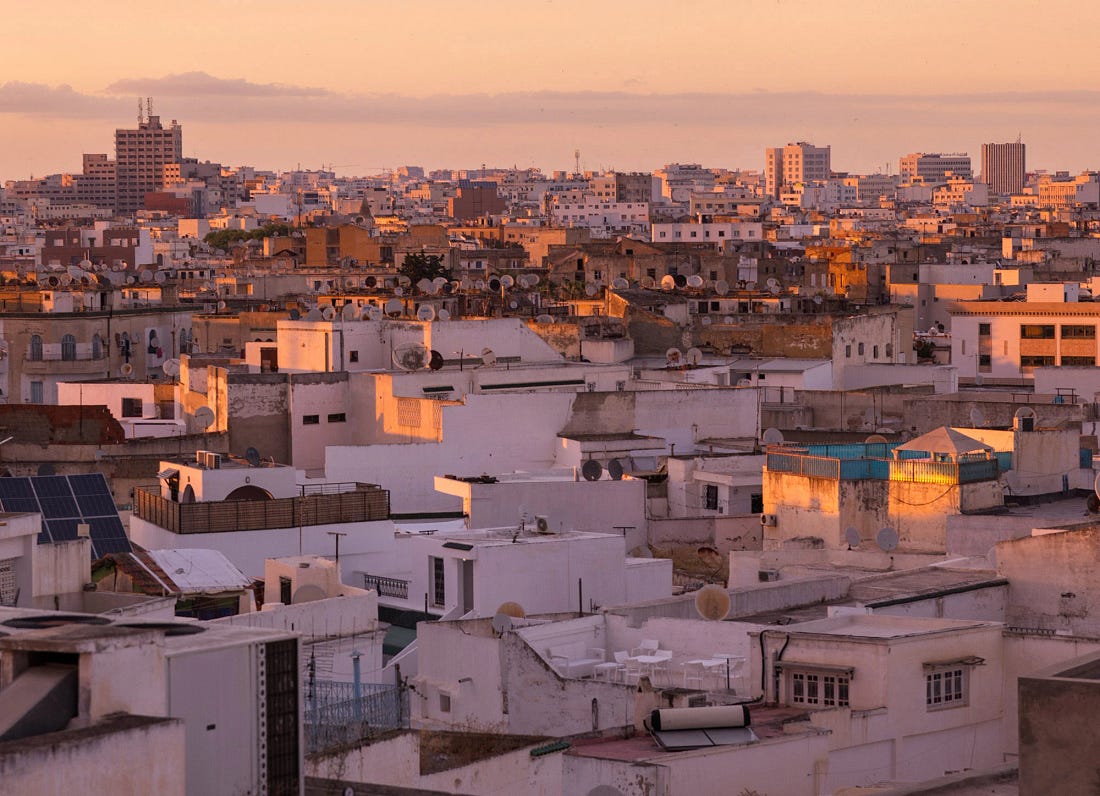
The RooftopOn our last night, we take the elevator up to The Rooftop above Dar El Jeld. It’s the only place inside the medina where you can order a beer. The view from the Rooftop Bar is stunning, an almost complete view of not only the medina below, but modern Tunis beyond. I tell Jane and Kellan to look out at the sky. If you look long enough, you’ll see not just swifts, but falcons and Night-Herons and maybe even flamingos. But mostly, it’s thousands of Common Swifts tearing through the sky overhead, looping and diving in the tangerine light. Scientists have learned that swifts can remain airborne for up to ten months at a time, eating, sleeping, and even mating in flight. They land only to breed. Gravity barely applies to them. For nearly two billion Muslims worldwide, Tunisia’s recent history was a living argument that pluralism, women’s rights, and secular governance are not foreign impositions. They are compatible, natural, and possible. The Tunisian Berbers maintained their proto-democracies for thousands of years, adapting in every way to the empires that invaded them while keeping the expectation that power should answer to the people. Tunisia’s democracy did not last. In 2021, President Kais Saied suspended parliament, ruled by decree, dismissed judges and rewrote the constitution to concentrate power. Democracy vanished before anyone realized it was gone. The world didn’t really notice until a man was sentenced to death for a Facebook post critical of the president. Tomorrow, we leave this city of light and beauty. In the weeks to come, Tunisian rage will boil over. Thousands of protests against one-man rule will erupt across the country. Tunisians are joining up, regardless of political affiliation, in massive numbers, and saying they want an end to one-man rule for good. If I could say anything to Tunisians now, it would be this. Authoritarianism has been stopped elsewhere recently by people who refused to treat power as permanent. South Koreans removed Yoon Suk Yeol through mass protest and constitutional process. Brazilians jailed Bolsonaro with a 27-year sentence for his attempted coup. He will die in jail. Polish voters reversed years of democratic erosion at the ballot box. And in Guatemala, judges, Indigenous movements, and international pressure blocked an attempt to nullify an election. The swifts keep flying. The medina settles into the night. Those little birds, just an evolutionary blip away from our New World hummingbirds, are, as individuals, just fragile things. Animals as elegance and muscle. Animals forever on the wing, the embodiment of freedom. Notes from the Road is free today. But if you enjoyed this post, you can tell Notes from the Road that their writing is valuable by pledging a future subscription. You won't be charged unless they enable payments.
|
Wednesday, December 24, 2025
Time in the Tunis Medina, Part II





Monday, December 22, 2025
A Walk in Tunis
A Walk in TunisIn the Tunis Medina, walking with my family becomes a lesson in how ideas of power either live or collapse across generations.
These notes can be read in full and high resolution on Notes from the Road. This is the second of a three part series on Tunisia. I am exhausted after a long day on the road. It’s that kind of good exhaustion that makes the changing out of hiking shoes into flip-flops as enticing as quenching thirst. I am just outside the Medina of Tunis. As I slip into this 1,300-year-old medina inside a 3,000-year-old city, the honking, the diesel smell, and the glare of asphalt and glass storefronts dissipate, and everything becomes quiet. Bougainvillea drape arched passageways, and cats, lots of them, sleep soundly in the afternoon heat. High in the sky, Common Swifts fly in sharp arcs. They never seem to land.
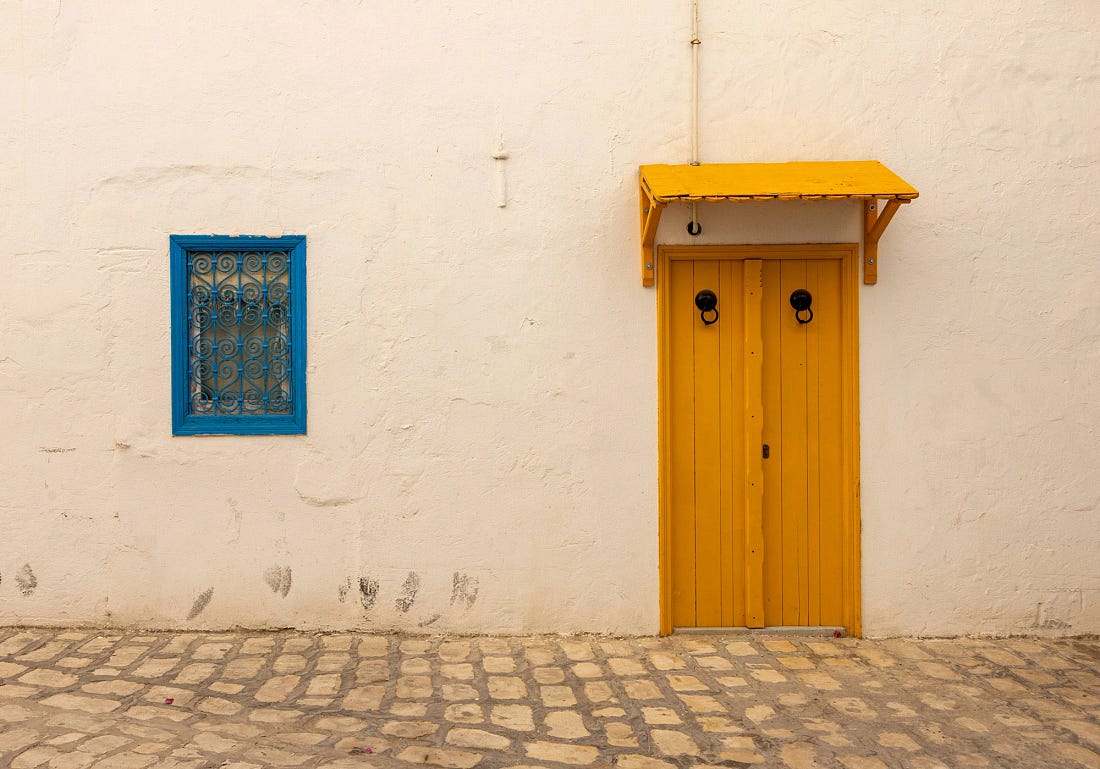
Rue Sidi Brahim RiahiThe home we rented is a sprawling 1800s courtyard dar. It had been featured in architectural coffee-table books and costs less than a night at a Motel 6. I enter through an unassuming door in the narrow whitewashed alley of Rue Sidi Brahim Riahi. Jane and Kellan have already learned their way around the medina, so Jane offers to help me find something to eat. We sit at a small outdoor table across the street from a tiny pizza shop, waiting for my tuna-and-olive pizza. Jane tells me about her day. Mostly, she wants to tell me about the cats. But when it’s my turn to talk, my mind keeps drifting thousands of miles away, back to the United States. I couldn’t avoid the news. Trump is testing how far the system can be bent, centralizing presidential power. The machinery meant to reckon with January 6, with an attempted theft of an election, is being dismantled piece by piece. Prosecutions of his political rivals are ramping up. Fake charges. Unscrupulous allies as prosecutors. What unsettles me most is not the audacity of it, but the absence of outrage, the inability of the system to work against the Founding Fathers’ greatest fear. Talking over this pizza, I realize how little I had understood democracy’s fragility. There are real forces committed to eroding it patiently, incrementally. Before you have the time to recognize the patterns, it has slipped away.
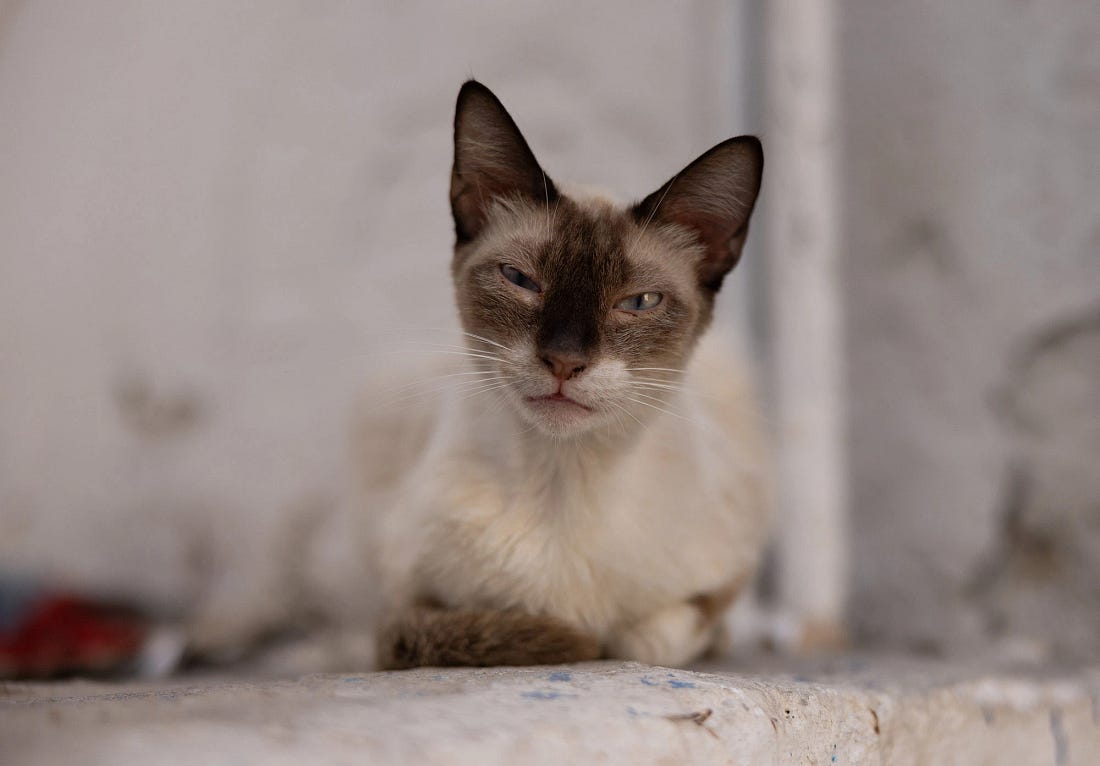
Rue Sidi SridekThere are different ways to travel. Ours is to avoid itineraries. We’ve all seen the other approach. Two days is plenty. Day One: visit a museum, then another, and a third, then quick authentic snack, suggested on TripAdvisor, another museum. Day Two: market at 9:00, panoramic viewpoint at 9:17, hidden gem at 9:42, taxi to the next city, 12:00. Photos, boxes checked, culture efficiently consumed. For us, it’s none of the above, but rather wandering in flip-flops, going nowhere, achieving nothing, petting alley cats. When Kellan asks if I want to do just exactly that, I’m thrilled. It’s an old habit from when he was small. Now, with college only weeks away, I wonder if there will ever be a time for us to pet alley cats together again. We take all the side alleys off Rue Sidi Sridek. We find a scrawny calico cat in a window, we feed a sleek, blue-eyed white cat, and watch a glossy black cat meowing for pets under a blue doorway. By doing nothing, we see things. People carrying groceries home, hundreds of shoes stacked outside a mosque. We hear that haunting call to prayer rising and falling through the lanes. Overhead, the swifts are looping through the sky. Rue Dar El JeldLater, while walking alone on Rue Dar El Jeld, a heavy fellow introduces himself, and we end up talking about Palestine, the one subject American travel blogs tell us not to talk about with Tunisians. I tell him about an idea I’ve been carrying for years. An idea of three layers of governance. A shared top-level authority above both Israel and Palestine, and then two separate governments beneath it. The key, I explain, is a sort of secularism made just for Israel and Palestine. The administrative executives may be agnostic, atheist, Hindu, Buddhist, but they must be foreign to the Middle East, and they must not be Jewish, Christian, or Muslim. That’s not a rejection of religions, I tried to say, but the only way to let the grievances of any one faith sit at the controls of power in a place where faith has already done so much damage. He listens, asks questions. He agrees with parts and disagrees with others. When I remark on his openness, he explains that Tunisians are different. He tells me he once lived in Vancouver, British Columbia, and Seattle, and that “you sure know how to protest in Portland!” He explains that people around the world tend to assume that Morocco is the most progressive and democratic country in the Arab world. “Not really true!” he says. “Morocco is very Western. But Morocco is a religious monarchy! Tunisia doesn’t have the same money that Morocco does, but democracy is more than money.” Later in our conversation, he says, “In Tunisia, people argue. They want you to listen. They want their voice to mean something.” As we say goodbye, I think about our conversation, and I try to remember my faint knowledge of the Tunisia that existed as I was growing up.
Zine El Abidine Ben Ali assumed power in a bloodless 1987 coup. It was a coup that he communicated was a necessary constitutional correction. He spoke calmly to Tunisians about law and order, stability, about protecting the nation from disorder. “Freedom does not mean disorder and chaos,” he would often say. Elections continued and arrived on schedule. The margins in favor of Ben Ali’s party were so large, the elections stopped being interesting. Opposition figures were permitted to exist, but only in ways that posed no risk. Outcomes became fixed. Politics shifted from competition to management. Ben Ali redistricted political voting boundaries to dilute opposition strongholds, and voting was tweaked so that rural communities had more voting power than urban communities. Urban voters were educated, had access to foreign media, and had more progressive ideas. Rural voters could be fed a managed narrative, a carrot dangled for them to follow. Daily life adjusted to increasing levels of authoritarianism. Phones were tapped and emails became records. Conversations became things you needed to have edited before you even talked. The Ministry of the Interior hovered over public life, always shaping behavior. Journalists, students, lawyers and educators learned that influence invited scrutiny, and scrutiny carried consequences. Ben Ali insisted Tunisia enjoyed freedom of expression. In his final address, he declared, “Do write on any subject you choose. There are no taboos except what is prohibited by law and press ethics.” The line said it all. Ethics were defined from above. Bloggers were arrested. Journalists were harassed or jailed. Websites vanished.
The courts remained open. Judges wore robes. Procedures were followed. But prosecution became selective and political. Detention could stretch on without explanation. Charges could be vague enough to fit almost anyone. Families learned that asking questions publicly invited attention. Innocence offered no insulation. Alignment did. Plainclothed security forces operated with wide latitude. Men without badges could smash your car window and ask for your ID. Human rights organizations documented torture and severe abuse for years. Beatings, electric shocks, sleep deprivation, and psychological pressure were methods used in one way to punish detainees, but in another to instruct everyone else on how they should behave. Fear worked best when it was visible enough to be imagined everywhere. Certain groups were targeted more deliberately than others. LGBTQ Tunisians were subject to the harshest criminal law. Same-sex relationships were illegal, punishable by prison. Police raids were common. Arrests were often accompanied by humiliating “medical examinations,” forced confessions, blackmail, and public exposure. The state framed these actions as moral enforcement, not repression, as protection of values, not punishment of identity. LGBTQ people became both illegal and unspeakable, threats, not citizens. The same narrowing applied racially. Sub-Saharan African migrants, people who were workers, refugees, or just people passing through, were increasingly framed by the Ben Ali administration as a threat to national identity and social order. They were tolerated when economically useful, aggressively policed when convenient, and blamed publicly for strain they did not create. Cooperation with European governments turned migration control into leverage. Racism went unchallenged. Abuse went unpunished. Belonging was quietly racialized. Ben Ali, who saw them as vectors of disease and illegality, began policies of remigration, sending sub-Saharan Africans back to ‘where they belonged’ in order to protect Tunisia’s identity, maintain social cohesion, and defend public order, all while combating illegal migration.
On the international stage, Tunisia signed environmental accords and delivered speeches about sustainability, development, and climate adaptation. The vocabulary was polished. On the surface, Tunisia sounds modern, aligned with the world on global scientific consensus and multilateral goals. But it was all smoke and mirrors. Scientific institutions were tightly controlled by the state. Research was permitted, but only if it supported economic growth, tourism, or Ben Ali’s development narratives. Studies that challenged pollution, land misuse, industrial corruption, or public health risks that challenged Ben Ali’s powerful friends disappeared. Environmental degradation, especially in industrial regions, was treated as an inconvenience. The economy followed a parallel logic. Ben Ali’s inner circle, especially the extended family of his wife, Leïla Trabelsi, consolidated control over major sectors. Licenses, contracts, land, and businesses shifted into friendly hands. U.S. diplomatic cables later described Tunisia as a “kleptocracy.” Wealth rose quickly at the top while opportunity narrowed everywhere else. Young Tunisians felt this most sharply. Degrees accumulated, but jobs did not. Entrepreneurship stalled unless it aligned with the right networks. Interior regions understood what coastal cities pretended not to see. Effort alone offered no protection. A single administrative decision could erase years of work. Civil society was managed accordingly. Unions were monitored. NGOs infiltrated or neutralized. Human rights advocates smeared as destabilizers. Protest framed as irresponsibility, even treason. Ben Ali spoke constantly of unity, but unity meant compliance. Order meant silence. Soon, Ben Ali started ordering his rise to power placed on street and boulevard names and public buildings. Sometimes renamed after himself. More often, places of culture were renamed for the date he assumed power. One of the most central places in Tunis, the “Avenue de la République,” was renamed “Avenue 7 Novembre 1987,” the day he assumed power. By the final years of his rule, Tunisia looked calm from the outside. Controlled media, polished infrastructure, predictable politics. But inside, it was something very different. It had become a nation of surveillance, scapegoating, the policing of identity, and the containment of knowledge in order to function. It was a nation that had to be told, again and again that only one man, one circle, one voice could be trusted to protect the nation from chaos. Continued on December 24. Notes from the Road is free today. But if you enjoyed this post, you can tell Notes from the Road that their writing is valuable by pledging a future subscription. You won't be charged unless they enable payments.
|