The Pupfish Wars of Death Valley IIILake Manly rises again, and the fight over a one-inch fish returns. Part III of III.
This is part III of a story I wrote 28 years ago. What follows is a complete revision, expanded and reshaped into a three-part series. If you prefer to read it all at once, the full story is available here. Badwater BasinI leave Stovepipe Wells at three a.m. The road south is empty. Just asphalt and stars. I reach Badwater Basin just before four. One car in the lot. When I step out, the silence is immediate and total.
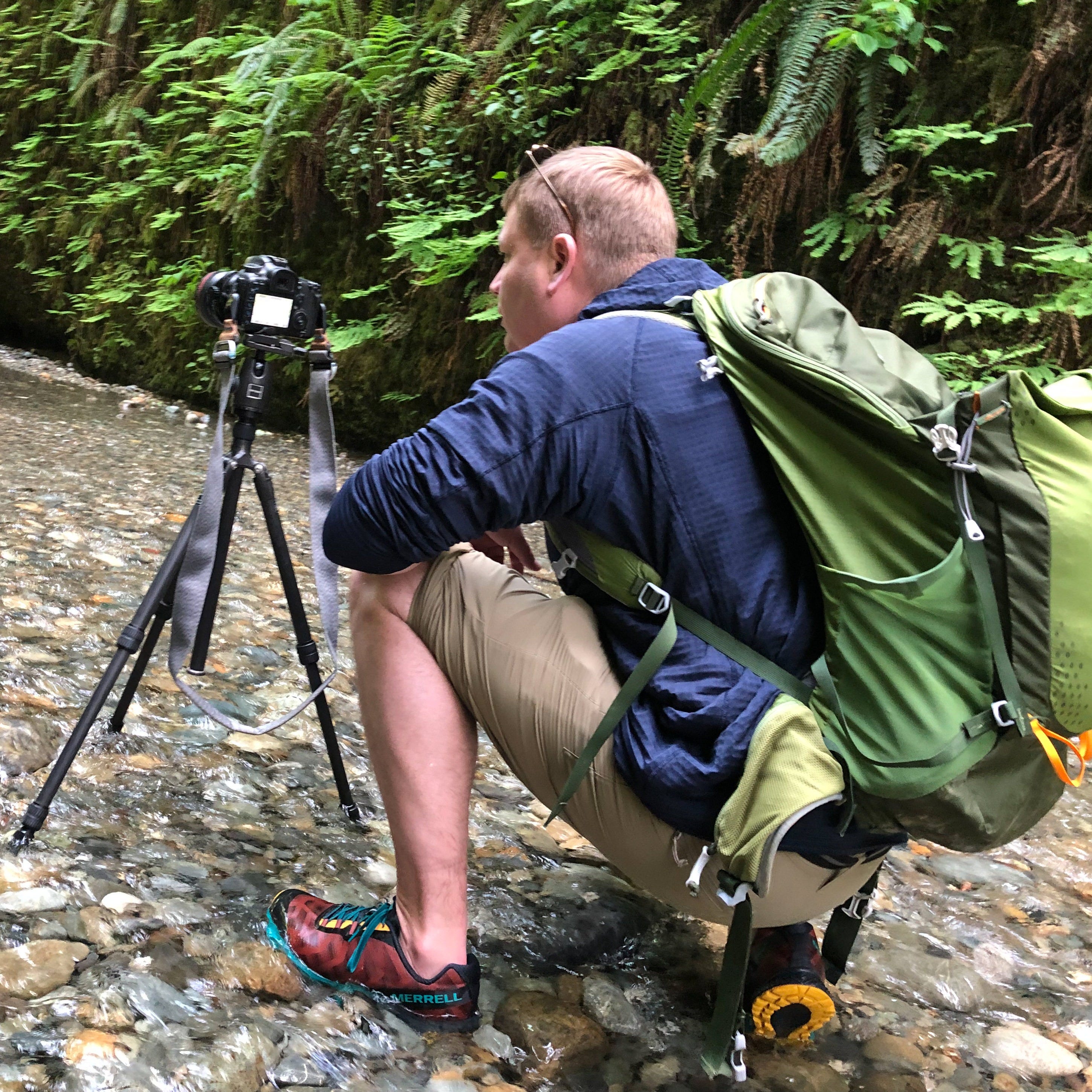
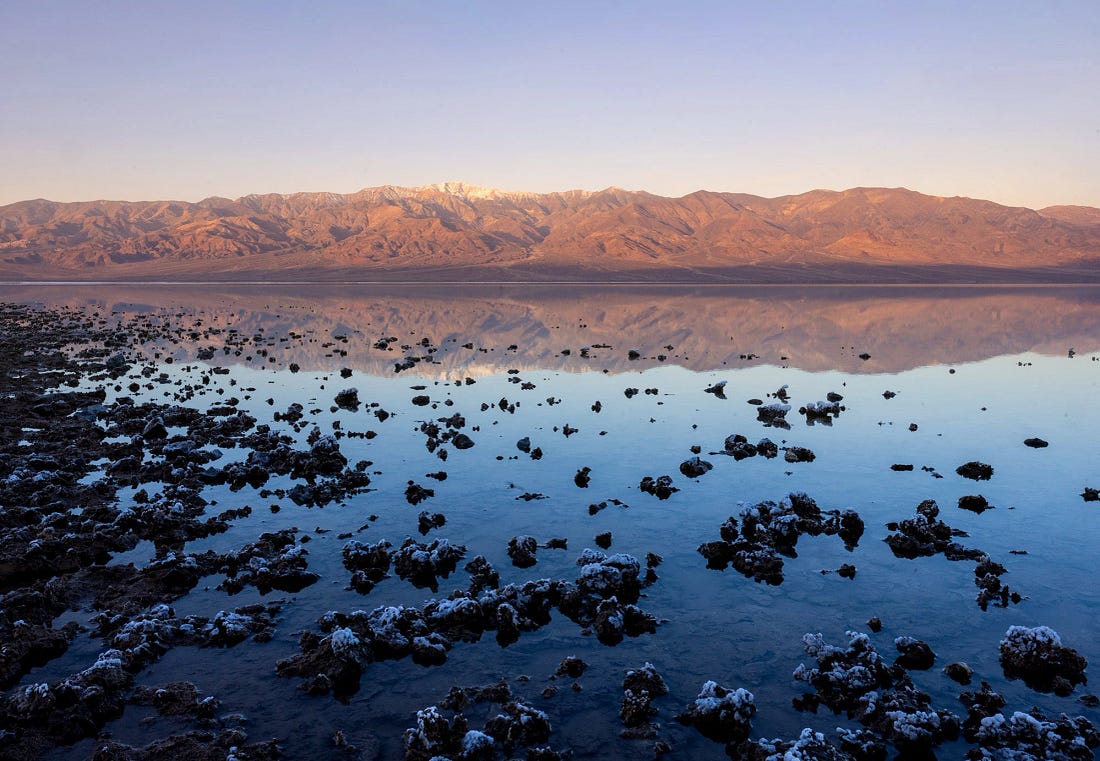
There is one other man here. He is standing a little apart from his car, looking out across the basin as if he has already been there a while. Mid-thirties, maybe. Evan. He tells me his dog is asleep in the back. His old pup. I look over. The rear window is cracked, and I can just make out the shape of a dog curled into itself, unmoving. It’s his assistance dog. Trained. Steady. Didn’t wake easily. Needs the rest. We walk out onto the Badwater Basin playa together. Two voices under the moon. He’d been moving around the West for a while now, living out of his car, chasing wildlife. Raptors mostly. Pronghorn. Anything that moved with intention. Landscapes are new to him. He tells me about Afghanistan when I ask. Not the early years. Later. Convoys. Heat. Hours of nothing that could turn in an instant. An explosion, not close enough to kill him, close enough to alter everything. Head trauma. The world afterward was just slightly out of alignment. Sound was different. Time was different. The dog came later. He said he tried going back to a normal life and found it didn’t hold. Too many walls. Too much contained space. Out here, he explains, things make more sense. Distance helps. Silence helps. His old pup helps most of all. Dogs don’t ask anything of you that you couldn’t answer. We are walking out to the edge of what we call Lake Manly…endless miles of a mirror of water. Underfoot is the cold white of alkaline salt. The basin opens up in every direction. White and silver, a wide shallow arc, stretching toward the dark walls of the Black Mountains and the Panamint Range. The salt crust breaks, edges catching moonlight, seams dark with moisture. A faint mineral sharpness in the air. Nothing moves. No insects. No wind. Just distance and light and the sense that you are standing in the lowest place in North America with nothing left below you. The lake stretched farther than I expected, a quiet mirror laid over the desert. He keeps talking as we walk. About birds. About how they move, how they decide. About waiting hours for a single moment when something aligns—the wind, the angle, the behavior—and then it’s gone. He laughs a little at himself, says he didn’t expect to care this much about things most people never notice. When we reached the edge of the water, he stops. Looks out at the lake. Looks at the moon sitting in it. Then he says he forgot his tripod. But he probably doesn’t need it. He shifts his weight and glances back toward the parking lot — a long way off now, his car reduced to a small dark shape against the flats. He said he could shoot handheld. He’d done it before. I tell him no. I tell him to go back and get it. He hesitates. You could see the calculation—the distance, the time, the effort of turning around and retracing everything we had just walked. It would take him close to forty-five minutes to get back and return. The light will change. The moment will shift. He says it probably isn’t worth it. I tell him it is. I say it again, more gently. You don’t come out here for this and not do it right. He looks out at the water once more, then back toward the car. Nods. Says alright. Then he turns and starts walking, his figure shrinks slowly across the flats, the sound of his steps fading into the same silence that had been there before either of us arrived. And now I am alone, at the edge of the water, watching the lake hold the moon.
Lake ManlyBefore there were pupfish in creeks, before there were springs cut off from one another, before there was a place called Death Valley at all, there was water here. And not like the inches deep water of the temporary Lake I’m looking out at now. At its height, during the late Pleistocene, Lake Manly stretched for more than ninety miles along the floor of the valley. In places it was deep enough to swallow entire alluvial fans. The old shorelines ran high on the Panamint Range and the Black Mountains. They left terraces — faint ones, but still there if you know what you’re looking at. It is difficult, standing in the modern desert, to reconstruct what that would have felt like. Nothing here prepares you for water at that scale. The valley floor that now radiates heat would have held a long ribbon of blue-gray water. Wind moved across its surface. Storms came down from the north. Waves broke against shorelines that are now dry and silent. The edges held water longest. Cattails, bulrushes, sedges — wide belts of them, dense and rooted in soils that never fully dried out. That kind of vegetation doesn’t grow just anywhere. It grows where the ground stays saturated, where the water table is close enough to matter. Willow and mesquite grew along the edges. The air would have been different. Cooler. Wetter. Full of movement. Ducks, grebes, coots. Shorebirds along the mudflats. Pelicans and cormorants moved across the lake in loose formations. Along the edges, herds came down to drink. Ancient camels. Horses. Ground sloths moving slowly along the margins. Dire wolves and American lions follow them at a distance. In the shallows, life was constant. Invertebrates drifting in the water column. Insect larvae clinging to submerged plants. Small crustaceans pulsing in the light. Fish moved through it all. Moving along shorelines, through wetlands, across connected water that extended far beyond a single spring or creek. The ancestors of the pupfish lived in this world. They were not desert survivors yet. They were lake fish. But then the water began to fall. Steadily enough that shorelines retreated year by year, generation by generation. The climate was warming. Wetlands were contracting. Channels were contracting. The long lake broke into pieces. Water pulled back into basins. Then into ponds. Then into springs. The fish followed it down. By the time the lake was gone, what remained were fragments. Springs fed by groundwater. Isolated. Chemically distinct. Thermally unstable. Each one its own world. And in those worlds, the fish began to change.
The Backup PupsThey built a second Devils Hole. Not out in the Amargosa Desert, where the cavern drops into black water and earthquakes send waves up the walls, but inside a sealed building of pumps and pipes and light rigs—an engineered cave meant to imitate a place that was never meant to be imitated. Temperature held near 93°F. Light timed and angled. Rock shelves poured and tilted to match the original ledge where the fish spawn. Algae cultivated like a crop, because the algae is the food, and the food is the system. The goal was as stark as anything in conservation: if the last wild population of the Devils Hole Pupfish vanished, there would be another one waiting—a second chance held in reserve. By the time anyone thought to build a replica, the wild population had already fallen to numbers that don’t really function as a population. In 2013 the count hit 35 — the lowest on record. Biologists who had spent decades at that shallow limestone shelf, no bigger than a dining table, were no longer estimating. They were counting individuals. Not estimating. Counting. The U.S. Fish and Wildlife Service has described it plainly: “The Devil’s Hole Pupfish is one of the rarest fish in the world.” Rarest is a strange word here. It suggests something precious. What it really means is that extinction has already begun and simply hasn’t finished yet. They had tried before—decades earlier—lifting pupfish out of Devil’s Hole and placing them into nearby springs, into tanks, into simplified versions of their world. The fish would survive for a while, but something always slipped. Courtship broke down. Spawning became irregular. Generations didn’t follow. The fish remained alive but stopped behaving like a species. The fate of the Devils Hole Pupfish once came down to a handful of federal biologists standing at the edge of a dark pool, watching fish that wouldn’t eat. Not a policy failure, not a funding gap — just that. A few people trying to convince a few dozen animals to take food. The problem was starvation. The shallow shelf where the fish fed could not reliably produce enough algae and invertebrates to sustain the population. So scientists intervened. They brought food—baby brine shrimp, commercial fish flakes, spirulina. They tried hand-feeding them. Strings, pipettes, food lowered carefully into the water. Whether the fish understood what was being offered is the wrong question — they didn’t, not in any meaningful sense. But the biologists kept at it anyway, which says something about where things stood. Some of these efforts failed. Some made things worse. Pathogens were introduced. The ecosystem reacted in ways no one fully understood. There is something almost unbearable in the image: government scientists, kneeling at the edge of extinction, trying to hand-feed the rarest fish on Earth. The work at Ash Meadows got strange in the way that serious efforts sometimes do. It wasn’t enough to match the water chemistry. They had to match the angle of the shelf, the way light hit it for only part of the day, the thickness of the algal mat. Sensors tracked oxygen and pH without interruption. Every variable that could be measured was measured. Every variable that could be controlled was controlled. And still, for years, the fish resisted. They swam. They fed. But they did not fully become themselves. In 2012, after a magnitude 7.7 earthquake off the coast of Mexico, water inside Devil’s Hole surged several feet up the walls, slamming across the spawning shelf. Biologists later said that event likely killed a large portion of that year’s eggs. A species reduced to a few dozen individuals can lose an entire generation to a tremor on the far side of the continent. That is the world the replica was meant to replace. The reaction to the facility, when word spread, was immediate and oddly visceral. The numbers circulated first—millions of dollars, federal funding, a purpose-built structure for a fish most people would never see. Then the tone shifted. “We’re spending millions to save a minnow in a hole?” “Just let it go extinct.” The old phrase resurfaced, sometimes as a joke, sometimes not: Kill the pupfish. The fish became, again, a symbol—less an organism than an argument about what matters. Water rights. Federal control. The lingering resentment that a Supreme Court decision—Cappaert v. United States—had once restricted groundwater pumping to protect this same fish. And because the facility was closed, controlled, difficult to access, the imagination filled the gaps. People said they were cloning them. People said they were altering them. People said the government was hiding something about the aquifer. None of it held up, but it didn’t need to. The reality—that a handful of scientists were trying to convince a few dozen fish to reproduce inside a fabricated cave—was stranger than most conspiracies. Buried in a federal planning document is a line that feels almost clinical: “The goal is to establish a second population…to reduce the risk of extinction.” — U.S. Fish and Wildlife Service A second population—as if a species that evolved in total isolation could simply be copied and run somewhere else. Eventually, the fish began to spawn in the replica. Eggs appeared on the artificial shelf. Juveniles survived. Numbers crept upward. By the early 2020s, hundreds of captive fish. The insurance policy seemed to be working. Then spring 2025 — earthquakes, water moving inside Devil’s Hole, surging across the shelf where the algae grows and the eggs sit. The counts came back low. Thirty-eight wild individuals. The biologists had a protocol for this moment. They had hoped it would stay a protocol. They took fish from the replica—the engineered cave, the backup world—and introduced 19 captive-raised pupfish into Devil’s Hole itself. Alongside that, they began carefully calibrated dietary supplementation, informed by what they had learned from the captive population: how much algae, how much nutrition, how to give the fish a margin where there had been none. The direction reversed. The copy was now feeding the original. In the months that followed, the wild population showed encouraging signs during the breeding season. The numbers moved in the right direction. That’s all that can be said. As of early 2026, the wild population is still precarious, still capable of dropping sharply after a single event. The facility didn’t solve that — it was never going to. What it did was create a margin, a backup, a place where the species could exist while the original hung on. An insurance policy that couldn’t replace what it was insuring, but might keep it from disappearing entirely. The program now runs as a collaboration—U.S. Fish and Wildlife Service, National Park Service, and Nevada Department of Wildlife—guided by a strategy that reads as a set of contingencies against loss. The numbers still swing. Historically, the wild population has ranged from lows in the 30s to peaks above 500. The species remains endangered. The margin remains thin. And now there are two places where the Devils Hole Pupfish exists. Between them, the species persists—part wild, part maintained, suspended between a past that made it and a future that may not.
The Limestone ShelfIt starts to come together as a pattern. The pipes at Stovepipe Wells are opened to the air and everything shuts down. The water is still there, but the pressure is gone. The rooms go dry. The kitchen closes. The bar empties out. The boardwalk at Salt Creek is torn apart by a flood. The creek is still there. The fish are still there. But access is gone. At Devil’s Hole, the argument comes down to inches of water on a limestone shelf. In Ash Meadows, springs that feel permanent shrink the moment someone starts pumping far enough away. In Tecopa, the water stays but shifts just enough—and a species disappears. The storms that filled the basin this year, bringing Lake Manly back for a moment, follow the same pattern—water appearing, then disappearing again. Too much, then too little. And the pupfish sit inside that pattern. They live at the narrowest edge of what this landscape can hold. When something shifts, they show it first. The question returns: Why not kill the pupfish? One jug of poison. One broken fence. One careless step. And something that has survived for tens of thousands of years would be gone. Forever. Salt CreekI am back at the bar, sitting at a table in a dark corner. I’m writing about Turrialba Volcano, and about why I believe biodiversity underpins human civilization—that it is the one foundational thing upon which we rest. While I write about fungus and bacteria and plankton, my mind returns to the pupfish. We don’t depend on them. Not directly. The Devil’s Hole Pupfish is a vertebrate in one of the most endangered ecological categories on Earth. In the United States there are only about a thousand freshwater fish species. When one disappears, it is gone. This one has been evolving in isolation for something like ten to twenty thousand years, a remnant of the Pleistocene lakes that once filled this basin. It carries forward adaptations to heat, oxygen, and water chemistry that exist nowhere else. Erasing it would mean erasing that. A story like this—a one-inch fish in a hole in the desert, a “worthless” species—draws people in. It drew me in and kept me thinking about biodiversity for nearly thirty years. It has drawn in scientists, vandals, judges, and presidents. Pister’s buckets. Court cases over inches of water. Men with guns and bottles of rum. Fish counted one by one in a cave. It is a preposterous story. And yet it works. Salt Creek, 1998. A boardwalk over a narrow channel, fish moving in the shallow water below. I didn’t know what I was looking at, not really — I knew the name, knew the basics, but didn’t have any way to hold what it meant that they were there at all, persisting in that thin thread of water in the middle of Death Valley. The story stayed, and over time it became a way of seeing. The fish—and everything behind them. The water moving under the desert. The algae on a limestone shelf. The narrow margins where a system either holds or collapses. Once you see it there, it begins to appear everywhere. What becomes clear is how little room there is for that decision. Most species don’t offer anything obvious. They don’t announce their importance. They are simply part of what holds everything else together. Once you begin deciding which ones matter and which ones don’t, the pattern sets quickly. Things start to drop away. Then all at once. We start making decisions we are not qualified to make. Until the springs that once held entire evolutionary stories run dry or shift just enough. Until we’ve simplified the world into something that serves the present moment but can no longer surprise or sustain it in the long run. Out here, the water is already dropping. Not all at once, and not always in ways you can see, but inch by inch—the same way it did at Devils Hole, at Tecopa, and now at Quitobaquito. Each time it happens, the question returns. Why keep this? And each time, the answer becomes a little easier. The pressures are higher. The margins are smaller. The number of places where water still holds continues to shrink. And this is where it happens. At the edge of a basin where water still rises. A decision that something stays. Or doesn’t. The moment you decide a species isn’t worth keeping, you’ve already decided what kind of world this is. Notes from the Road is free today. But if you enjoyed this post, you can tell Notes from the Road that their writing is valuable by pledging a future subscription. You won't be charged unless they enable payments.
|