The EvidenceAlong a quiet stretch of river, the search for insects brings the systems beneath everything into focus—the conclusion of Turrialba and Lago Angostura.
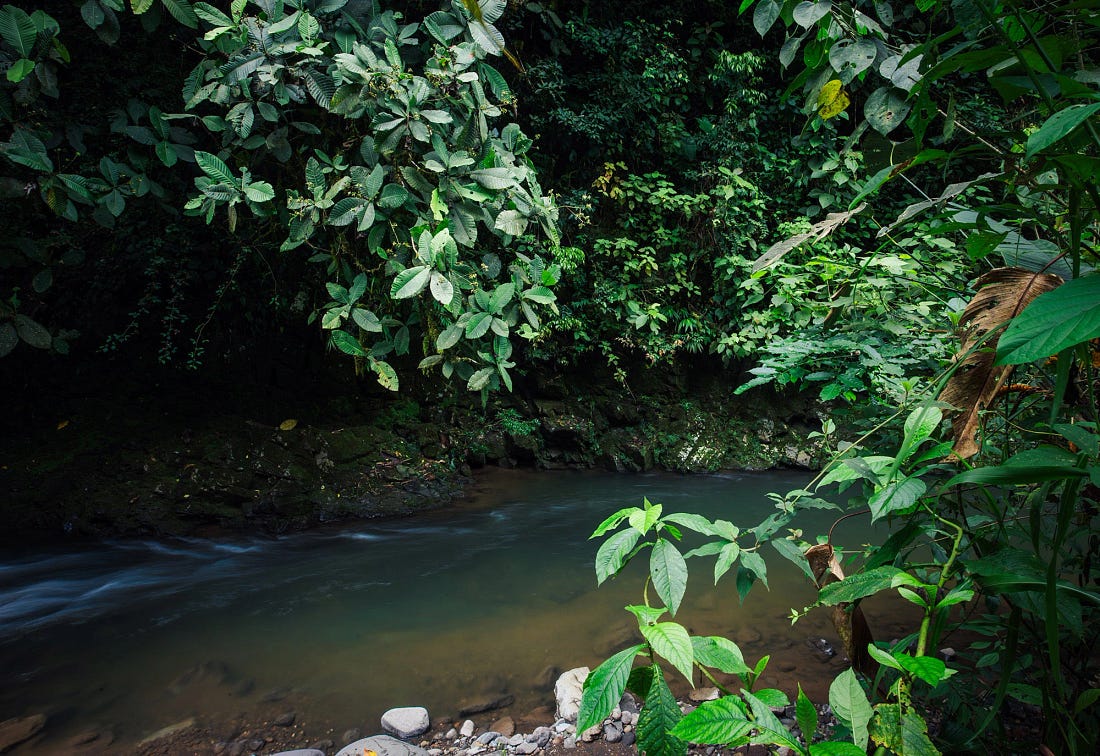
This takes a little time. It’s worth it. If you haven’t read Turrialba or Lago Angostura, start there. High resolution version available at Río Guayabo. If you’ve read the series, let me know your thoughts: You might think the gravel road along the Río Guayabo is just a road lined with weeds and grass. Harry and I ditch our other plans and drop elevation to spend the day on the river road. We are walking as slow as possible, stopping every few steps. I remember a drop of water under a microscope as a kid—like watching monsters in a jar. Now Harry and I are the ones in the jar. Something is watching us from every leaf and stem. We don’t know they’re there.
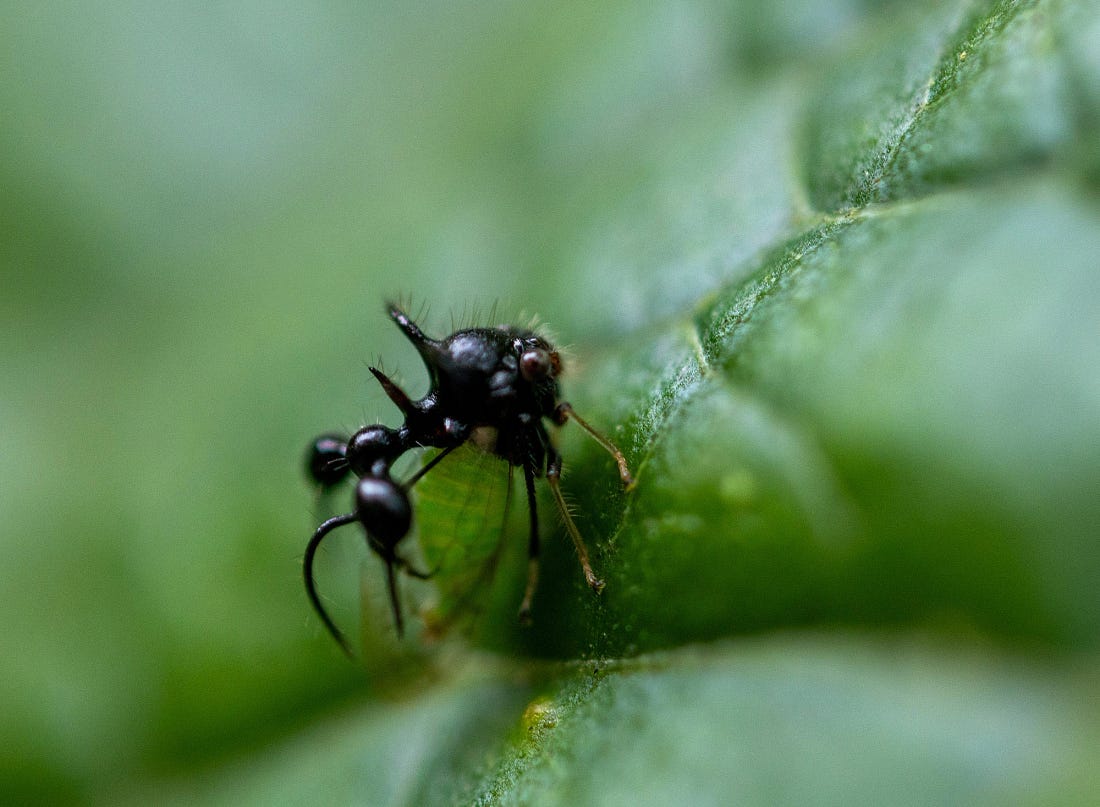
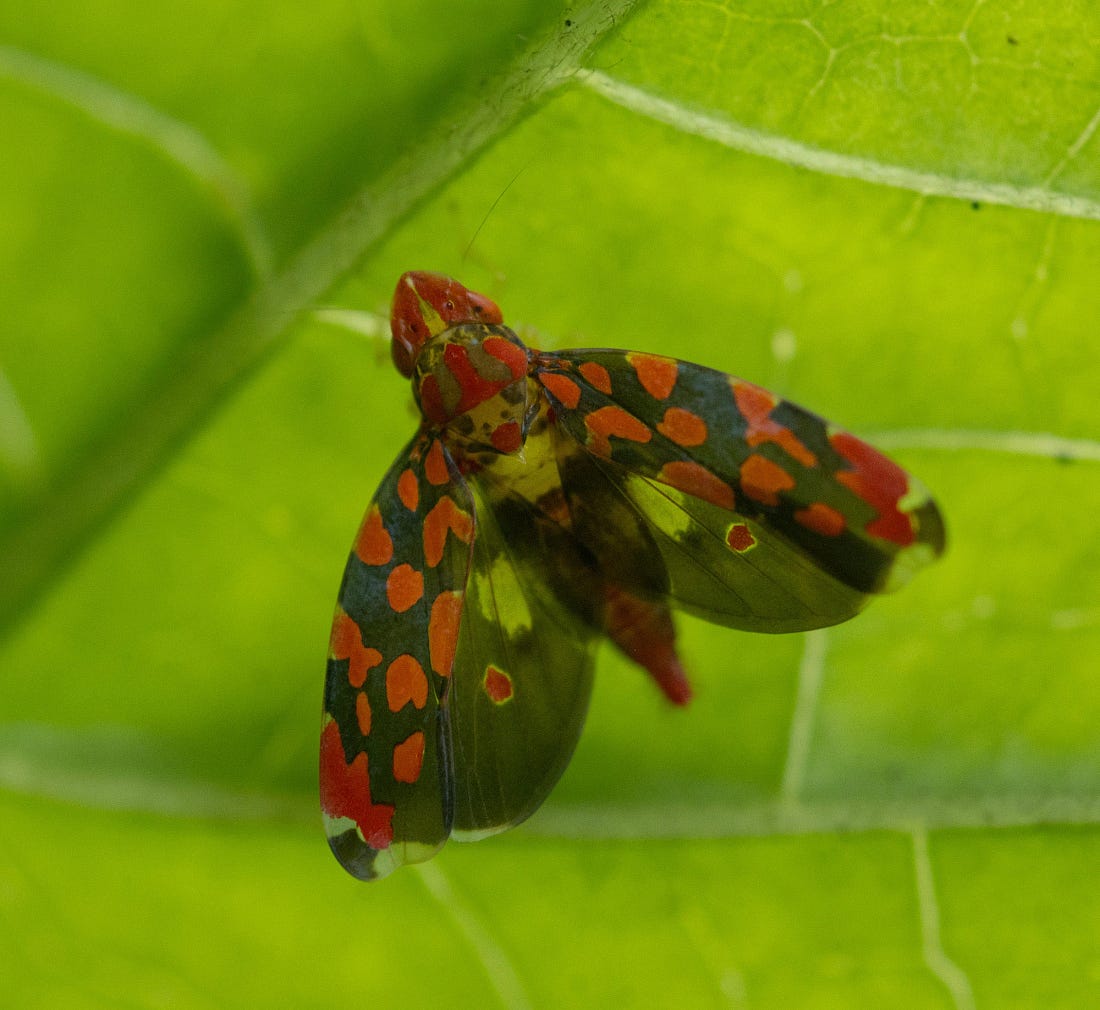
We’re somewhere around 1,600 feet. Below the cloud forest, above the lowlands. It’s premontane wet forest, an in-between zone where everything tangles together. I am crouched alongside a weedy plant—yes, I travel with a garden pad—when Harry, studying the vegetation along a cliff wall, asks me to take a look. A grotesque black ant—elongated, armored, overbuilt—has locked onto the back of something soft and green, leaflike, katydid-like. Head forward, body arched, legs braced. It looks like a fight stopped mid-frame. Neither one is what it appears to be—not the ant, not the victim. It’s one animal. The front half is an elaborate impersonation, complete with a false head, false posture, false intent. The real head is tucked beneath, almost hidden, the true insect quietly going about its life while its decoy plays the role of something far more dangerous. It is backwards. It is deceptive. It is absurd. And it works. There’s a reason so many things pretend to be ants. All the ants on Earth weigh roughly 12 million metric tons of carbon. More than every wild bird and mammal on the planet combined. They play a critical role in the function of our planet. A recent global estimate puts the number of ants on Earth at 20 quadrillion—20,000,000,000,000,000 individuals. Right now, millions of them are moving through the forest around us. Underfoot, in the soil, inside rotting wood, along every stem and branch. Evolution copies success. Across entirely different branches of the tree of life, insects, spiders, even some vertebrates have landed on the same answer: look like an ant, move like an ant, behave like an ant. Most things, when given the choice, would rather not eat one.
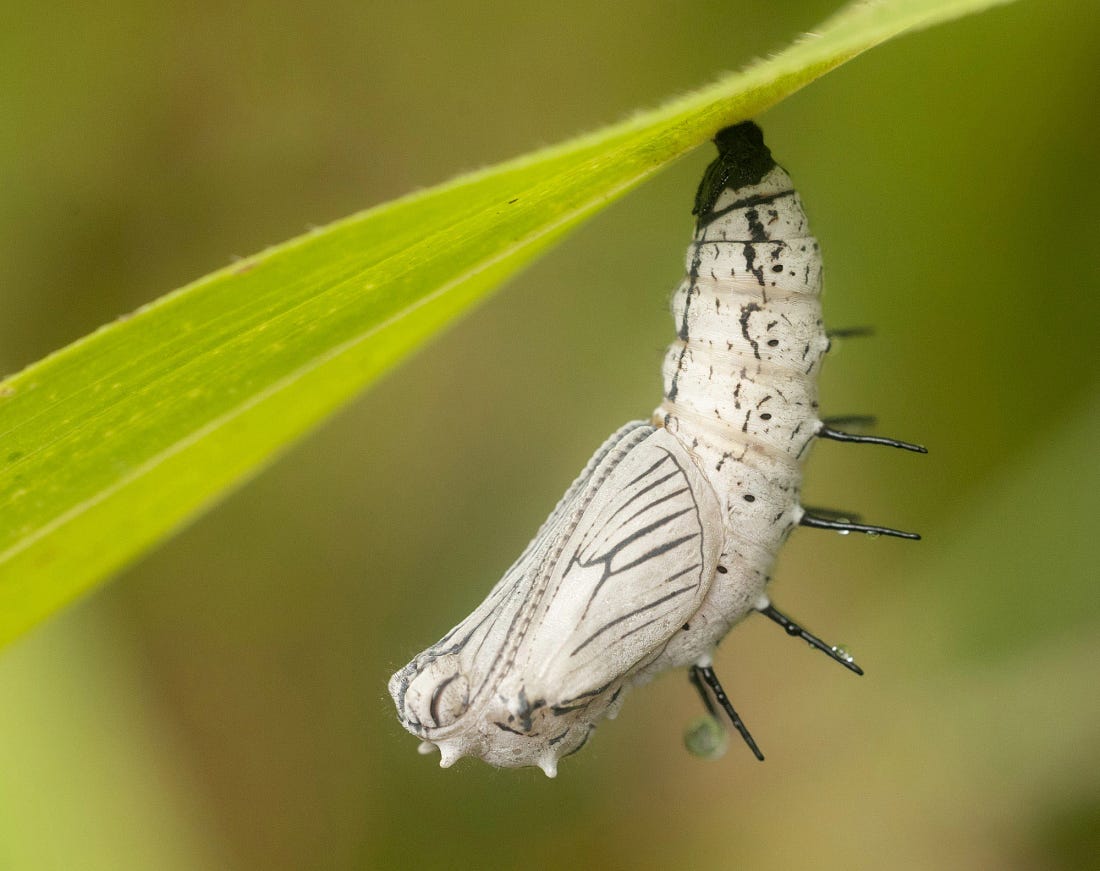
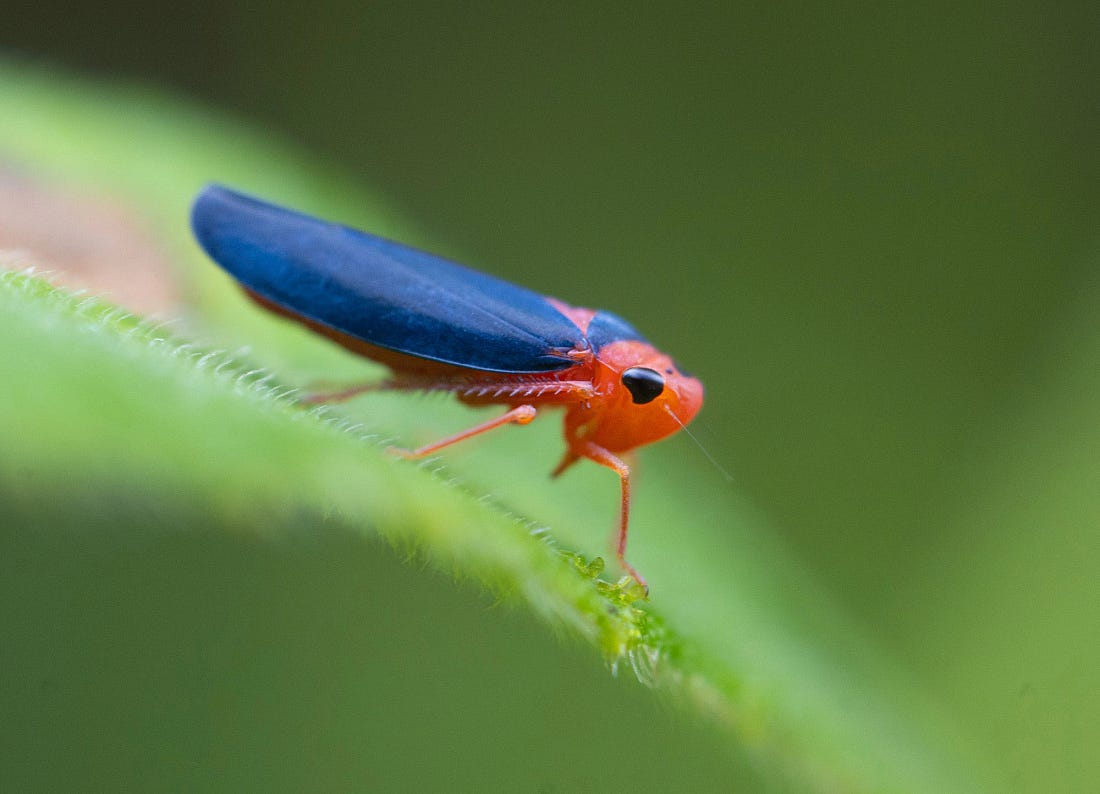
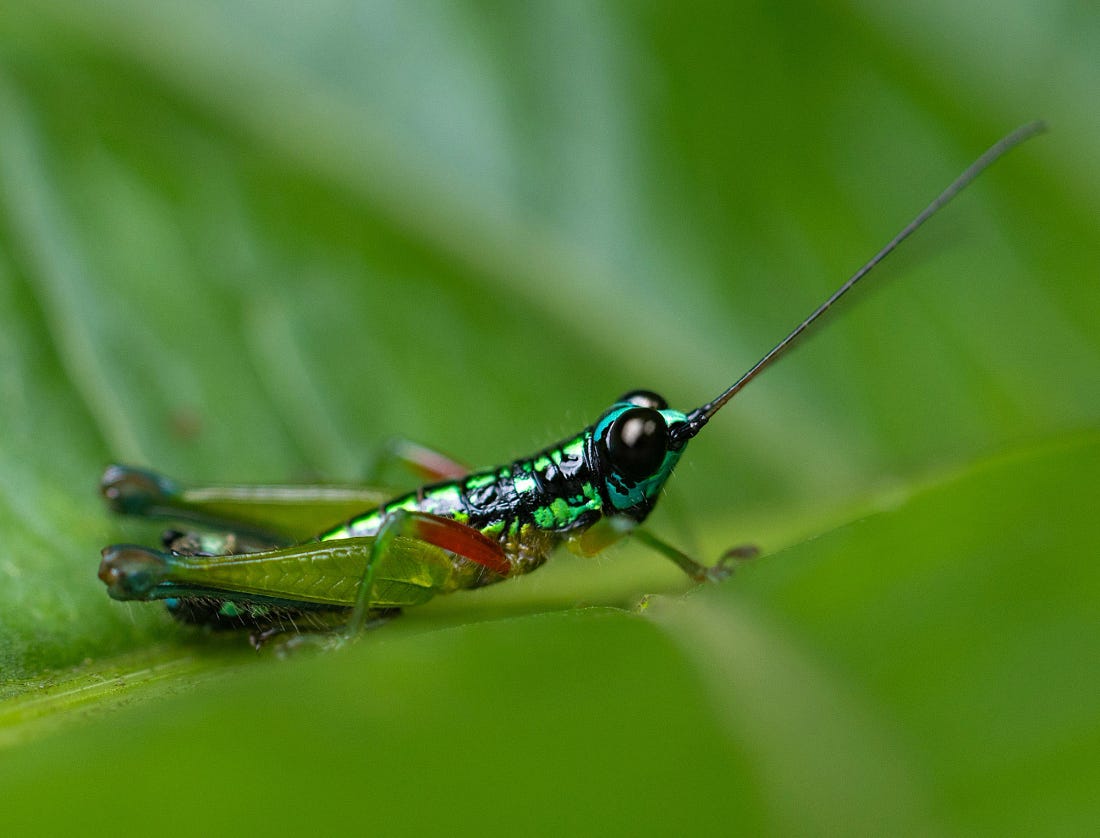
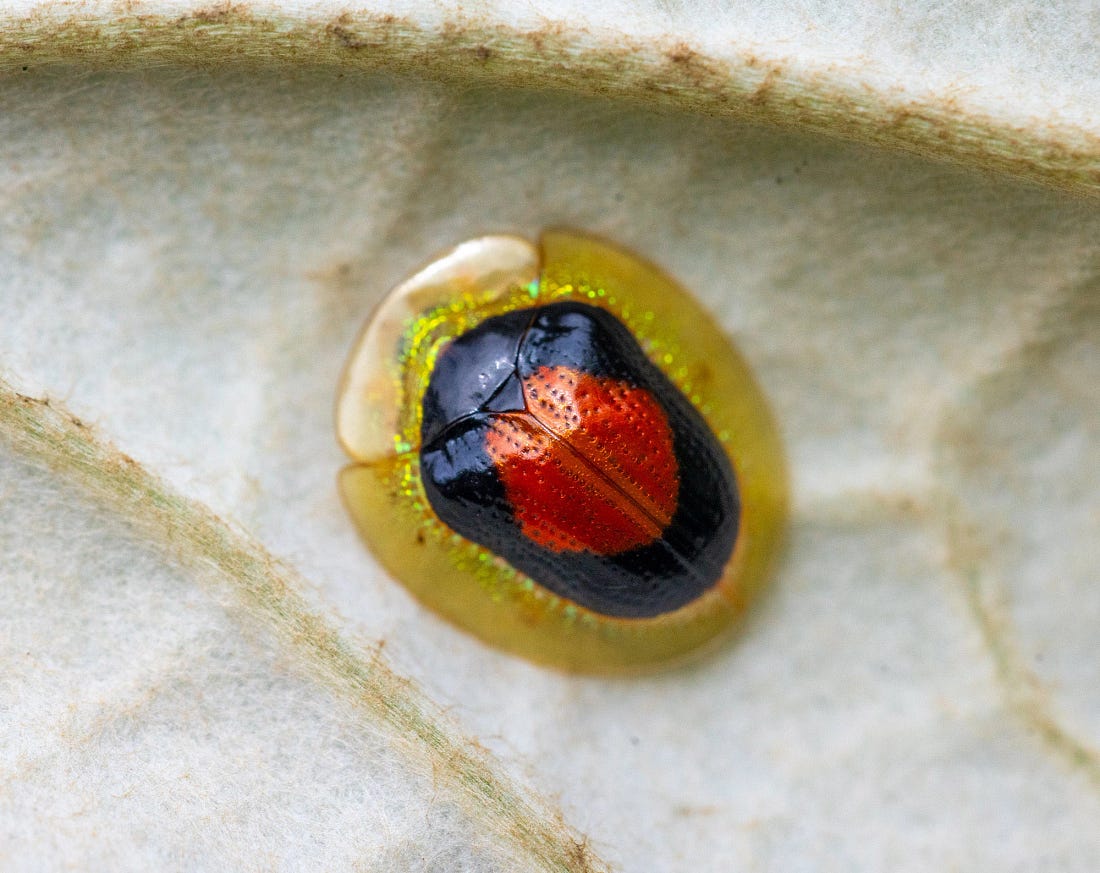
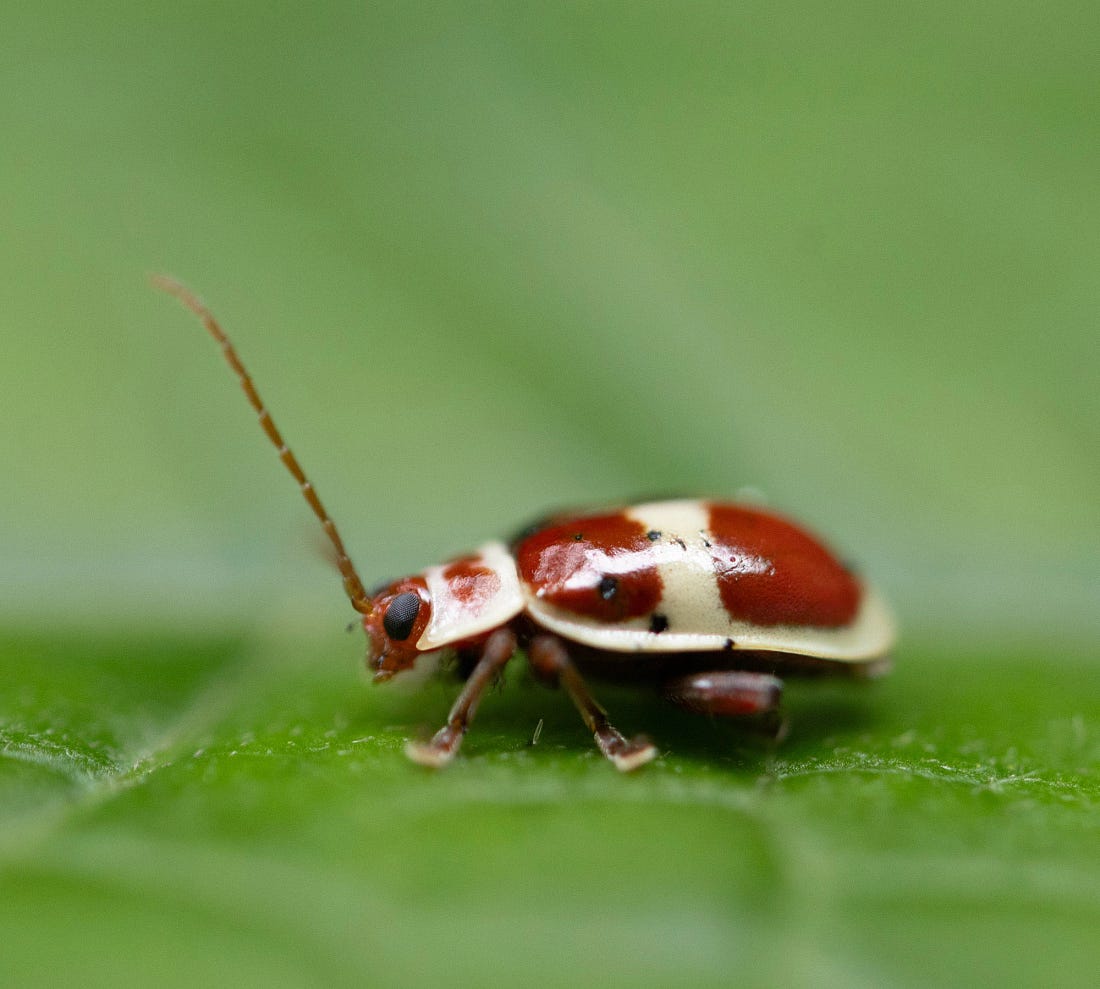
Up close the illusion gives way. What I’m actually looking at is an ant-mimicking treehopper, Cyphonia clavata. A sap-feeder. One of a group that has made disguise into a body plan. Some resemble thorns or bits of plant. This one’s whole body is bent on resembling an ant. I move to the other side of the gravel road and, somehow, notice something that looks like a sculpture. A white Fabergé egg, traced with delicate black lines. Modern. Imperial. Spiked. Almost galactic. A different approach to the same problem. I used to think that when a caterpillar became a butterfly, it simply wrapped itself in an organic cloak while wings pushed out from its sides. A chrysalis is nothing like that. Inside, the caterpillar has gone to liquid. No legs, no eyes, no face. Sludge. And then—like this one, which is days away—it becomes something else. This is Actinote anteas, another form of life reorganizing itself completely. It will fly away in the colors of black, orange and yellow. Harry calls me over again. Perched on the surface of a bright green leaf is something impossibly clean, coral and blue like enamel, its wings folded tight along its back in a perfect taper. It looks like a naval jet the size of half a grain of rice. This is a leafhopper—Macunolla ventralis. It doesn’t move at first. Then, in a blink, it’s gone. We keep walking. Along the edge of a shaded leaf sits a multicolored insect—Lithoscirtus viceitas. A slant-faced grasshopper. This one doesn’t tap into the plant; it eats it, leaf by leaf, converting green into motion. Harry points his pinky toward its legs and describes them as being colored “toxic pistachio”. A few steps later, something catches the light when the wind bends a leaf. A tortoise beetle—Tapinaspis atroannulus—flat on the underside of the leaf, its translucent shell catching light like a mirror. Aware of my presence, it stands up on all fours, becoming a miniature turtle moving across the surface in a stiff and deliberate march. It has little black eyes and what looks like a cartoon smile.
We will keep going all day like this. Every few steps, something else—a disguise, a transformation, a way of eating, a way of disappearing. Each insect is doing some narrow piece of work: carrying seeds, opening soil, breaking matter down, feeding something else. Remove enough of that activity and the effects begin to ripple outward. Soil compacts more easily, recovery slows, plants and insects fall out of step, decomposition lags, and the forest becomes less responsive to disturbance. The loss does not need to be total. Something built from millions of small exchanges can begin to weaken while still looking, at a glance, alive. Life spent 3.8 billion years building arrangements like this, layer by layer and interaction by interaction, refining relationships that hold under pressure and adapt over time. Humans have been modifying them for a few centuries, and most intensely in just the last fifty years. This is where insects become especially revealing. Across much of the biosphere, change is hard to measure over long periods and across large areas. Insects are different because they can actually be counted, season after season, year after year, with methods that can be reliably replicated long enough for patterns to emerge. Butterflies can be tracked along fixed transects. Moths can be sampled with light traps. Flying insects can be collected in Malaise traps. When those records are repeated over decades, observation turns into evidence. A 2025 synthesis found butterfly abundance in the United States fell 22 percent between 2000 and 2020. Across 554 species. That timeline is personally startling to me: I started photographing butterflies before that window even opened. In Europe, the grassland butterfly index has fallen 47 percent since 1991. In Britain, the abundance of larger moths fell 33 percent between 1968 and 2017. This is much more than one-off anecdotes. They are long records, gathered the hard way, by trained volunteers, professional recorders, and researchers returning to the same places with the same methods over time.
The Krefeld study in Germany didn’t focus on a single species or even a single group. They used standardized Malaise traps for over 27 years and in 63 protected areas. What they found was a 76 percent seasonal decline in flying insect biomass. Eighty-two percent in midsummer. The causes—climate, land use, pesticides—are still being debated. What fell wasn’t one vulnerable species. It was the total mass of insects moving through the air. And it was falling inside protected landscapes—places that were, at least on paper, supposed to be intact. The tropics are harder to read. The records are shorter, patchier, more difficult to standardize. Some studies show sharp arthropod declines alongside warming. Others say it’s more complicated. People who have spent lifetimes paying attention to insects are raising the alarm. Entomologists studying Costa Rica’s Área de Conservación Guanacaste learned that insects have been declining there since the late 1970s, with the decline intensifying significantly after about 2005. Not every insect, in every place, is declining at the same rate. Some species are up. Some communities are just shifting. Some regions are holding longer than others. But the overall pattern doesn’t offer much comfort. Death by a thousand cuts is how one review put it—no single collapse, just a long uneven thinning of the small lives that hold everything else in place. They aren’t alone in this. But insects are one of the few parts of the living world we’ve measured well enough to watch decline happen openly—in numbers, in graphs, in repeated counts. Which means they show us something the rest of the biosphere can’t yet: what this looks like before it becomes visible everywhere. And that breaks open a harder question. If this is what we can see in one of the best-measured parts of the living world, what is happening in the parts we can barely observe at all? We have nothing like this for microbial communities in soil, for fungal networks underground, or for the microscopic life in the ocean adjusting to shifting chemistry and temperature. Those processes may be moving just as quickly. We’d have no way to know.
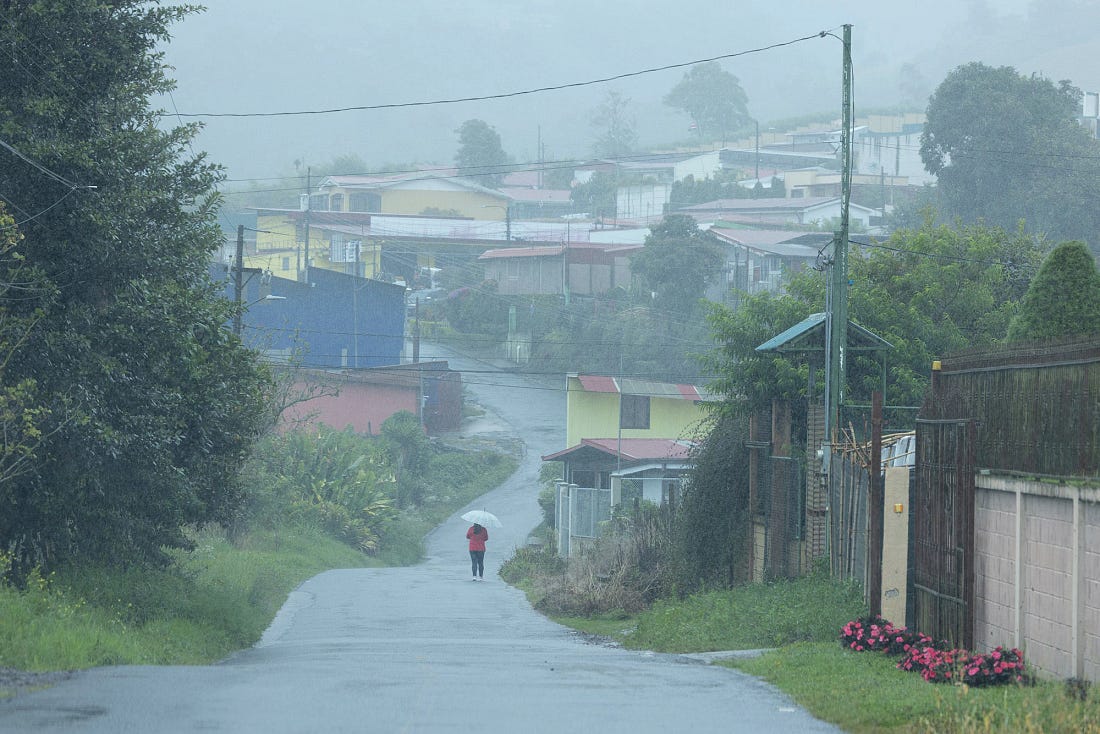
The pressures are widespread and they accumulate. Rising temperatures throw off life cycles and dry out landscapes that once held moisture. Oceans absorb carbon and slowly shift the chemistry that microscopic organisms need to build shells and hold food webs together. Habitats are cut apart, simplified, drained, and converted. The visibility has already clearly begun. Coral reefs, among the most complex biological structures on Earth, have lost half their living cover, reducing massive global marine systems to simplified remnants. In the Amazon, large areas no longer reliably absorb carbon — drought and fragmentation are pushing the forest somewhere it may not come back from. Peatlands that stored water and carbon for millennia are drying out, burning, releasing both. Across parts of North Africa and the Mediterranean, drought is becoming an annual condition, grinding down agriculture and the people who depend on it. In the ocean, warming and acidification are starting to work against the chemistry that marine food webs depend on. Chemicals move through air, water, and soil in combinations we still do not fully understand. These forces overlap and reinforce one another, changing things long before they eliminate them. The process can look subtle at first: a little less movement, a little less transfer, a timing mismatch here, a weakened connection there. Then the pattern accumulates. The system thins. The redundancies shrink. The unspooling begins. After returning to the lodge grounds, I head to my cabin, leave my umbrella to dry under the eaves, and fall asleep. Sometime later, I am jolted awake. At first I don’t know what it is—just violent shaking motion, rolling, noise everywhere. Then the structure begins to creak, the sound of wood under stress, and I remember where I am. The cabin is on stilts, hanging out over a steep valley, a narrow platform of boards and beams suspended above a drop I never fully let myself think about during the day. Now it is impossible not to think about it. The ground is moving.
I lie still and wait. Move or stay—I can’t decide. The rain keeps falling, steady and loud on the roof, and for a few seconds the two sensations won’t resolve: the vertical world of the storm, the horizontal motion of the earth. Then it passes. Just like that. The structure settles. The forest returns. The rain continues as if nothing happened. I’ve been through my share of natural disasters. In the eye of Hurricane Erin, I was able to ride a bike without using the pedals. In the immediate aftershocks of the Northridge Earthquake, I saw land move like it was water. From outside, I saw my apartment complex roll one way, then the other. I spent 18 days indoors when Portland faced some of the most toxic wildfire air in recorded history, with air quality peaking at an absurd 516. I’ve experienced a lot of fire, wind, smoke and shaky ground. But earthquakes are different. They are the only ones I’ve experienced that are not getting worse because of us. Wildfires are. Hurricanes are. Floods are. Heat waves are. We are changing the conditions that make those events more frequent, more intense, more destructive. An earthquake is just the planet being the planet. And this is where our thinking often goes wrong. We still talk about the environmental crisis as a story about disasters—stronger storms, rising seas, bigger fires. And in that thinking, there is a certain logic to believing that human ingenuity will adapt its way through. Jon Miltimore, who used polar bears as a symbol for why concerns about biodiversity are unwarranted, also suggested in a different essay that mitigating environmental crises are unnecessary. He wrote: “The solution is to unleash the power of the free market and allow entrepreneurs to build humans a more prosperous and resilient world through human ingenuity.” In this very common view, better technology, and increasing wealth make societies more resilient. Markets respond. Innovation fills the gaps. Even as the environment changes, human systems adjust.
If the problem is storms the argument works. If it’s fires or floods or hurricanes it works. We’re good at surviving disasters—that part is just true. Yes. We could do it. The answer, uncomfortable as it may be to admit, is yes. We could survive that world. We would move cities. We would build seawalls. We would develop better forecasting, better evacuation systems, and better fire suppression technologies. Markets would respond. Technologies would emerge. People would adapt. If the problem were only disasters, this view might be right. This is the misunderstanding. The environment isn’t primarily a source of shocks to be endured. It’s the living foundation that makes endurance possible. Treating it as the former, while it is actually the latter, is a mistake with consequences most people haven’t begun to calculate. Such views carry consequences that are easy to underestimate. The real risk is that the living foundations beneath everything begin to fail. The systems we have been walking through this week—the ants, the fungi, the insects, the invisible organisms in soil and water—are our planet’s operating system. All human wealth, all markets, all freedom, all individual choices rely on it. We tend to think of the economy as something separate from the natural world—markets, capital, labor, innovation. I’ve spent much of my life around international trade publications, freight media, commodities desks, and option trades. I have seen firsthand how this idea that the economy is separate from the inner workings of the biosphere dissolves quickly. In the largest commodities trading houses, for example, the analysts specialize – crop science, hydrology, climatology. Some come out of agronomy programs. Others work with the same atmospheric models used in climate forecasting. Their job is to understand how physical systems behave before those changes register in supply. A corn desk watches subsoil moisture anomalies weeks before planting is complete. A coffee desk tracks cold air movement across elevation bands in Brazil, modeling where frost will settle and what yields will be lost. Teams follow snowpack in the Rockies and Andes because it determines water availability months later. Others monitor ocean temperature anomalies that shift rainfall patterns across continents. These signals are the work.
What moves through those systems—water, temperature, disease, insect pressure—moves directly into price, volume, and risk. By the time it becomes visible in a field or a harvest report, the signal has already been absorbed. Standing along the Río Guayabo, the connection is hard to miss. The same variables moving through this forest—soil, moisture, growth, stress—are being modeled, tracked, and priced elsewhere. The difference is timing. Most of us arrive after the signal has already moved through. Most of those signals trace back to systems no trading desk controls. The markets don’t sit outside the biosphere—they are expressions of it. Food production depends on pollinators. Water systems depend on intact watersheds. Agriculture depends on soil built slowly by microbial and fungal networks. Climate stability depends on forests, oceans, and atmospheric chemistry that no market created. These systems form the foundation beneath every market on Earth. Markets are powerful. Technology is powerful. Neither built the systems they depend on. To believe that human ingenuity alone can replace all this is to imagine a world where the biosphere itself becomes optional. But commodities markets demonstrate the opposite. They are built on yield, water, temperature, soil, and time. They track the physical world with precision because they have to. A shift in rainfall patterns moves price. A fungal outbreak moves supply. A change in temperature at the wrong moment alters an entire harvest. In that sense, commodities are not separate from the biosphere—they are measurements of it. They reveal, in real time, that the economy is downstream from nature—not separate from it. What would it take to replace what nature does? Imagine with me for just a moment how we might replace fungal networks. Picture fiber-optic-like lattices threaded through the soil beneath every forest and grassland, distributing nutrients, breaking down matter, running continuously. Imagine pollination being carried out by fleets of micro-robots, released at dawn, moving field to field, orchard to orchard, each programmed to do what insects once did without instruction. Imagine oceans stabilized by distributed chemical systems; giant autonomous platforms monitoring pH, injecting alkalinity, capturing carbon in an endless, managed cycle. Imagine microscopic submarines, trillions of them, sitting in for plankton.
Imagine atmospheric balance being maintained by vast arrays of giant metallic machines a hundred stories tall—circulating air, redistributing heat, correcting imbalances as they emerge. And almost no one stops to picture what it would take to keep that world running. Every function becomes something to be engineered and maintained. Every replacement becomes a cost. Because if you take that idea seriously—if you imagine a world where biodiversity continues to fray while human civilization tries to “adapt”—you end up somewhere very different from seawalls and fire insurance. What does that look like? Picture it. Water must be filtered. Soil must be maintained. Nutrients must be cycled. Carbon must be managed. The cost would be measured in trillions upon trillions. The tax would be permanent. Every function once distributed across billions of species becomes a human-managed process. The bureaucracy required to run it would not resemble anything we’ve built before—less a government than a permanent global management system, attempting to replicate the quiet, continuous labor of the biosphere. This is the world you have to believe in. Total substitution. The biosphere rebuilt as a human machine. And it is here that the idea collapses. Three point eight billion years of interlocking processes, microscopic to planetary. That’s what we’re talking about replacing. We will never replace it. We are still far from even measuring it. To imagine rebuilding it—function by function, species by species, interaction by interaction—extends beyond optimism. It is the realm of fantasy. Writers who confront concerns about biodiversity often focus on taxes, regulation, and the cost of constraint on human freedom. No tax in human history approaches this. A world where the biosphere no longer carries us is a world where every basic function of life becomes something we have to provide ourselves. Every crop. Every drop of water. Every breath. The largest, most complex, most expensive project ever undertaken—required for survival. And even then, it would fall short. Lying there in the dark, waiting for the next aftershock, rain steady on the roof—this is when it becomes clear how completely we have the risk wrong.
The things that wake us in the night—shaking ground, rising water, advancing firelines—are visible failures, the ones we know how to respond to. The real danger is quieter, and largely invisible. It’s something we can barely measure. A slow thinning of everything that holds the world together. By the time I fall asleep the forest has taken the night back. The rain continues. The insects and frogs resume their quiet nighttime songs. Whatever shifted beneath the earth has settled again into a kind of temporary agreement. In the morning, I look at my photos from the day before. I’ll delete those thousand out-of-focus photos of that little turquoise-and-orange leafhopper—Sibovia pileata—tomorrow. Oh wait. What is this one, where it appears to catapult a drop of water out its rear end? Leafhoppers—perhaps 120,000 species of them—are always feeding on the phloem of plants. But that means they need to constantly eject honeydew. iPhones may have a sleek new design twenty years from now, and more RAM, but we will not have invented an alternative to phloem suckers with anal catapults. This is the part that is easy to miss. The future we imagined—the one of replacement and artificial systems—is absurd. The alternative is not complicated. Protect what already works. Limit the changes we are forcing into them. Give them the space to continue doing what they have always done. We already know what that looks like. Protect at least half the planet, permanently. Land and ocean. Not fragments, not isolated parks—connected landscapes and seascapes where intact systems can keep running without constant interruption. Shift our global energy system so that it reduces the pressure we are placing on temperature, water, and chemistry across the planet. Restore what has been damaged—mangroves that buffer coasts and build land, peat bogs that store carbon and regulate water, forests that hold entire networks of life in place. Rebuild complexity in the areas where we grow and alter the land. Agroforestry instead of monoculture. Proforestation instead of constant clearing. Systems that begin to resemble ecosystems again.
Continue to innovate in the direction of alignment rather than replacement. Protected areas are expanding. Restoration is happening at scale. Energy systems are beginning to shift. The trajectory remains uneven and incomplete, but it exists. Decades of science point in the same direction: the biosphere is resilient, dynamic, capable of recovery—if we give it room. There is a tendency, in arguments like this, to frame environmental protection as restriction. As limitation. As a kind of imposed scarcity. But standing here, looking at what actually exists—the density of life, the precision of it, the sheer abundance of solutions already in place—it becomes harder to see it that way. This is abundance. This is inheritance. We are starting from a world already built. More land and ocean are protected today than at any point in human history—roughly seventeen percent of land and approaching ten percent of the ocean, a footprint that continues to expand. Even here, at Rancho Naturalista, this small patch of forest exists because someone, at some point, chose to leave it intact—to let the systems continue running instead of clearing them away. That kind of decision is no longer isolated. Entire countries—Costa Rica among them—have made the preservation of biodiversity a central project, a defining priority rather than a side note. Over time, those choices accumulate, spread, and begin to reshape the landscape itself. And the technologies we need—renewable energy, electrification, better land management—are already in motion. They are here, improving, and being deployed. There is plenty of resistance, as there always is, but the direction remains clear. We don’t need a new Earth. The future can avoid becoming a world of artificial substitutes and endless maintenance—a planet we are forced to attempt to run ourselves, at impossible cost, and only for a time. It can remain what it already is—the infrastructure that underpins all human civilization. A Purple-crowned Fairy slips down into the steep canyon, hovers at a flower, its white-and-black tail flashing. Then it is gone. A system that runs on its own. Notes from the Road is free today. But if you enjoyed this post, you can tell Notes from the Road that their writing is valuable by pledging a future subscription. You won't be charged unless they enable payments.
|