Turrialba Volcano and the Infrastructure of EverythingPart I: On Costa Rica's Turrialba Volcano, a journey into the living systems beneath the world.
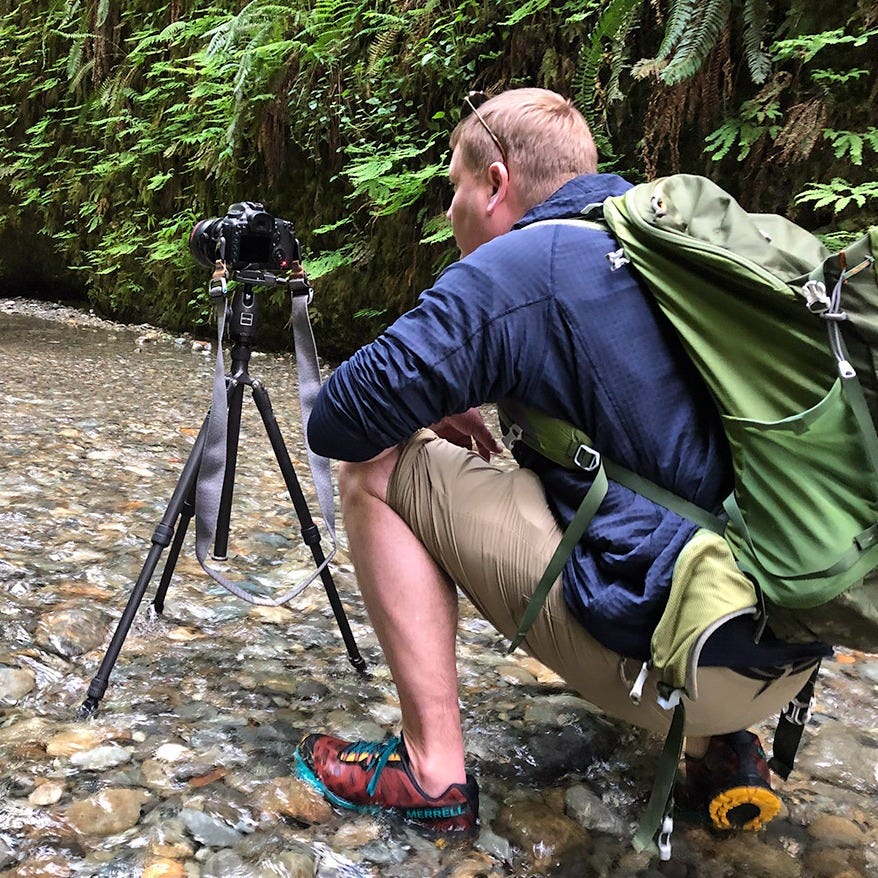
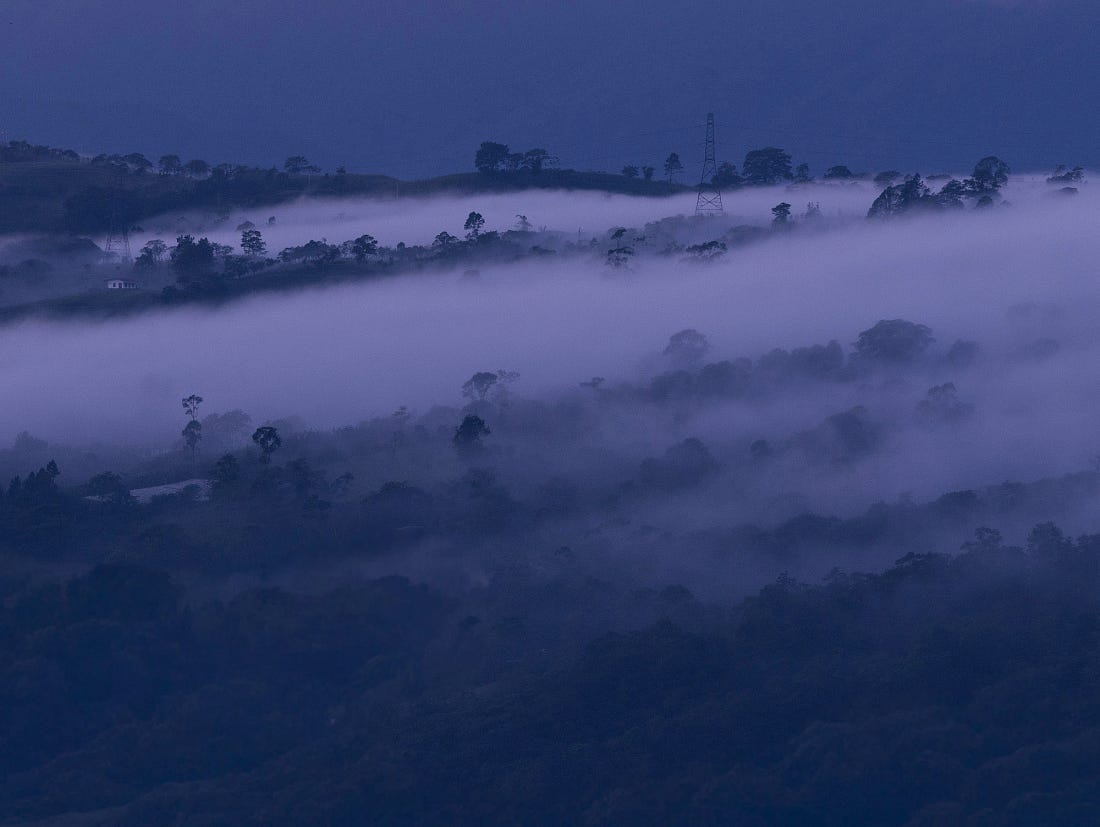
This is part I of a series on biodiversity. You can also read Part I on Notes from the Road with high resolution images. I am standing on a sharp bend in the road on Turrialba Volcano with naturalist guide Harry Barnard and Gabriela, a high school student pursuing her proyecto de investigación in ecotourism. At this elevation, we are surrounded by undisturbed native cloud forest, dense with life. Lobsterclaws hang in the understory. Pink bananas, massive philodendrons, and monsteras rise in a tangled wall of green, while living-vase bromeliads grow from towering canopy trees. Below us, the land falls away into cloud and forest, rivers beginning journeys they will not complete for hundreds of miles. Everything here is connected to something it cannot see.
In Costa Rica, seniors in high school are required to complete a proyecto de investigación, an original research project, before graduation. It’s an unusual expectation, but it’s very Costa Rican in its expectation that young people are capable of producing knowledge, not just absorbing it. Gabriela’s project focuses on ecotourism, but for her this world shrouded in a smoking volcano above is not theoretical. She grew up here on Turrialba as the daughter of a farming family, watching weather patterns shift, crops struggle, and forests retreat or recover. She was aware of the birds and wildlife of the land she grew up with, but you cannot really start to see the diversity until you learn it with somebody like Harry. For me, as someone who grew up always poking around in the woods, I realize Gabriela is seeing her backyard in a way that I could not comprehend at age eighteen. I never imagined that in the very woods in Minnesota I haunted every summer day, I could see colorful Summer Tanagers and Baltimore Orioles, Jack-in-the-Pulpits, Ghost Pipes and Red Admirals. But today, Gabriela will see her backyard in a way that will likely alter the way she sees it forever. The life is overwhelming. Costa Rica’s Cartago Province is not well known on the travel circuits, yet it is a haven of biodiversity. I am staying at a small lodge, Rancho Naturalista, which sits at a rare crossroads between the Pacific and the Caribbean, as well as the lowland and the highland. The 120-acre property lies at a perfect intersection of natural zones, and because of that it holds the country’s highest known bird diversity, with 527 species recorded on the grounds. Even Pacific and Caribbean seabirds have been seen drifting overhead. Costa Rica itself occupies a kind of fairytale zone of biodiversity. Species richness peaks in the tropics. A majority of life on Earth exists in the tropics, a pattern known as the latitudinal diversity gradient. Life concentrates most densely in the warm, wet band around the equator and thins steadily toward the poles. As we scan a mixed flock of high-elevation birds, I think of an article by Jon Miltimore that I debunked months ago. It relied on an infographic that tried to reduce biodiversity to the fate of a single Arctic species, a place where diversity is naturally sparse. The piece was riddled with errors and misused citations, but standing here, that almost feels beside the point. The deeper mistake was conceptual. It assumed that the complexity unfolding in front of me could be collapsed into a single symbol.
The distortion was the idea that one charismatic animal could stand in for the condition of an entire living planet. A polar bear becomes a proxy for Earth. Win the bear and the argument is settled. Lose the bear and everything is supposedly fine. The appeal of this framing lies in how easily it simplifies a world whose underlying systems are anything but simple. What keeps bothering me on Turrialba is that even highly educated people, people who read science, who accept climate change, who consider themselves environmentally literate, often do not understand what biodiversity actually means for human civilization. It’s not their fault; there is almost no one attempting to explain biodiversity at the level where it becomes legible. It is usually presented as facts, species counts, or moral obligation. It is easier to say that Monarch butterflies are in decline than to describe something more web-like, more labyrinthine, more complex. What is rarely articulated is that biodiversity is the condition that makes a habitable world possible in the first place. The thought I cannot shake is a simple one. Biodiversity is a structural fact. Human societies do not sit first on technology or ideology or economics. They sit on living systems. They are built on the biosphere. Understanding that, and acting in its preservation, is humanity’s most urgent task. That claim can sound abstract until it is placed alongside real human urgency. If your child has cancer, then curing cancer becomes everything. If you are in Ukraine and Russian bombs are killing your neighbors and stripping away your future, then the death of Putin is the only thing that matters. None of this is theoretical. These struggles are real, immediate, and not interchangeable. Yet each one assumes something that rarely gets named. They presume a world that still functions underneath them. Medicine, research and human rights depend on societies that still hold together. Even war does not occur in isolation. Its causes, its scale, and what follows are shaped by shortages, environmental stress, and the slow breakdown of systems people rely on. This is not an argument against caring deeply about human suffering. It is an argument about ordering reality correctly. Solving for cancer, defending human rights, and resisting authoritarian violence are urgent human imperatives. They all sit downstream of biodiversity. Without living systems that grow food, regulate climate, clean water, and absorb shocks, moral victories do not endure. Rights, laws, and institutions depend on biological stability that rarely receives attention. That urgency is easy to miss because attention is constantly being redirected. Each year brings a new existential panic. This year, it’s artificial intelligence. Last year was social media. The year before that, culture wars. Remember Y2K? When the noise falls away, very few forces threaten human civilization at a planetary scale. Nuclear war does. A large comet impact does. Both would be abrupt and unmistakable. Both remain statistically unlikely.
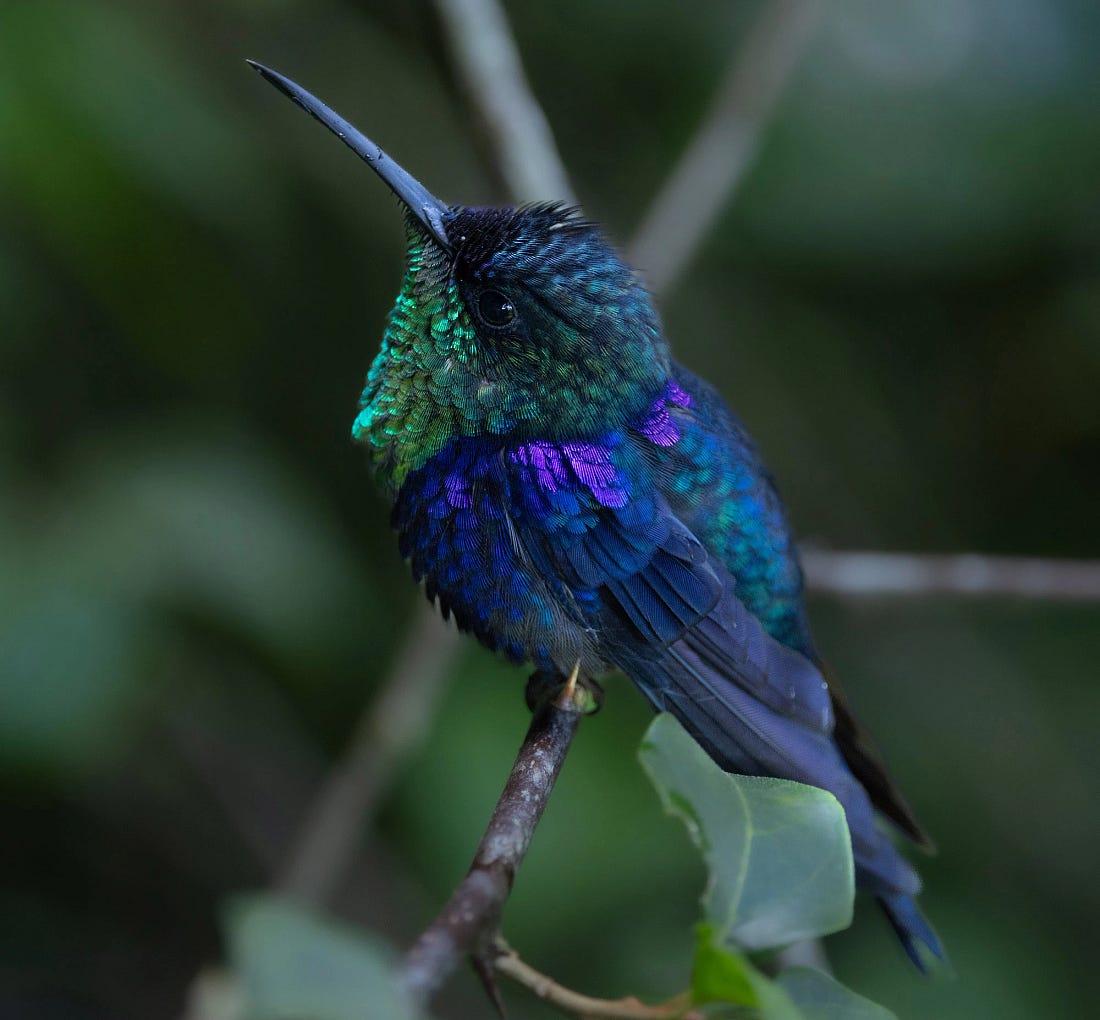
Biodiversity collapse belongs in this same narrow category of existential risk, with one crucial difference. It is already unfolding. Unevenly. Quietly. Largely unmanaged. There is no explosion. No singular moment. That is why biodiversity loss is so often underestimated. It looks like normalcy slowly losing its guarantees. Crops still grow until they do not. Freshwater still flows until it becomes erratic. Ecosystems continue functioning until they suddenly fail. A mixed flock is moving through the trees above. Flame-colored Tanagers, a Slaty Flowerpiercer, Black-thighed Grosbeaks, and a Spangle-cheeked Tanager. Harry grew up in England in a family of avid birders, and so an almost Victorian naturalist vocabulary is second nature to him. So precise is his language that small details come into focus for anyone standing alongside him; that language adds a layer of beauty to everything we observe. He’ll say things like, “there’s just a faint hint of viridescence along the trailing edge of the tertiaries,” or, “that breast isn’t brick-red, it’s closer to crushed cochineal.” When we stand still over a roadside ledge, looking down into a dark quebrada, clouds and mist descend on us, making everything around us invisible except for the dark riverine corridor below. Harry remarks on his disdain for the name of the secretive skulking bird we are looking for. Of the Wrenthrush, he explains. “Everything about its name is unfortunate. It’s not a wren. It’s not a thrush.” He comments on its beautiful song, its bright orange crest. “It’s the only species in its genus, Zeledonia coronata, and it used to be called just that. Zeledonia. That was such a more lovely name. To me, it is still the Zeledonia.” After we see a tiny Volcano Hummingbird resting on a fence, Harry points to a nearby plant. “This is Cavendishia, an ericad,” he says, “You see how the corollas carry that lacquered carmine, which fades into this sublime smoke-violet at the tips. That’s classic plant signaling to a hummingbird, precisely evolved for bills like Selasphorus.” From our perch up here on Turrialba Volcano, the fact that we are so close to both the Caribbean and Pacific becomes visible. To the east, we can see the blue of the Caribbean. A few container ships are just barely visible beyond the haze. And to the west, we can sense the marine layer just beyond that Pacific slope. Being caught between two oceans is a reminder that some organisms, even some individual species, have global impact. Get rid of just that one species, and the world unravels. These two oceans are where organisms exist that are doing work most people will never see. Coccolithophores are single-celled plankton that sit near the base of marine food webs. By turning sunlight and carbon into living matter, they underpin the biology of the oceans, as well as supporting the fisheries that literally feed millions. When coccolithophores die, their shells sink. Over time, they carry carbon into the deep ocean, making them one of the world’s key regulators of carbon. They also play a role in the planet’s albedo; they reflect heat in a way that makes them regulators of climate. Over much longer stretches of time, their remains accumulate into chalk and limestone, the raw material of cliffs, buildings, and cities. A surprising amount of the physical world is built from organisms almost no one knows exist. But the system under which coccolithophores evolved over hundreds of millions of years is changing. As carbon accumulates in the atmosphere, more of it dissolves into seawater. Ocean chemistry is changing; acidifying. Conditions these plankton adapted to over millions of years become harder to maintain. Their shells are thinning and their growth is slowing. When organisms this foundational begin to falter, the effects do not stay confined to the sea. They move upward through food webs and outward into climate regulation, narrowing the margin of safety complex societies depend on. The effects accumulate slowly, reducing the range of conditions under which civilization can function.
If coccolithophores were to collapse at scale, oceanic biomass would decline sharply with them. Some models suggest losses upwards of 30% of fish, marine mammals, and seabirds. One billion humans rely on fish as a primary protein source. Yet this is not a simple chain of cause and effect. It is part of a broader, interconnected unraveling. Coccolithophores, of which roughly four hundred species have been described, with many more likely undiscovered, offer a way to understand biodiversity. They are only one example, but they reveal the kind of invisible labor I’m trying to learn how to see. It is the network of relationships that allows living systems to function, adjust, and recover over time. As we begin to descend the volcano, this idea becomes easier to grasp without definition. Biodiversity reveals itself through motion and interaction. In ants and beetles, fungi and soil, birds and rivers, estuaries and mangroves, the same dynamic plays out again and again. Life sustaining life, quietly and collectively, across scales we rarely notice. There is a discipline that tries to grapple with this truth directly. Ecological economics is the academic study that treats economies as embedded within nature and dependent on living systems. Ecological economics actually IS economics, because the very definition of economics is the study of unlimited wants in a world of limited resources. Ecological economics just accounts for irreversible failures in the system that provides humans with almost all their wealth. Even here, however, the limits are obvious. No model can integrate the full web of interactions that make ecosystems work. We can gesture toward value, but we cannot total it. The relationships are too many, too dynamic, too alive. Biology and ecology are not blind to this complexity. They have revealed extraordinary detail in peer-reviewed work about food webs, nutrient cycles and feedback loops. Yet even with their collective depth of knowledge, we are nowhere near a unified understanding of how the biosphere functions as a whole, let alone how it fails. The systems that sustain life operate across scales of time, space, and interaction that exceed our ability to observe or integrate. Collapse is not a single mechanism or moment. It is a cascade, unfolding through relationships we only partially understand. Imagine the biosphere as a sort of watch. A marvel of precision, assembled from hundreds of tiny gears, springs, and levers, each depending on the others to keep time. Now imagine that instead of hundreds of parts, there are billions. Imagine that many of them are alive. Some are brass, some liquid, some organic, all microscopic. They expand, contract, migrate, reproduce, and die. There is no instruction manual. No master diagram. And no watchmaker standing outside the system, immune to its failure. If we could insert ourselves into that watch, though, we could make some sense of its systems. We might even learn that were we to tinker too much with it, we might bust the whole thing. As we descend through the ecosystems of Costa Rica, that’s exactly what we’re beginning to do. We are beginning to glimpse that great clockwork; the gears that make a habitable world possible, a system we barely understand, and one we’re already altering faster than we can describe. This journey begins on a volcano, but it will only end when I’ve reached that riverbank I cannot see or imagine this high above. And yes — it turns out to be a hell of a lot of fun. Part II continues in two weeks. Notes from the Road is free today. But if you enjoyed this post, you can tell Notes from the Road that their writing is valuable by pledging a future subscription. You won't be charged unless they enable payments.
|