Zaghouan to the Tunis MedinaFrom Zaghouan's stone villages to the Medina's maze, Tunisia's identity unfurls across its terrain. (Part 1 of 2)
You can also read these notes at Notes from the Road, with high resolution photography. I am walking with birding expert Mohamed at Zriba Olia, a mostly abandoned Berber mountain settlement in Tunisia’s Zaghouan governorate. From where we stand, we can see olive groves and palm plantations below us, and on the horizon, the Mediterranean Sea. “Erik,” Mohamed tells me. “Stop for just a moment.” I am walking over and between several large rocks to get a better look at the inside of old limestone buildings whose interior walls still hold the original vivid blue pigment. “I don’t mean to alarm you, but there are vipers here. This is the reason I always walk on the trail.” When I promptly make my way back to the trail, Mohamed points out the direction of two other similar mountain villages, Takrouna and Jradou. “These villages would communicate with smoke signals, for example, to warn of incoming invaders.”
Zriba OliaAt first, the timeline didn’t make sense to me; Zriba Olia seemed too recent to belong to the long Mediterranean pattern of hilltop refuges. Throughout almost all of the long history of the Mediterranean, people reacted to outside threats by moving their villages and towns away from the coast, usually to isolated hilltop villages, during eras of instability, safer from attacking pirates, in a long continuum that began thousands of years ago. But these mountaintop Berber villages were built in the 16th or 17th century. Wasn’t the Mediterranean beyond bands of marauders by then? Perhaps elsewhere. But in the 16th and 17th centuries, Zaghouan’s rural lands were volatile: bandits were on the roads, and Spanish forces were raiding inland while Maltese and Sicilian fleets struck back at corsairs. Ottoman authority, new at the time, was weak enough that rebellions could spark sudden violence. In that environment a village perched in the open, visible from the plains, was exposed. A village hidden high on a ridge, its houses, mosque, and even its graveyard concealed in the folds of the rock, stood a far better chance of surviving the shifting dangers of that time. From the bones of Zriba Olia, I try to imagine it as a living village. The houses’ thick walls and vaulted roofs would have provided incredible insulation in heat and cold, and those brilliant blue interiors would have helped ward off flies in the same way as blue ceilings in the American South. I imagine the tiny square next to the little mosque and its minaret, adjacent to the zawiya with its whitewashed domes, busy with students and worshippers. I imagine the sunken courtyards alive with goats resting in the heat, terraces where the women would weave their alfa-grass mats, rooftops where met met while surveying the land below. Everything in Zriba Olia back then was compact, communal, practical, defensive. Below the cliffs, I imagine terraces of barley and wheat; orchards filled with figs, olives, and almonds, and further down, families would shepherd their grazing goats on the slopes and tend their honeybees in clay hives. But from down there, where I imagine those beehives, would I even have seen Zriba Olia? The answer to this is part of the history of the Berbers, the indigenous people of North Africa’s Maghreb. These Berber people, who call themselves the Amazigh—the free people—had always had to seek novel ways—and novel political institutions— to maintain their freedom and autonomy. Their loose desert societies were among civilization’s earliest and most durable proto-democracies—an inheritance that helps explain why Tunisia stands out in the Arab world as the only Muslim-majority country to have built, however briefly, a real democracy.
Zaghouan HighlandsWe are driving down a rock road through the Zaghouan highlands when Mohamed sees something on the edge of the road. He asks Mohammed, our driver, to pull over. Several prickly-pear cactuses grip the cliffside, their pads dulled by an unnatural white, cottony sheen. Up close, the pads are thickly tufted with what look like tiny cotton balls. Mohamed touches one with a stick, pressing hard. Instantly a bright magenta smear blooms across the green pad. “This color,” he says, “is so hard to reproduce that Japanese cosmetics companies use it for some of their lipsticks.” The dye is used by companies like Shiseido to make a rich bluish-red that can’t be replicated by artificial colors. “This isn’t a fungus,” he continues. “It’s the cochineal scale insect.” A pest the size of a sesame seed, armored, thirsty, multiplying fast. The females hide under those soft white cocoons, sucking the cactus dry. You crush them and the ancient dye spills out. It’s actually the same pigment once prized by the Aztecs, traded across empires, still valuable today. Like the cactus, the scale insect is an import from the Americas. Tunisia’s prickly-pear orchards are supposed to sort an array of industries, from juice producers, jam makers, seed oil exporters, and small family farms that depend on the cactus for both its fruit and as a livestock fodder. Tunisia was on the verge of becoming a major North African producer of prickly-pear seed oil, a high-value cosmetic ingredient. All of that now hangs in the balance. When the cochineal scale insect first appeared in Tunisia, agronomists were instantly concerned, and warned that the country had a narrow window to contain the blight. We have weeks, not years, they explained. Neighboring countries that ignored early outbreaks saw whole cactus landscapes collapse, stripped to skeletal paddles. But as is almost always the case with environmental threats, the warnings were lost in bureaucratic delays, underfunded programs, and a hope that the problem might just go away. By the time coordinated action began, the insects had already leapt from farm to farm, riding wind, birds, and trucks. OudnaMohamed and I stand in the brown scrub near the ruins of a Roman aqueduct, taking a break from scanning for the Lesser Kestrels that nest in its tall arches to admire the system that once carried water fifty-six miles from the Zaghouan mountains to Carthage. Mohamed is a professor of engineering, a specialist in roads and bridges. As we walk toward the point where the aqueduct rises on its arcades, he explains, “In modern bridge nomenclature, the first support is the abutment—A0.” He points to the first small arches. “Then come the piers: P1, P2, and so on. So the third support is P2, not P3. The abutment doesn’t get a number.” Years ago, while walking here, he noticed a Roman numeral VIII carved into one of the supports. Curious, he counted back to the embankment. “It was the ninth support,” he says. “Meaning the Romans also treated the first support as an abutment, not a pier. Our modern terminology—A0, P1, P2—comes straight from them. I doubt most archaeologists notice that unless they’ve built bridges.” We climb onto the low section of the aqueduct where it still runs along the ground and then step inside it—my first realization that Roman aqueducts were enclosed. “This is a low-pressure system,” Mohamed explains. “The water can’t move too fast or it erodes the channel. Too slow, and sediment or leaves accumulate and block it.” Inside, he points to a circular chamber cut into the floor. “These appear at intervals. The flow slows just enough here for heavy sediment to settle.” “How did they clean these out?” I ask. “Workers descended through access shafts,” he says, pointing upward.
To keep the water flowing at the right pace, Roman engineers built the channels with just a slight gradient, sometimes just a few centimeters per hundred meters. These aqueducts were feats of precision, carrying mountain water to Carthage’s baths and fountains. We walk on, watching the plains for bird movement. I hired Mohamed to help me find Tunisian birds, but he isn’t a guide in the usual sense; he guides only a handful of days each year. Tunisia draws few foreign birders, but the lack of local interest is even starker. “There are maybe twenty to twenty-five active birders in the whole country,” he says. Mohamed is usually the top lister, often traveling deep into the Sahara. Only two others match his dedication. A country of twelve million people, with only two dozen birders—roughly two birdwatchers for every million residents. In the United States, five to fifteen million people bird out of 335 million: between fifteen and forty-five thousand birders per million. Adjusted for population, an American is between 7,590 and 20,000 times more likely to be a birder than a Tunisian, a disparity so large it becomes almost surreal. Why does that matter? I use this ratio as a rough measure of a society’s naturalist literacy. Ours in the United States is already abysmal; in some places, it’s lower still. It’s one indicator of how citizens perceive conservation, and how urgently they expect their governments to engage in climate and biodiversity work.
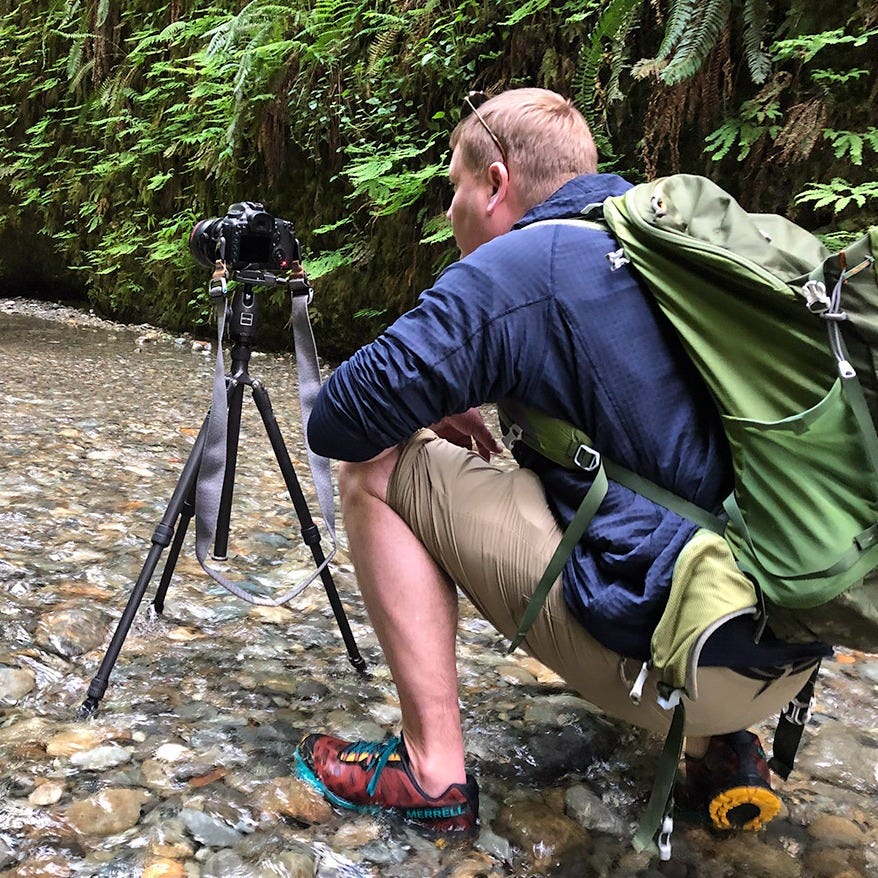
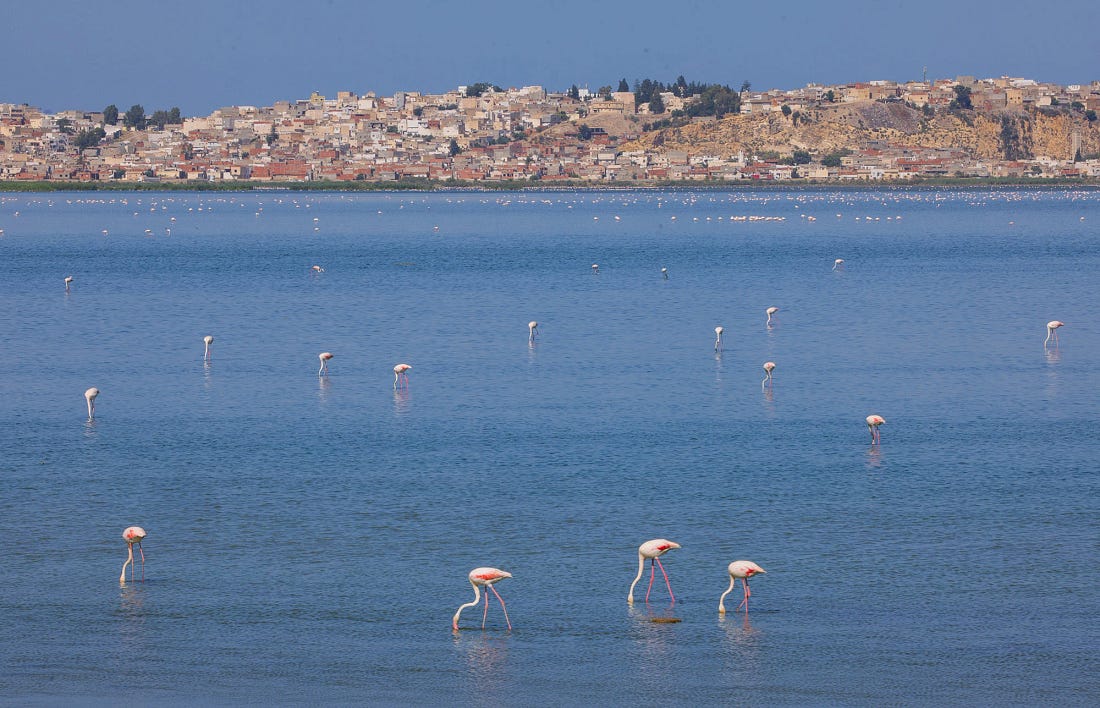
Sebkhet SejoumiWe drive alongside Sebkhet Sejoumi, the shallow salt lake that hugs much of the southwestern edge of Tunis. We had been here early this morning, walking out to the Reboisement Sijoumi, looking for marsh birds. While sorting out Slender-billed Gulls and Eurasian Thick-knees, I talk to Mohamed about the fact that several people had told me not to use a tripod in the historic Tunis Medina, because it’s cause to get into trouble from the Police. Instead of heeding their warnings, I decided to translate a message to the Police into Arabic and French, explaining that I was photographing cityscapes, and not government buildings, and that the tripod was necessary for long exposures. Mohamed wanted to read the message, so I pulled it out of my wallet. “Okay, they will understand this French one, but th Arabic one would not commonly be used here in Tunisia.” “I don’t understand,” I explain, “if Arabic is the main language here?” “Yes, of course, but you have to realize the language spoken in Tunisia is very different from the Arabic from the Middle East. Arabs of the Middle East actually have trouble understanding us. You could say Tunisian is a bit like Latin, for example, and French or Spanish. French and Spanish are both Romance languages that come from Latin, but very different from Latin itself. Arabic, is of course a living language, and is the origin of the Tunisian language, or what you might call the Tunisian dialect, but it really remains quite distinct. The Tunisian language, while fundamentally Arabic, contains words of Berber, Turkish, Italian, and French, so it is quite incomprehensible to Arabs from the Middle East.”
But now, it’s late afternoon, and I peer out at the thousands of flamingos in the lake, and at the mud and sand shore, which is littered with gulls. It’s been a long day, longer than we had intended to be out. But something tells me there are birds out there we might have missed this morning. Mohamed gleefully asks Mohammed to pull over at the side of a busy roundabout. He sets up the scope while I scan the mudflats. The heat is creating intense rays, and my view of the flats is uneven. But while Mohamed is scanning with the scope, I see something long, squat, and gray on a sandy island. An unusual shape. “I think it’s a piece of trash,” I say, “but this object out there is bugging me.” In all the intense heat shimmer, Mohamed can’t see the gray object. Shimmer intensifies in the binoculars, but even more so through a scope. And it’s so far away, and the light so bad, I lose it for several minutes. “Maybe I was imagining it?” I say. But then I sight the gray object again, just a faint thing in the swirl of the sun. “Ah ha,” Mohamed says, peering through the scope. “Collared Pratincole!” I have always longed to see a Pratincole; such weird but elegant birds. Pratincoles are shorebirds in the same way that phalaropes are shorebirds: a bird of the mudflats and river margins, evolved in the long histories of the world’s coasts. But they are the true outliers of the shorebird world. They are the weirdos! Pratincoles are technically shorebirds; evolutionary cousins of the gulls, terns, skimmers, sandpipers and plovers. Their long, tapered wings are the same aerodynamic tech used terns, and they have that same floppy flight, and yet their heads are soft, round, like a plover.
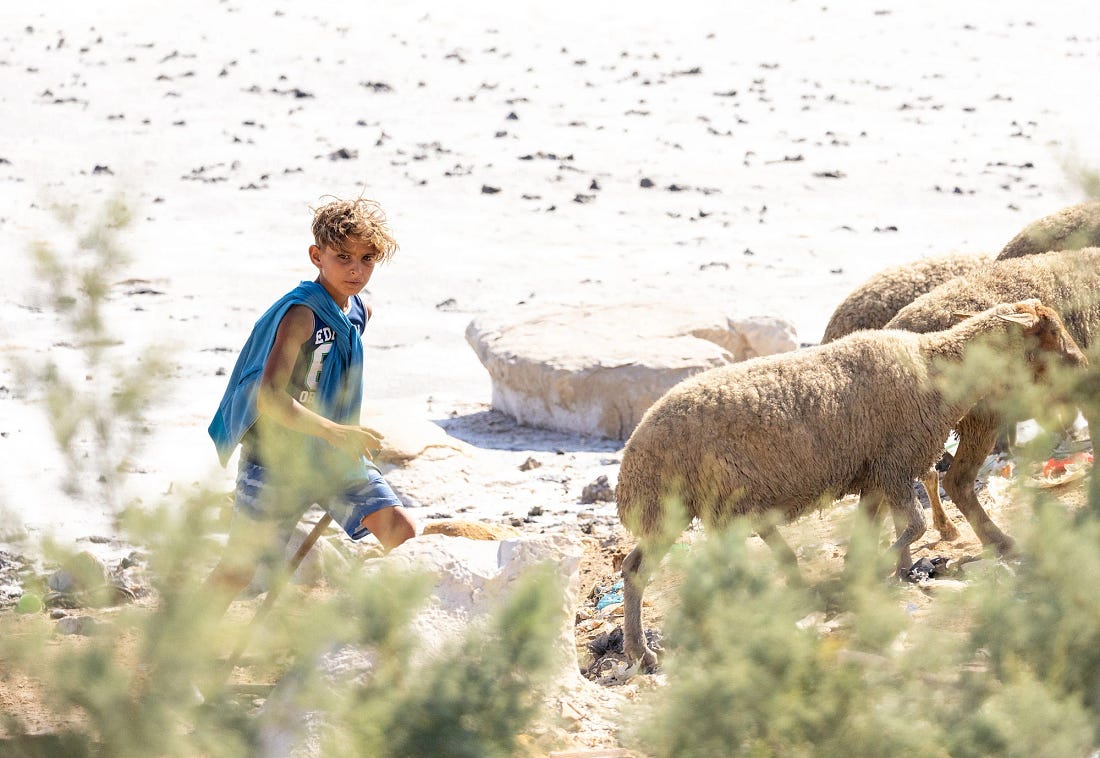
What sets pratincoles apart is the evolutionary swerve they took toward the desert and away from the shore. While their cousins evolved to probe tidal flats or stalk that uneven line of nutrients and seeweed that washes up with each wave, pratincoles took to the air like the swifts and swallows, fluttering low over savannas and desert pans to catch insects on the wing, a relatively rare feeding style among birds. Their bills shrank, their legs shortened, and their wings became scimitar blades designed for acrobatic flight. They began nesting not on salt marshes but on dry, open earth. They are shorebirds that reinvented themselves as aerial hunters of the desert—bodies born of the coast, rewritten for inland heat and distance. As we watch the pratincoles, a boy, perhaps age 13, guides a flock of goats along the edge of the mudflats. His eyes are a pale shade that doesn’t seem to belong to this dry landscape. For a moment I assume what many people do when they see a blond Berber: maybe he’s the genetic storyline of a little leftover Roman blood, or perhaps sailors from the Mediterranean’s northern coast mixing their their genes along the ports of Tunisia. But as Mohamed reminds me, while coastal Berber communities did encounter and intermarry with Phoenicians, Romans, Vandals, and others who washed up along these shores, this doesn’t fully explain the story of European and Asian features among the Berbers. If the pratincoles are shorebirds whose bodies still remember the sea even as they hawk insects over desert pans, Berber ancestry follows a similar double story. The story of their genes begins even before the first ships set sail in the Mediterranean. Genetic studies show that Berbers have roots stretching back at least 20,000 years; that first 10,000 years of genes is pure African. But by around 10,000 years ago, their genetics start to pepper with the genes of Europeans and West Asians, showing the prehistoric drift of people crossing continents, the human equivalent of a flyway. The shepherd boy at Sejoumi reminds me that Tunisia, and perhaps all of the Maghreb has always been a crossroads; Africa, Europe, and Asia blended here and created something unique to this dry land, just like those pratincoles are coastal birds that reinvented themselves to set sail through a sky of inland heat. Part II out next week. Notes from the Road is free today. But if you enjoyed this post, you can tell Notes from the Road that their writing is valuable by pledging a future subscription. You won't be charged unless they enable payments.
|